
OCP Mental Health Practice Exam
$69.00
- Buy to unlock unlimited access to all Quiz questions and Answers in this Quiz.
- After purchase you can print a PDF of the whole quiz at any point. The PDF will contain the questions and the correct answers.
About this Exam
The OCP Mental Health Certification is a premier credential designed for healthcare professionals, social workers, counselors, and educators seeking to validate their advanced knowledge and competency in mental health principles. This certification is ideal for individuals dedicated to providing high-quality, evidence-based care and support to individuals facing mental health challenges. It signifies a comprehensive understanding of diverse conditions, treatment modalities, and ethical practices in the field.
Earning this certification demonstrates your commitment to professional excellence and positions you as a specialist in mental healthcare. Whether you are looking to enhance your current practice or pivot your career toward a mental health specialization, the OCP certification provides the recognition and knowledge base needed to succeed.
Ready to test your knowledge?
Buy Now to Access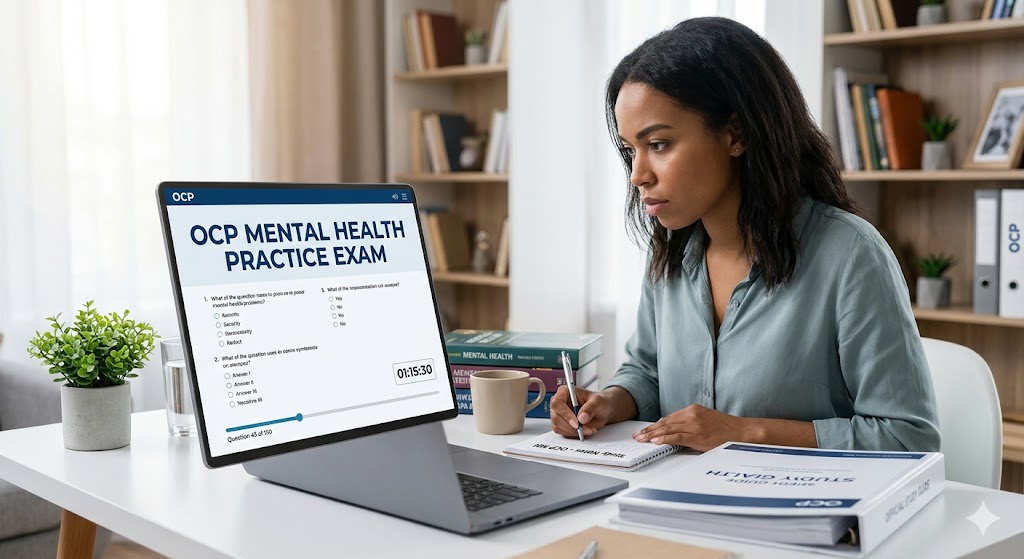
Additional Information
What the Course Entails and Exam Details
The preparatory curriculum for this exam covers a wide spectrum of critical mental health topics. Candidates are expected to master complex concepts and practical applications across several key domains. The core areas include:
Psychopathology: Comprehensive study of major mental health disorders across the lifespan, including mood, anxiety, psychotic, and personality disorders.
Psychotherapeutic Interventions: Mastery of evidence-based therapy models, including Cognitive Behavioral Therapy (CBT), Dialectical Behavior Therapy (DBT), trauma-informed care, and motivational interviewing.
Ethical and Legal Considerations: In-depth understanding of patient privacy laws (such as HIPAA guidelines), ethical codes of conduct, informed consent, and professional boundaries.
Assessment and Diagnosis: Developing skills in conducting thorough mental state examinations, utilizing diagnostic tools, and formulating accurate diagnoses based on current classification systems.
Pharmacology Basics: Understanding the fundamentals of psychopharmacology, including common classifications of psychotropic medications and their management.
Crisis Intervention and Risk Management: Effective strategies for responding to acute mental health crises, assessing suicide risk, and implementing safety plans.
What to Expect in the Final Exam
The OCP Mental Health Final Exam is a rigorous, computer-based assessment designed to evaluate both theoretical knowledge and practical application skills through scenario-based questioning. Here is a breakdown of the exam format:
Format: The exam consists primarily of multiple-choice questions. These may include single-choice, multiple-response, and complex scenario-based questions that require clinical decision-making.
Question Count: Candidates can typically expect between 100 and 150 questions.
Time Limit: The examination is timed, usually allowing between 2 and 3 hours for completion.
Passing Score: The passing score is determined by the certifying body but generally falls within the range of 70% to 75%.
Rules: The exam is closed-book and administered in a proctored environment. No outside reference materials or electronic devices are permitted during the testing session.
How to Study and Exam Centers
Preparation is the key to success for the OCP Mental Health exam. A structured approach combining multiple study methods is highly recommended:
Official Study Guides: Begin by thoroughly reviewing the official OCP Mental Health Study Guide and any recommended textbooks. Focus on the learning objectives outlined for each section.
Practice Exams: Utilize high-quality practice exams to familiarize yourself with the question format, manage your time effectively, and identify areas where you need further review.
Online Courses and Workshops: Enroll in authorized training programs or virtual workshops that offer deep dives into the core domains covered by the exam.
Flashcards: Create digital or physical flashcards for key terms, diagnostic criteria, therapy models, and legal regulations.
Exam Centers:
The OCP Mental Health exam is administered globally through secure testing networks and online proctoring services.
Pearson VUE: The most common method is scheduling an in-person exam at an authorized Pearson VUE testing center. These physical centers provide a standardized, secure testing environment.
Online Proctoring: Many candidates opt for remote proctoring, which allows you to take the exam from the comfort of your home or office. This requires a compatible computer, a webcam, a stable internet connection, and a private room free from distractions.
Detailed scheduling information and a list of local testing centers can be found on the official OCP certification portal upon registration.
Job Opportunities from the Course
Obtaining the OCP Mental Health Certification can significantly enhance your career trajectory and open doors to specialized roles in a variety of healthcare and community settings. Certified professionals are well-equipped for the following job titles and career paths:
Mental Health Counselor (Licensed or Certified)
Clinical Case Manager
Behavioral Health Specialist
Crisis Intervention Specialist
Psychiatric Rehabilitation Practitioner
Mental Health Educator
Substance Abuse Counselor (with a Mental Health Focus)
Social Worker in Mental Health Services
Community Health Worker
Program Coordinator in Mental Health Organizations
Frequently Asked Questions
Reviews
5.0
Based on 0 reviews
Leave a Review
No reviews yet. Be the first to review!