
OCR Child Development R018 Practice Exam
$69.00
- Buy to unlock unlimited access to all Quiz questions and Answers in this Quiz.
- After purchase you can print a PDF of the whole quiz at any point. The PDF will contain the questions and the correct answers.
About this Exam
The OCR Cambridge Nationals: Child Development Level 1/2 qualification is designed specifically for students who have a keen interest in working with children or pursuing careers in the early years and care sectors.
This vocational course offers a practical and engaging approach to learning, focusing on the fundamental principles of child development.
The specific R018 unit (Health and well-being for child development) is the externally assessed, underpinning component of the entire course, establishing the core knowledge required before progression.
This practice exam serves as a crucial benchmarking tool, allowing students to familiarize themselves with the style, structure, and academic rigor necessary to succeed in their final assessment.
Success in this unit demonstrates a foundational understanding of the essential factors that contribute to a child’s healthy growth and holistic well-being.
Ready to test your knowledge?
Buy Now to Access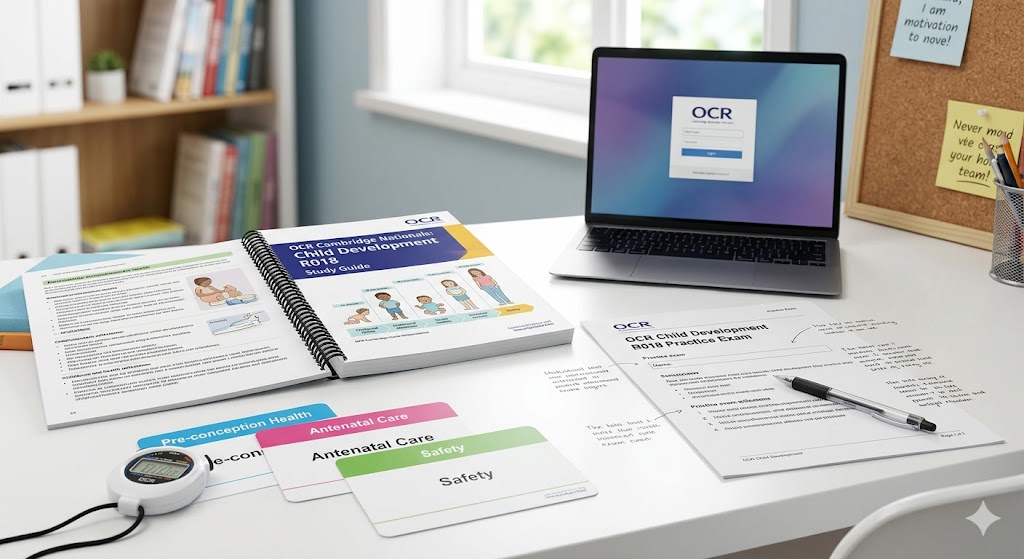
Additional Information
What the Course Entails and Exam Details
The R018 unit focuses specifically on health and well-being, which serves as the foundation for the broader Child Development syllabus.
The core syllabus content covered in this unit includes several critical topics essential for anyone working with young children.
Students will study pre-conception health and reproduction, including factors that affect fertility and the importance of healthy lifestyles before pregnancy.
They will also delve into antenatal care, exploring the roles of different health professionals and the standard checks performed during pregnancy.
Postnatal provision is another key area, covering the essential care needed for both the mother and the newborn immediately after birth up to the age of five.
Furthermore, the unit addresses common childhood illnesses and safety measures, including the recognition of signs and symptoms of illness and the implementation of child-safety precautions in various environments.
This unit is externally assessed, and the performance here significantly impacts the final grade for the overall Cambridge National qualification.
What to Expect in the Final Exam
The final assessment for the R018 unit is a formal, written examination that requires students to apply their theoretical knowledge to real-world scenarios.
The exam format usually consists of a mixture of question types designed to test depth of understanding and analytical skills.
Students will encounter objective questions (such as multiple choice or labeling diagrams) and short-answer questions requiring precise definitions and descriptions.
Additionally, the paper includes structured questions and extended response questions which use case studies or scenarios to evaluate a student's ability to explain, analyze, and justify their reasoning in context.
The examination typically has a duration of 1 hour and 15 minutes and has a total of 80 marks available.
There isn't a fixed 'passing score' required to pass only this unit; instead, the marks are combined with the other units in the course to determine the final overall grade (ranging from Level 1 Pass to Level 2 Distinction*).
The exam is conducted under strict formal examination conditions set by OCR and the Joint Council for Qualifications (JCQ).
How to Study and Exam Centers
Effective preparation for the R018 exam requires a balanced approach of thorough content revision and robust exam technique practice.
Start by creating a structured revision timetable that allocates specific time slots to the main topics: pre-conception, antenatal care, postnatal care, and illness/safety.
Utilize active recall techniques, such as using flashcards for key definitions (e.g., amniocentesis, APGAR score) and creating mind maps to link complex concepts like the roles of different health professionals.
Practice with past exam papers is perhaps the most critical strategy; this builds familiarity with common question structures and command verbs (like "describe," "explain," or "discuss").
Focus particularly on how case studies are presented in exams and practice applying theoretical knowledge to the specific needs of the individuals in those scenarios.
Regarding exam centers, this qualification is usually undertaken within a school or college setting as part of standard curriculum delivery.
The educational institution must be an authorized OCR examination center to register candidates and administer the test.
Final exams are scheduled on specific dates within national exam series (usually January and June), and they are not typically taken externally at private testing centers like Pearson VUE.
5. Job Opportunities from the Course
A strong foundation in Child Development through the OCR Cambridge Nationals opens several rewarding career pathways.
While this Level 2 qualification often leads to further specialized study (such as Level 3 Early Years Educator qualifications or T-Levels), the knowledge is highly relevant for entry-level positions.
Potential career paths and job opportunities that benefit from this qualification include:
Trainee Nursery Nurse
Early Years Assistant
Teaching Assistant (specializing in early years/primary)
Childminder (requires further registration)
Nanny or Au Pair
Health Care Assistant (pediatric settings)
Playworker in community centers or after-school clubs
Progression to Higher Education (e.g., BA in Early Childhood Studies or Nursing)
Frequently Asked Questions
Reviews
5.0
Based on 0 reviews
Leave a Review
No reviews yet. Be the first to review!