
OCSMP Level 1 Behavioral Practice Exam
$69.00
- Buy to unlock unlimited access to all Quiz questions and Answers in this Quiz.
- After purchase you can print a PDF of the whole quiz at any point. The PDF will contain the questions and the correct answers.
About this Exam
Preparing for the OMG Certified Systems Modeling Professional (OCSMP) Level 1 (Model User) certification is a vital step for any professional looking to validate their skills in Model-Based Systems Engineering (MBSE).
This specific behavioral practice exam is designed to help you master one of the four key pillars of SysML (Systems Modeling Language) covered in the Level 1 exam: behavioral diagrams. While the full OCSMP Level 1 is a comprehensive test, dedicating focused study time and taking practice tests that drill into the nuances of behavioral modeling is highly effective. This guide, and the associated practice test, are engineered to ensure you have the deep understanding and speed required to accurately interpret, analyze, and apply SysML behavioral diagrams in both a test environment and real-world engineering scenarios.
This practice is ideal for systems engineers, solution architects, software developers, and engineering managers looking to deepen their MBSE and SysML capabilities and ace the behavioral sections of the OCSMP Level 1 exam.
Ready to test your knowledge?
Buy Now to Access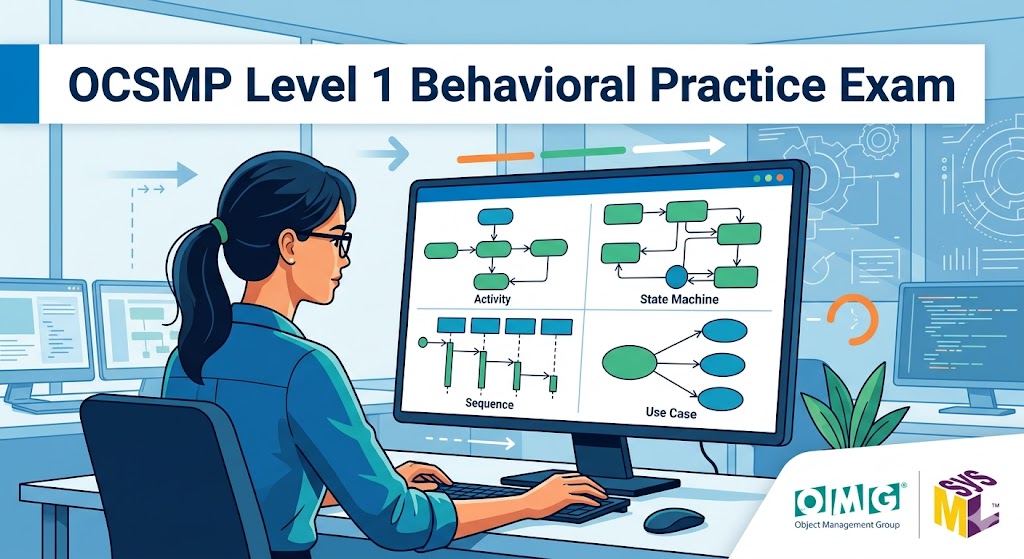
Additional Information
What the Course Entails and Exam Details
While this article focuses on a practice exam for the behavioral aspect, it is essential to understand the context of the entire OCSMP Level 1 certification and what that broader "course" of knowledge entails. OCSMP Level 1 validates a standard level of understanding across the core pillars of SysML: Structure, Behavior, Requirements, and Parametrics.
The behavioral component of OCSMP Level 1 is particularly important as it describes how a system functions and operates over time. A dedicated "behavioral" practice exam deep-dives into the definition, notation, and application of the main SysML behavioral diagrams:
Activity Diagrams: Model flow of control and data between actions, emphasizing parallel and sequential processing, decisions, and merges.
State Machine Diagrams: Describe the different discrete states a system or block can be in and the transitions (triggered by events) that cause movement between these states.
Sequence Diagrams: Illustrate the detailed interaction and message exchange between different parts of a system (lifelines) in chronological order.
Use Case Diagrams: (Sometimes considered at the requirements level, but key to initial functional modeling) Capture high-level system functionality and interactions with external actors to define system goals.
Exam details to expect within the context of the overall OCSMP Level 1: You must master how each of these diagram types represents system logic, timing, and state changes. Questions will test your ability to read a diagram, identify errors, select the correct diagram for a given scenario, and predict system behavior based on a provided model. The Level 1 exam as a whole will contain approximately 90-100 multiple-choice questions with a time limit of around 120 minutes, administered by Pearson VUE, and requires a specific passing score (typically around 67%).
What to Expect in the Final Exam
It is crucial to understand that there is no separate "final exam" for just the behavioral practice. The goal of this focused practice is to prepare you for the actual OMG-Certified Systems Modeling Professional (OCSMP) Level 1 Certification Exam.
When you sit for the final OCSMP Level 1 exam through a proctored testing center (like Pearson VUE), you can expect:
A proctored environment, typically with ID verification.
A timed multiple-choice and/or scenario-based question format, presented digitally.
Questions that cut across all diagram types, but with a significant focus on correctly interpreting structural and behavioral models.
Questions that range from fundamental definitions to scenario-based applications—e.g., "Given this Activity Diagram, which statement about the output is true?" or "Which behavioral diagram is best to model a multi-mode operation?"
A required passing score of approximately 67% to achieve the Level 1 qualification.
Results available immediately upon completion.
A strict adherence to OMG examination guidelines, including no outside materials.
Mastering the behavioral diagrams through dedicated practice is your best way to prepare for a large and tricky portion of this final certification exam.
How to Study and Exam Centers
Effective preparation requires a combination of self-study, practical application, and targeted practice testing.
Actionable Study Strategies:
Start with the OMG Official Resources: Read the current OCSMP Level 1 Exam Summary and Syllabus and the official SysML Specification from the OMG website. These are the gold standards.
Recommended Textbooks: Study standard textbooks like "SysML Distilled" by Lenny Delligatti or materials by Sanford Friedenthal and his colleagues. Pay extra attention to the chapters dedicated to behavioral modeling.
Hands-on SysML Tool Practice: While the exam is multiple-choice, creating simple behavioral models in a real SysML modeling tool (such as Cameo Systems Modeler, MagicDraw, or Papyrus) significantly enhances conceptual understanding and memory retention.
Take Multiple Practice Tests: Use the dedicated "OCSMP Level 1 Behavioral Practice Test" multiple times in both timed and untimed modes. Review every wrong answer and explanation carefully to understand the underlying principles and common pitfalls. Look for broader practice exams that cover the full Level 1 syllabus as well.
Focus on Diagram Application: Don't just memorize notations; practice reasoning through scenarios, flows, and state transitions described by behavioral diagrams. Try to translate textual requirements into simple behavioral models and vice-versa.
Join Online Forums: Participate in professional networks (LinkedIn groups, relevant Stack Exchange tags) or discussion forums dedicated to MBSE and OCSMP preparation.
Exam Centers: The official OMG-Certified Systems Modeling Professional (OCSMP) Level 1 Certification Exam is administered worldwide through the Pearson VUE testing center network. You must:
Create an OMG candidate account.
Locate an authorized Pearson VUE testing center on their website.
Schedule your exam date and time through the Pearson VUE portal or by contacting a local testing center.
Pay the examination fee directly to Pearson VUE.
The behavioral practice exam itself would typically be accessed online via a study platform and does not require a physical testing center, but is a critical step to ensure you are ready for the final, official proctored exam.
Job Opportunities from the Course
Achieving the OCSMP Level 1 (Model User) certification, bolstered by your deep dive into behavioral aspects, demonstrates a globally recognized baseline competency in MBSE. This qualification significantly improves your career prospects and unlocks job opportunities in complex systems engineering environments, particularly in industries like aerospace, defense, automotive, aerospace, healthcare, and infrastructure.
Potential job titles and career paths this certification (along with relevant experience) can lead to include:
System Analyst (with a focus on MBSE models)
Systems Engineer (Entry or Mid-Level)
Model-Based Systems Engineer (MBSE Specialist)
Systems Architect / Junior Systems Architect
Requirements Engineer
Verification & Validation (V&V) Engineer
Process Engineer
Technical Lead / Systems Engineering Lead
Model & Simulation Engineer
Project Manager (with technical systems background)
Frequently Asked Questions
Reviews
5.0
Based on 0 reviews
Leave a Review
No reviews yet. Be the first to review!