
OCSMP Model User Practice Exam
$69.00
- Buy to unlock unlimited access to all Quiz questions and Answers in this Quiz.
- After purchase you can print a PDF of the whole quiz at any point. The PDF will contain the questions and the correct answers.
About this Exam
Embarking on the journey to become an OMG Certified Systems Modeling Professional (OCSMP) - Model User (MU100 & MU200) is a significant step for anyone working with systems engineering or model-based systems engineering (MBSE). This comprehensive certification path, validated by the Object Management Group (OMG), demonstrates a fundamental understanding and practical skill set in creating, interpreting, and utilizing systems models effectively.
The Model User levels are designed for a wide range of professionals, including systems engineers, software developers, technical architects, and analysts who use modeling languages and tools, such as the widely accepted Systems Modeling Language (SysML). Whether you are relatively new to model-based approaches or looking to formalize your existing expertise, these certifications validate your proficiency in using SysML to represent different aspects of a system. The OCSMP Model User Practice Exam is your essential tool to gauge your readiness and gain confidence before attempting the actual certification assessments.
Ready to test your knowledge?
Buy Now to Access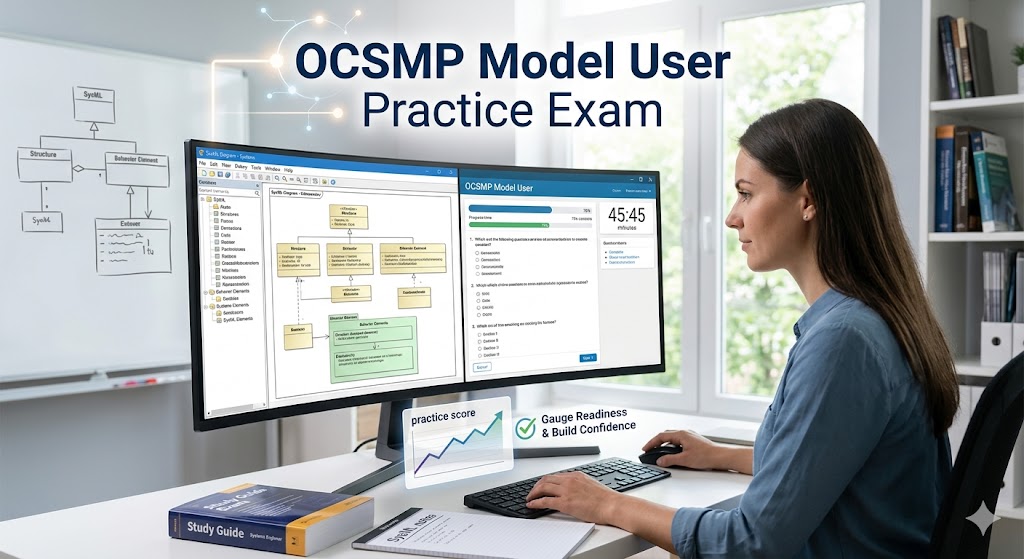
Additional Information
What the Course Entails and Exam Details
The curriculum for the OCSMP Model User (both MU100 and MU200 levels) centers heavily on mastery of SysML and its practical application. While there isn't a single, prescriptive "course" mandated by OMG, many authorized training partners offer comprehensive training programs covering the extensive body of knowledge.
Key topics covered include a deep dive into the four foundational pillars of SysML: structure diagrams (block definition, internal block), behavior diagrams (activity, sequence, state machine, use case), requirements diagrams, and parametric diagrams for analytical constraints. Students will learn not only the syntax and semantics of these diagrams but, crucially, how to use them together within a broader modeling methodology to create meaningful and executable models that truly represent complex systems.
The Model User Practice Exam itself is meticulously crafted to simulate the experience and content of the real MU100 and MU200 exams. By attempting a practice test, you will encounter diverse scenarios and questions that reflect the breadth of the official syllabus, identifying specific areas where you excel and where further study is required. This practice exam typically covers:
Detailed understanding and application of key SysML diagrams.
Interpretation of system requirements and translating them into models.
Use of modeling to represent system behavior, structure, and constraints.
Best practices for model organization, consistency, and traceability.
What to Expect in the Final Exam
The actual OCSMP Model User certifications are typically split into two separate, progressively challenging exams: MU100 (Fundamental) and MU200 (Intermediate). The OCSMP Model User Practice Exam often combines elements relevant to both levels, or you might find separate practice exams tailored to each. Here's a look at what to generally expect from the final certification exams:
Exam Format: The real MU100 and MU200 exams consist primarily of multiple-choice and potentially scenario-based questions, focusing on conceptual understanding, diagram interpretation, and practical application scenarios.
Number of Questions: The precise number of questions can vary slightly, but typically expect around 60-70 questions per exam.
Passing Score: A passing grade is generally considered to be 60-70% for both MU100 and MU200. OMG continuously updates its exams, so it's critical to check the official OMG website for the most current specifics.
Time Limits: You will typically be allocated between 90 to 120 minutes per exam to complete all questions, making effective time management crucial.
Specific Rules: The real exams are proctored assessments, requiring a quiet testing environment and adherence to strict guidelines (no reference materials, typically). They are taken in a secure testing environment, either in person or remotely monitored.
How to Study and Exam Centers
Effective preparation is paramount for success on both the practice and final OCSMP Model User exams. A multi-faceted study strategy is highly recommended:
Leverage Official Resources: Start by thoroughly exploring the OMG website and downloading the official OCSMP Model User exam objectives (syllabi). This provides the essential roadmap of what to study.
Engage in Formal Training: Consider enrolling in OCSMP-aligned courses offered by authorized training partners. These courses provide structured learning, expert instruction, and practical modeling exercises.
Utilize Study Guides and Books: Seek out reputable study guides, textbooks, and online resources specifically tailored to the OCSMP Model User curriculum and SysML best practices.
Practice Modeling: Dedicate ample time to creating and analyzing SysML models using various modeling tools. Apply SysML concepts to real-world system examples to reinforce your understanding.
Take the Practice Exam Repeatedly: Use the OCSMP Model User Practice Exam multiple times to identify weaknesses, become comfortable with the question format, and build confidence. Review incorrect answers carefully to understand the underlying principles.
Exam Centers: For the real certification exams, OMG partners primarily with Pearson VUE, a global leader in computer-based testing services. You can conveniently register for and schedule your MU100 and MU200 exams through the Pearson VUE online portal.
There are thousands of Pearson VUE authorized testing centers worldwide, allowing you to take the exam in a professional, supervised setting near your location. Additionally, Pearson VUE offers secure online proctoring for some OMG exams, allowing you to take the assessment from the comfort of your own home or office, provided you meet specific technical and environmental requirements. Always verify the available testing options and locations directly on the Pearson VUE website when you register.
The practice exam is typically accessed online through various education platforms or specialized practice test providers, rather than through official Pearson VUE centers.
Job Opportunities from the Course
Achieving the OCSMP Model User certifications (MU100 & MU200) validates valuable and in-demand modeling skills, significantly enhancing career prospects and opening doors to diverse professional opportunities within systems engineering and related fields.
Here is a list of specific job titles and career paths this certification sequence unlocks:
Systems Engineer
Model-Based Systems Engineer (MBSE Engineer)
Systems Architect
Software Architect / Software Engineer (with modeling focus)
Technical Analyst
Requirements Engineer
Simulation Analyst / Simulation Engineer
Test Engineer (especially focused on model-based testing)
Process Analyst
Consultant specializing in systems modeling and MBSE adoption
Frequently Asked Questions
Reviews
5.0
Based on 0 reviews
Leave a Review
No reviews yet. Be the first to review!