
ODS Cancer Registry Ops Domain 2 Practice Exam
$69.00
- Buy to unlock unlimited access to all Quiz questions and Answers in this Quiz.
- After purchase you can print a PDF of the whole quiz at any point. The PDF will contain the questions and the correct answers.
About this Exam
Prepare for success in the specialized field of cancer registry with our comprehensive study guide for the ODS Cancer Registry Operations Closed Book Domain 2 Practice Test. This certification practice test is meticulously designed for aspiring Oncology Data Specialists (ODS) and current registry professionals looking to solidify their expertise in registry operations management. This specific practice test focuses exclusively on Domain 2: Cancer Registry Operations, presenting candidates with a closed-book challenge to simulate the operational knowledge assessment within the official ODS credentialing process. Mastering these foundational operational concepts is crucial for career advancement and ensuring the integrity of cancer data systems.
Ready to test your knowledge?
Buy Now to Access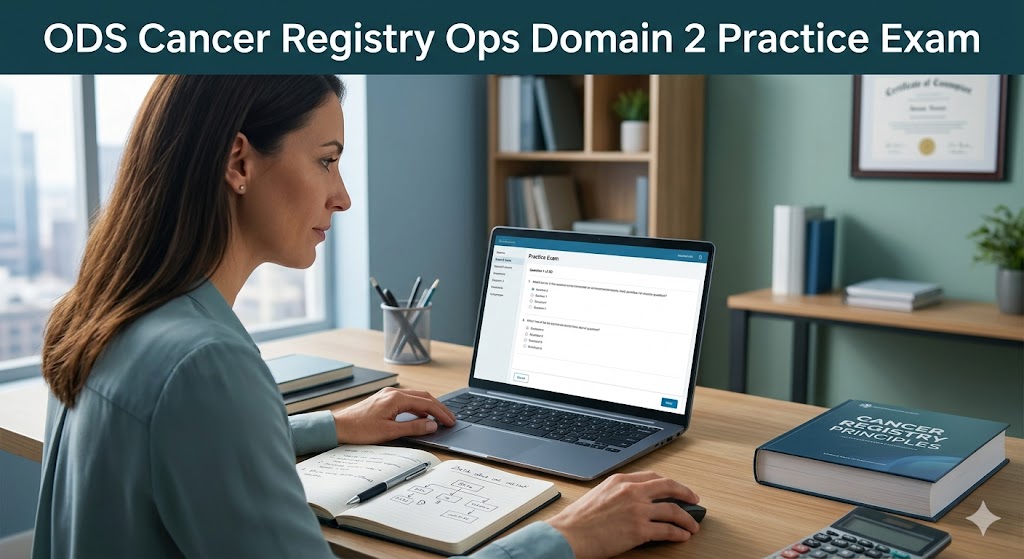
Additional Information
What the Course Entails and Exam Details
Our study guide for the ODS Cancer Registry Operations Domain 2 Practice Test delves into the critical components covered within this domain. Candidates will find focused material and practice scenarios related to:
Data Quality Management: Ensuring accurate, complete, and timely cancer data collection and submission.
Registry Standards & Compliance: Understanding and applying current registry standards set by organizations like the Commission on Cancer (CoC) and National Cancer Institute (NCI).
Abstracting & Coding Operations: Effective processes for medical record abstracting and applying appropriate coding systems (e.g., ICD-O-3, AJCC staging).
Casefinding and Follow-up Procedures: Methodologies for identifying potential cases and maintaining accurate patient follow-up data.
Legal, Ethical & Confidentiality: Adherence to HIPAA regulations and ethical considerations in handling sensitive patient information.
Technology & Data Systems: Utilizing registry software and managing electronic medical records (EMR) interfaces.
General Registry Management: Optimizing workflow, resource allocation, and overall operational efficiency.
This specific practice test is composed entirely of closed-book multiple-choice questions, mirroring the format and testing environment you can expect for Domain 2 on the final certification exam. It focuses solely on evaluating your rapid recall and application of operational knowledge without external resources.
What to Expect in the Final Exam
This practice test is an excellent simulation for the Domain 2 portion of the comprehensive ODS final exam. For this specific practice test, you can anticipate a focused set of multiple-choice questions testing your foundational understanding of registry operations, allowing you to assess your baseline readiness.
The actual ODS certification exam, administered by the National Cancer Registrars Association (NCRA), is a more extensive proctored test. You will encounter various domains with a combination of closed-book, multiple-choice questions (including those resembling this Domain 2 content) and potentially open-book components. Passing scores and detailed time allocations for each section are determined by the NCRA and communicated directly to candidates. Ensure you familiarize yourself with the full structure, specific question types, and rules outlined on the NCRA's official credentialing website. This simulation provides invaluable practice and highlights areas where focused study is needed to excel on exam day.
How to Study and Exam Centers
Effective preparation is key to conquering this domain. Here are actionable study strategies and information on accessing the practice and final exams:
Active Review: Systematically review relevant textbook chapters, NCRA guidelines, industry standards, and your own study notes focusing only on registry operations topics covered in Domain 2.
Practice Tests: Take this comprehensive Domain 2 practice test multiple times. Analyze both correct and incorrect answers thoroughly to understand the rationale and reinforce key concepts.
Focused Study: Pinpoint specific weak areas identified through practice and dedicate focused study time to those operational concepts. Don't just guess – master the underlying principles.
Study Groups: Discussing concepts and sharing resources with fellow aspiring ODS professionals can provide diverse perspectives and enhance understanding.
Consistency: Consistent, regular study sessions over several weeks or months are generally more effective than last-minute cramming. Integrate flashcards and concise summaries for efficient review.
Accessing Exams: You can access this specific practice test securely through your designated online study portal. For the actual ODS final exam registration, you must apply through the NCRA website. Upon application approval, you will receive instructions on how to schedule your exam, which is typically administered at authorized physical testing centers or online with secure remote proctoring options.
Job Opportunities from the Course
Earning the ODS credential, after demonstrating proficiency across all domains including Registry Operations, opens doors to various fulfilling career paths within the specialized field of oncology data management. Successfully navigating this practice test is a crucial step towards qualifying for roles such as:
Oncology Data Specialist (ODS): The definitive role showcasing expertise in cancer data management and analysis.
Cancer Registrar: Responsibilities include identifying, abstracting, and tracking cancer patients.
Tumor Registrar: A similar role, often used interchangeably, focusing on data related to tumors and cancers.
Cancer Registry Manager: Overseeing registry operations, supervising staff, and ensuring compliance with standards.
Cancer Data Analyst: Utilizing registry data for research, quality improvement initiatives, and strategic planning.
Data Quality Specialist: Focussing specifically on ensuring the accuracy and completeness of collected data.
Quality Improvement Coordinator (Cancer Registry): Using registry data to drive quality improvements in patient care.
Cancer Conference/Tumor Board Coordinator: Utilizing registry data and expertise to facilitate multi-disciplinary patient care discussions.
Registry Consultant: Providing expertise and guidance to organizations on setting up or optimizing their cancer registries.
Frequently Asked Questions
Reviews
5.0
Based on 0 reviews
Leave a Review
No reviews yet. Be the first to review!