
OET Reading Practice Exam
$69.00
- Buy to unlock unlimited access to all Quiz questions and Answers in this Quiz.
- After purchase you can print a PDF of the whole quiz at any point. The PDF will contain the questions and the correct answers.
About this Exam
The Occupational English Test, commonly known as OET, is an international English language test designed specifically for the healthcare sector. It assesses the language communication skills of healthcare professionals who wish to register and practice in an English-speaking environment. This includes doctors, nurses, dentists, pharmacists, and physiotherapy professionals, among others. The OET ensures that candidates have the necessary English language proficiency to communicate effectively with patients and colleagues in professional settings. Unlike general English tests, OET evaluates language skills in context, using real-life healthcare scenarios. Successfully passing this test is a crucial step for many healthcare practitioners seeking to work abroad.
Ready to test your knowledge?
Buy Now to Access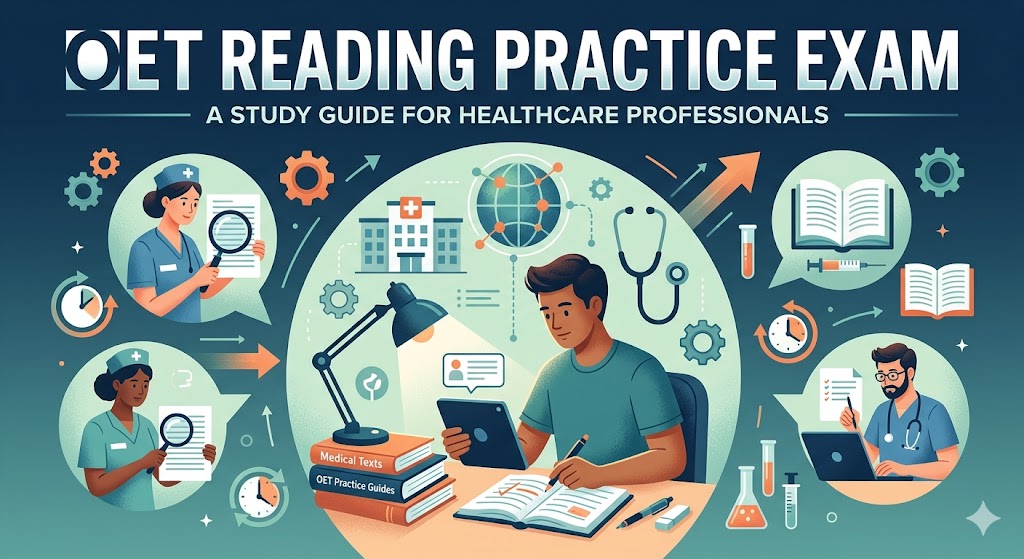
Additional Information
What the Course Entails and Exam Details
The OET is divided into four sub-tests: Listening, Reading, Writing, and Speaking. The OET Reading sub-test specifically focuses on evaluating your ability to understand various types of texts relevant to the healthcare workplace. The course aims to develop your skills in recognizing text structure, identifying main ideas, scanning for specific information, and inferring meaning from context. You will learn to navigate professional articles, policy documents, medical reports, and case studies. The content is carefully curated to reflect the kinds of reading materials that a healthcare professional would encounter daily in their clinical practice. Mastering this component is essential for overall success in the OET, as it demonstrates your competency in processing complex professional information accurately and efficiently.
What to Expect in the Final Exam
The OET Reading sub-test is a time-limited examination that requires sharp focus and effective time management. It consists of three parts (Part A, Part B, and Part C), totaling 42 questions. Part A is a rapid reading task where you must find specific information within four short health-related texts quickly. It lasts 15 minutes. Parts B and C are longer, more detailed reading tasks. Part B involves reading six short workplace texts (e.g., guidelines, manuals) and answering one multiple-choice question for each. Part C features two longer presentation or research texts, each followed by multiple-choice questions focusing on detailed meaning, opinion, and attitude. The total time for the Reading sub-test is 60 minutes. No dictionary or any reference materials are permitted. The passing score varies slightly depending on the specific regulatory body you are applying to, but a common target is a minimum score of B, which generally corresponds to around 350 out of 500 on the numerical scale.
How to Study and Exam Centers
Preparing effectively for the OET Reading sub-test involves targeted practice and unfamiliarity with medical terminology. Start by taking a practice test to gauge your current level and identify areas needing improvement. Familiarize yourself with the exact format of the Reading sub-test, understanding the types of questions and text genres. Allocate consistent study time, focusing on improving your reading speed, vocabulary, and scanning skills. Utilize authentic OET practice materials, available from official sources and authorized providers. Analyze your mistakes in practice exams to understand why you got questions wrong. Read healthcare-related articles in publications like medical journals or newspapers to broaden your understanding of professional language.
Regarding taking the exam, OET is available at approved test centers in multiple locations globally. These centers can be found in various countries and are listed on the official OET website. There are typically specific dates scheduled for the test, and you must register and book your test session in advance through the official online portal. The OET can be taken as OET on Paper or OET on Computer at a physical test center, depending on the availability in your chosen location. Ensure you check the specific requirements and dates available for your preferred center well in advance.
Job Opportunities from the Course
Achieving a strong score in the OET, including the Reading sub-test, opens numerous career opportunities for healthcare professionals in English-speaking countries. A passing grade is widely accepted by healthcare boards and councils in countries such as the United Kingdom, Australia, New Zealand, Ireland, Canada, and the United States. This certification is vital for registering with these regulatory bodies and practicing your profession legally. Specifically, passing the OET is the key requirement to secure a broad range of positions.
Registered Nurse
Doctor of Medicine (GP, Specialist)
Dentist
Pharmacist
Physiotherapist
Radiographer
Occupational Therapist
Speech Pathologist
Veterinarian
Optometrist
Podiatrist
Dietitian
Frequently Asked Questions
Reviews
5.0
Based on 0 reviews
Leave a Review
No reviews yet. Be the first to review!