
OFD Instructor 1 Practice Exam
$69.00
- Buy to unlock unlimited access to all Quiz questions and Answers in this Quiz.
- After purchase you can print a PDF of the whole quiz at any point. The PDF will contain the questions and the correct answers.
About this Exam
The OFD Instructor 1 certification is a foundational milestone for fire service professionals dedicated to training the next generation of responders. This course and exam are designed specifically for experienced personnel within a Fire Department—or aspiring fire service educators—who are ready to transition from operator to educator. Earning this credential validates your understanding of the essential principles required to effectively deliver prepared lesson plans, manage classroom and field training environments, and ensure safe, compliant educational experiences. It is the critical first step toward becoming a recognized leader in fire service training.
Ready to test your knowledge?
Buy Now to Access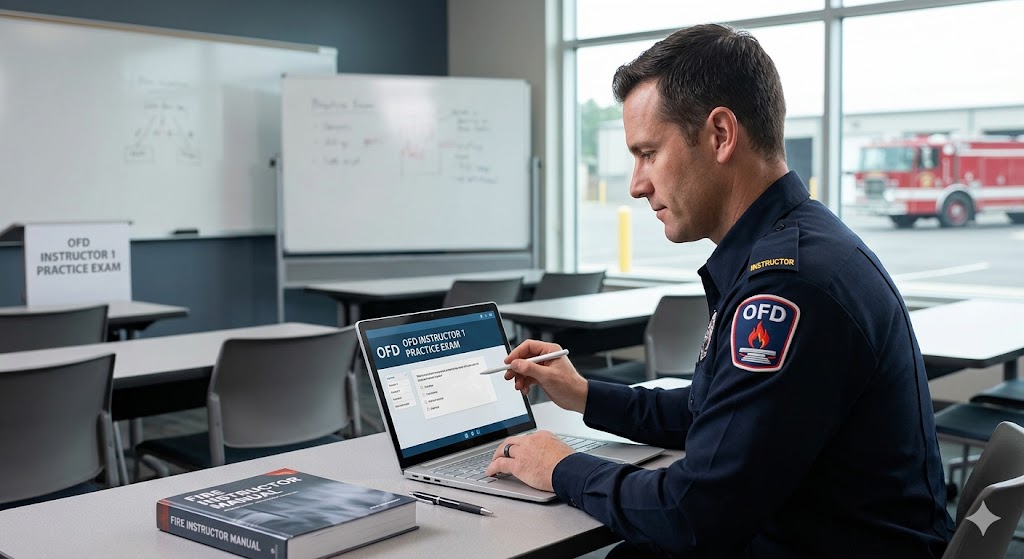
Additional Information
What the Course Entails and Exam Details
This course provides a deep dive into instructional methodologies specifically adapted for the unique demands of the fire service. The curriculum is typically structured around recognized professional standards, such as NFPA 1041 (Standard for Fire and Emergency Services Instructor Professional Qualifications), or equivalent departmental requirements. Candidates will learn the fundamental skills needed to successfully teach prepared course materials rather than developing them from scratch, which is reserved for higher levels.
The core syllabus and skills covered generally include:
Communication Skills: Mastering verbal, non-verbal, and written communication to effectively deliver information to diverse learning audiences.
Instructional Delivery: Understanding different teaching methods, such as lecture, discussion, demonstration, and the proper use of training aids and media.
Lesson Plan Use: Learning how to read, follow, and adapt authorized lesson plans, ensuring all learning objectives are met within the required scope.
Learning Processes: Gaining insight into basic adult learning theories, student motivation, and managing different learning styles and abilities.
Safety Practices: Identifying and mitigating potential safety hazards in both classroom and practical (hands-on) training environments.
Student Evaluation and Testing: Administering, grading, and providing constructive feedback on student assessments and performance evaluations.
What to Expect in the Final Exam
The final certification exam for OFD Instructor 1 is usually composed of two distinct components designed to test your knowledge and teaching ability.
The first part is typically a cognitive written examination. This test is often administered as a multiple-choice exam, although it may include other question types like true/false or matching. The questions cover the key theoretical concepts presented in the course, from safety standards to learning psychology. Candidates should be prepared for a timed test, often lasting between 90 and 120 minutes, depending on the jurisdiction. The exact time limit and passing score (commonly 70% or higher) are set by the specific department or certifying body (e.g., State Fire Marshal).
The second, and equally important, part is the practical (or psychomotor) skills evaluation. During this phase, you will likely be required to prepare and deliver a short presentation based on a pre-assigned or approved fire service topic. Examiners will assess your ability to use training aids, apply communication skills, follow a lesson plan, and manage the instructional environment safely and effectively. Both the written and practical portions must be passed to earn the certification.
How to Study and Exam Centers
Effective preparation requires a structured approach. To succeed in the OFD Instructor 1 exam, you should develop actionable study strategies:
Master the Core Material: Thoroughly review the primary textbook used in the course. Read every chapter related to Instructor 1 topics. Pay close attention to definitions, lists, and key concepts highlighted in the text.
Practice with Purpose: Utilize high-quality practice tests repeatedly. Focus not just on the correct answers, but also understand the reasoning behind them. Analyze the questions you missed to identify weaknesses in your knowledge.
Create Visual Aids: Develop flashcards for key terms, regulatory standards, and instructional techniques. This aids in memory retention for quick recall during the exam.
Teach Others: One of the best ways to learn is to teach. Practice delivering 5-10 minute lessons on simple fire service topics to colleagues or friends, focusing on clarity, structure, and safe demonstrations.
The certification exam is typically taken at a physical location. Because "OFD" is highly specific (likely referring to a local, large department, e.g., Orlando, Ottawa, etc.), the exam will almost exclusively be administered through the department's internal training academy or a designated regional fire training facility. These centers are authorized schools or testing sites. Be sure to check with your specific department’s training division for the exact location, available test dates, and required registration procedures.
Job Opportunities from the Course
Earning the OFD Instructor 1 certification is a vital career catalyst that opens doors to several key specialized roles within the fire service. The instructional skills gained are essential for moving beyond basic operational duties into leadership and training positions. This certification unlocks the following specific job titles and career paths:
Fire Service Instructor I (Department or Academy level)
Training Officer (Specializing in company-level drills and maintenance training)
Shift Training Captain (Overseeing on-duty training coordination)
Public Education Officer (Utilizing instructional techniques for community outreach)
Company Officer (Advanced career progression requiring instructional oversight)
Special Operations Training Specialist (e.g., HazMat, Technical Rescue Training)
State or Regional Fire Academy Instructor (Full-time or adjunct positions)
Advanced Instructor (Instructor II or III) (A necessary prerequisite for management-level instructor roles)
Frequently Asked Questions
Reviews
5.0
Based on 0 reviews
Leave a Review
No reviews yet. Be the first to review!