
Ohio 3a Aquatic Pest Practice Exam
$69.00
- Buy to unlock unlimited access to all Quiz questions and Answers in this Quiz.
- After purchase you can print a PDF of the whole quiz at any point. The PDF will contain the questions and the correct answers.
About this Exam
The Ohio Commercial Pesticide Applicator Category 3a – General Aquatic Pest Control certification is essential for individuals seeking to apply pesticides professionally to aquatic environments. This certification, administered by the Ohio Department of Agriculture (ODA), is specifically designed for commercial pesticide applicators whose work involves controlling pests in, on, or around water bodies such as ponds, lakes, reservoirs, streams, and other relevant aquatic sites. Whether you are a professional working in lake management, conservation, or general pest control and need to address aquatic issues, this license validates your competency in safely and effectively managing these complex ecosystems. The practice exam, and the resources described in this guide, are structured to help you master the knowledge needed to pass the actual ODA-administered exam and begin your career as a qualified aquatic pesticide applicator in Ohio.
Ready to test your knowledge?
Buy Now to Access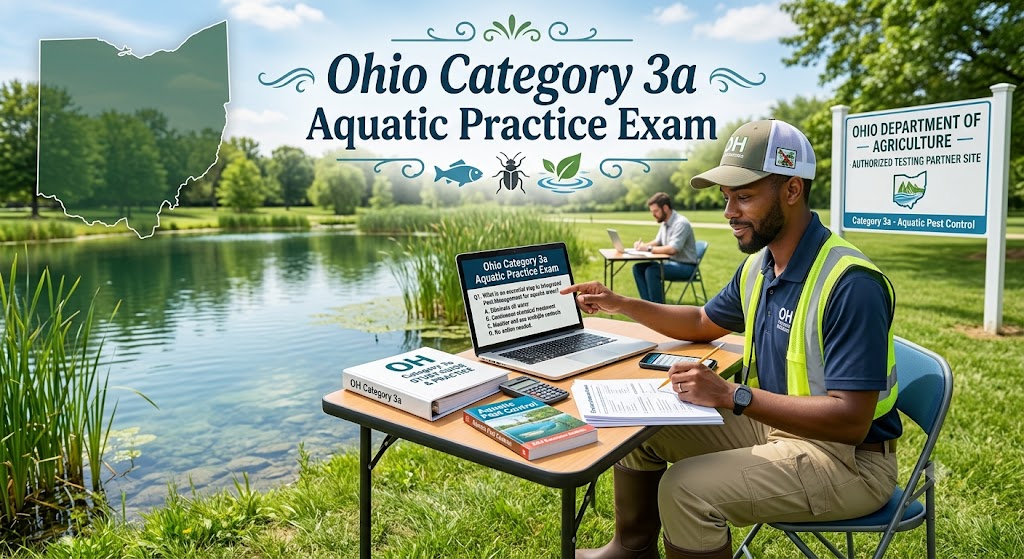
Additional Information
What the Course Entails and Exam Details
To become a certified Category 3a applicator, you must demonstrate a thorough understanding of various core topics.
The examination and corresponding study materials cover:
Pesticide Safety and Law: Understanding federal and state regulations, reading and interpreting pesticide labels, proper handling, storage, disposal, and personal protective equipment (PPE).
Aquatic Pest Identification: Recognizing and understanding the biology of common aquatic pests, including invasive plants, algae species, and aquatic insects that may require control.
Integrated Pest Management (IPM) in Aquatic Systems: Implementing environmentally responsible strategies that combine cultural, mechanical, biological, and chemical controls to manage pests effectively.
Aquatic Pesticides and Formulations: Knowledge of different types of herbicides, algicides, and piscicides used in aquatic environments, their modes of action, and appropriate application methods.
Application Techniques and Equipment: Understanding and calibrating various pesticide application equipment, ensuring accurate and safe delivery to target areas without harming non-target organisms.
Water Quality and Environmental Considerations: Recognizing how pesticide applications can impact water chemistry, aquatic organisms, and non-target areas, and implementing measures to prevent adverse effects.
The "practice exam" is not a formal course you enroll in, but a simulation of the exam, and it is a crucial component of your self-study or preparation through external training providers (such as the Ohio State University Extension or other authorized trainers) before you take the actual ODA exam. The primary knowledge required is usually outlined in the official ODA study guide, known as an OSU Extension Bulletin, which you can obtain from the university's publication store or the ODA.
What to Expect in the Final Exam
The actual final exam administered by the Ohio Department of Agriculture is a robust assessment of your practical and theoretical knowledge.
Here’s what you should expect on exam day:
Format: The ODA Category 3a exam typically consists entirely of multiple-choice questions. This format tests your ability to recall facts, analyze scenarios, and apply knowledge to various problem-solving situations.
Passing Score: To obtain your certification, you must achieve a passing score of at least 70%. This ensures that all certified applicators have a foundational and consistent level of competency.
Language: The exam is conducted in English. Ensure you are comfortable with technical terminology in this language before testing.
Time Limit: While specific time limits can vary, the ODA typically provides a reasonable and predetermined amount of time to complete the multiple-choice exam, often allowing sufficient time for careful consideration of all questions. This information is usually provided upon registration for the test session.
Rules and Regulations: The ODA exam is administered in a proctored environment, ensuring integrity. Specific rules, such as what is allowed in the testing area (typically very little, often no outside resources or electronics), will be clearly communicated by the proctors. Cheating of any form is strictly prohibited and can result in severe penalties.
It is critical to review all communications and guidelines provided by the Ohio Department of Agriculture when you schedule your exam for any specific and current details.
How to Study and Exam Centers
Preparation is the key to passing this demanding exam.
Here are actionable strategies to help you study effectively:
Study Strategies:
Get the Official Study Guide: Obtain the official Ohio State University Extension Bulletin for Category 3a – General Aquatic Pest Control. This is the cornerstone of your studies.
Create a Study Schedule: Break down the bulletin into manageable sections and assign specific study times. Consistency is more effective than cramming.
Focus on the Label: Pesticide labels are legal documents and a major component of the exam. Practice finding and understanding information on sample labels, including mixing rates, safety warnings, and application constraints.
Use Practice Exams and Flashcards: The "Practice Exam" in this guide's title highlights a vital learning tool! Actively look for or create realistic practice tests. Simulate exam conditions (time constraints, multiple-choice format). Create flashcards for pest identification, key regulations, and application terms. Review sample questions found in study workbooks and online resources.
Review the ODA Core Knowledge: Don't forget that you must pass the Core pesticide exam as well as the 3a test. Review foundational concepts like pesticide safety, environmental protection, and federal regulations common to all license types.
Seek Clarification: If you're struggling with a concept, don't hesitate to reach out to colleagues with experience, consult with agricultural extension agents, or check with authorized training providers.
Exam Centers:
To take the actual ODA Commercial Pesticide Applicator exam, you must register through the Ohio Department of Agriculture.
Registration: Register for an exam date and location by calling the ODA, Pesticide Division at 614-728-6987 or by using the online registration system on the ODA website. Pre-registration is required, and spaces are often limited.
Locations: ODA conducts exams at various authorized locations throughout the state. These may include specific ODA offices or partnership locations like community colleges or extension centers. The registration process will provide you with the most current and available testing options.
Fees: Be prepared to pay applicable license and exam fees to the ODA. This information is typically detailed on their website.
Job Opportunities from the Course
A Category 3a – General Aquatic Pest Control certification from the ODA can significantly advance your career in the professional pesticide application and environmental management industry.
Unlocking this license positions you for specialized roles, including:
Aquatic Pest Control Technician: Performing hands-on application of pesticides to water bodies to manage invasive species and algae.
Lake and Pond Manager: Overseeing all aspects of water quality, vegetation management, and ecological balance for private communities, municipal water bodies, or recreational areas.
Water Management Specialist (Aquatic Focus): Working within larger teams to manage aquatic ecosystems for health, safety, and regulatory compliance.
Landscaping Professional (Aquatic Services): Incorporating specialized aquatic pest control and management services into comprehensive landscaping packages.
Conservation Technician: Supporting conservation efforts by controlling invasive aquatic species in natural habitats under appropriate agency supervision.
Environmental Field Technician (Aquatic): Conducting monitoring and treatment of aquatic environments as part of broader environmental studies or remediation projects.
Frequently Asked Questions
Reviews
5.0
Based on 0 reviews
Leave a Review
No reviews yet. Be the first to review!