
Ohio BMV Temporary Permit Practice Test
$69.00
- Buy to unlock unlimited access to all Quiz questions and Answers in this Quiz.
- After purchase you can print a PDF of the whole quiz at any point. The PDF will contain the questions and the correct answers.
About this Exam
The Ohio BMV Temporary Permit Practice Test is an essential study tool designed for aspiring drivers in Ohio who are preparing to take their official written knowledge exam to obtain a Temporary Instruction Permit Identification Card (TIPIC)—often referred to as "temps."
This practice test is designed for anyone at least 15½ years old who wants to master Ohio's traffic laws, road signs, and safe driving regulations before the real exam, ensuring they build the confidence needed to pass on their first attempt and begin their journey toward becoming a licensed driver.
Ready to test your knowledge?
Buy Now to Access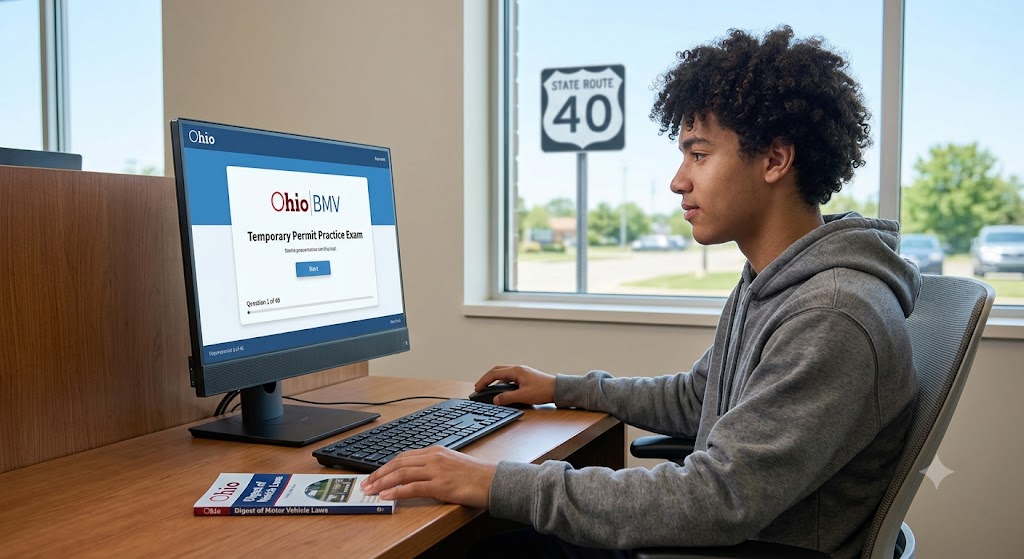
Additional Information
What the Course Entails and Exam Details
This practice exam process focuses entirely on mastering the material found within the official Ohio Digest of Motor Vehicle Laws. To prepare effectively, you must study the comprehensive regulations that govern driving within the state.
The core syllabus covered includes:
Ohio Traffic Laws: Detailed rules regarding right-of-way, speed limits, signaling, turning, and overtaking other vehicles.
Road Signs and Signals: The ability to identify and interpret regulatory, warning, guide, and informational signs, as well as traffic light signals and pavement markings.
Safe Driving Practices: Techniques for defensive driving, handling emergencies, sharing the road with motorcycles, commercial vehicles, and pedestrians.
Unique Ohio Regulations: Knowledge of specific state laws, such as the Ohio maneuverability test requirements, child restraint laws, and OVI (Operating a Vehicle Impaired) laws.
Vehicle Equipment and Maintenance: Understanding basic requirements for lighting, brakes, and safety equipment.
What to Expect in the Final Exam
The actual Ohio BMV Temporary Permit written exam is a computer-based knowledge test. You should expect a straightforward, multiple-choice format designed to test your retention of the study materials.
Exam Format: The test consists of multiple-choice questions administered at a touch-screen terminal.
Number of Questions: There are usually 40 questions on the official exam.
Content Division: The exam is typically divided into two sections: 20 questions on road signs and traffic signals, and 20 questions on Ohio traffic laws and regulations.
Passing Score Requirements: You must achieve a score of at least 75% overall to pass. This means answering at least 30 questions correctly out of 40. However, most testing stations require you to pass both sections (signs and laws) independently.
Time Limits: There is no official time limit for the written knowledge test in Ohio, allowing you to read each question carefully.
Rules: You are not allowed to use the Digest of Motor Vehicle Laws, any notes, or your phone during the examination.
Retakes: If you do not pass, you must wait at least 24 hours (or the next business day) before you can retake the written exam.
How to Study and Exam Centers
Preparation is key to success. Our targeted practice tests are specifically designed to simulate the structure and tone of the actual BMV exam.
We recommend a multi-step study strategy:
Study the Manual: First, thoroughly read the official Ohio Digest of Motor Vehicle Laws available at any BMV Deputy Registrar license agency or online at the official Ohio BMV website.
Take Multiple Practice Tests: Use our Ohio BMV Temporary Permit Practice Exam repeatedly. Focus on understanding why an answer is correct rather than just memorizing it.
Review Weak Areas: Use the feedback from practice tests to identify topics where you struggle (e.g., specific right-of-way rules or warning signs) and revisit those sections in the manual.
Get Enough Rest: Ensure you are well-rested on the day of the test to maintain focus.
Exam Centers:
You do not need to schedule an appointment for the written knowledge exam. To take the official exam, you must visit an authorized Driver Examination Station in Ohio.
These stations are usually co-located with or are near Ohio BMV Deputy Registrar license agencies. You can find the nearest examination station by using the “Find a Location” tool on the official Ohio BMV website.
When you go to take your test, remember to bring original documents proving your name, date of birth, Social Security number (if assigned), citizenship or legal presence, and Ohio residency. If you are under 18, a parent or guardian must also accompany you to co-sign the application.
Job Opportunities from the Course
Obtaining your TIPIC is the initial requirement for earning your probationary and eventually full Ohio driver's license. While the permit itself has driving restrictions, holding a driver's license is a requirement or a massive advantage for a wide array of career paths in Ohio.
A valid driver's license unlocks opportunities in sectors such as:
Delivery Services (e.g., Food Delivery, Package Courier)
Rideshare and Transportation (e.g., Uber, Lyft, local taxi services)
Sales Representatives (requiring travel to client sites)
Logistics and Supply Chain (Fleet Management, Warehouse Support)
Field Service Technicians (e.g., HVAC, Telecom, Appliance Repair)
Construction and Skilled Trades
Health Care (Home Health Aides, Medical Transport)
First Responders and Public Safety
Professional Driving (advancing to CDL for Trucking or Bus Driving)
Frequently Asked Questions
Reviews
5.0
Based on 0 reviews
Leave a Review
No reviews yet. Be the first to review!