
Ohio Boiler Licensing Practice Exam
$69.00
- Buy to unlock unlimited access to all Quiz questions and Answers in this Quiz.
- After purchase you can print a PDF of the whole quiz at any point. The PDF will contain the questions and the correct answers.
About this Exam
The Ohio Boiler Licensing certification is a critical credential for professionals who want to operate, maintain, and manage industrial boiler systems safely and efficiently within the state of Ohio.
This certification ensures that operators fully understand state-specific safety regulations, pressure vessel dynamics, and emergency protocols.
It is specifically designed for aspiring stationary engineers, facility maintenance personnel, and plant operators who handle high-pressure and low-pressure steam systems.
Earning this license proves your technical competence, dedication to workplace safety, and compliance with the stringent codes enforced by the Ohio Department of Commerce.
Whether you are stepping into the industrial sector for the first time or looking to advance your current engineering career, this certification serves as a powerful foundation for your professional journey.
Ready to test your knowledge?
Buy Now to Access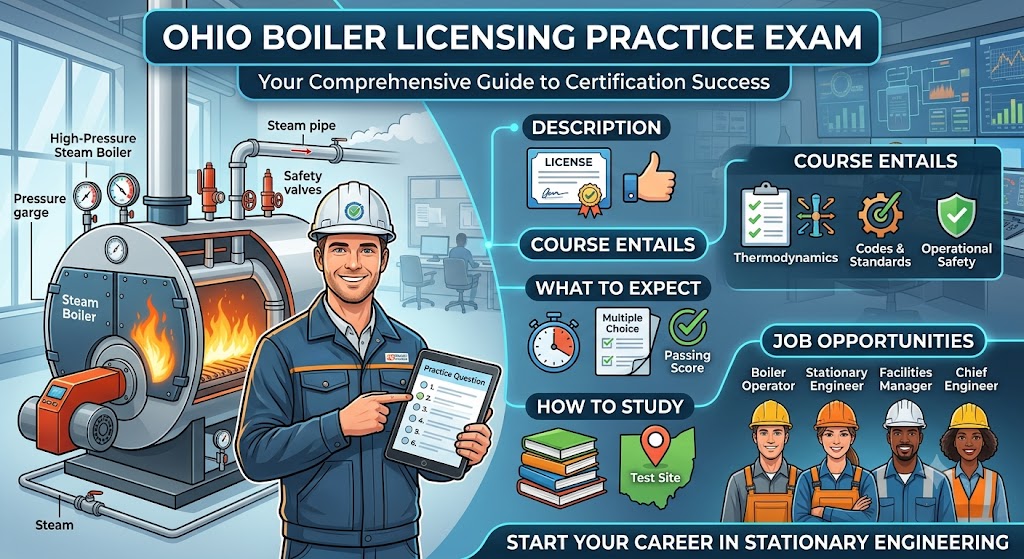
Additional Information
What the Course Entails and Exam Details
Preparing for the Ohio Boiler Licensing exam involves mastering a wide array of highly technical and mechanical topics.
The core syllabus heavily focuses on the fundamental principles of thermodynamics, heat transfer, and fluid mechanics.
Candidates will dive deep into boiler design and construction, learning the intricate differences between water-tube, fire-tube, and cast-iron boilers.
A significant portion of the coursework covers combustion principles, fuel types, and draft systems to ensure efficient plant operation.
You will also be trained extensively on essential boiler accessories and fittings, including safety relief valves, water column assemblies, blowdown systems, and feedwater regulators.
Additionally, a major component of the training involves strict adherence to the Ohio Revised Code (ORC) Chapter 4104 and the associated administrative rules governing boiler operation and inspections.
What to Expect in the Final Exam
The final examination is a comprehensive, closed-book test designed to rigorously evaluate your practical knowledge and theoretical understanding of boiler operations.
You can expect a multiple-choice format that covers all the critical areas from your coursework, including safety protocols, operational procedures, and state laws.
The exam is meticulously timed, generally giving candidates a strict limit of around two to three hours to complete all the questions.
To achieve a passing score, you typically need to answer at least 70% of the questions correctly, though it is always best to aim much higher to ensure a comfortable margin of success.
Calculators are usually permitted for the math-based questions regarding pressure and capacity, provided they are standard, non-programmable models.
Any form of communication or access to outside reference materials during the test is strictly prohibited and will result in immediate disqualification.
How to Study and Exam Centers
Success on the Ohio Boiler Licensing exam requires a structured, consistent, and proactive study strategy.
Begin by thoroughly reviewing the Ohio state boiler codes and the ASME Boiler and Pressure Vessel Code guidelines, as these form the backbone of the test.
Taking multiple practice exams is one of the most effective ways to familiarize yourself with the question formats and identify your weak areas.
Create flashcards for essential formulas, valve settings, and safety thresholds so that you can recall them instantly under pressure.
When you are ready to test, the exams are typically administered by authorized third-party testing agencies like Pearson VUE or PSI, on behalf of the state.
You must apply and be approved by the Ohio Department of Commerce before scheduling your exam at one of the physical testing centers located throughout the state.
These physical testing facilities provide a secure, proctored environment, so be sure to arrive early with your approved scheduling documentation and valid photo identification.
Job Opportunities from the Course
Earning your Ohio boiler license unlocks a highly stable and lucrative career path in various industrial and commercial sectors.
Below are some of the excellent job opportunities you can pursue with this certification:
High Pressure Boiler Operator Low Pressure Boiler Operator Stationary Engineer Facility Maintenance Technician Power Plant Operator Central Utility Plant Engineer Industrial Maintenance Mechanic HVAC and Boiler Specialist Hospital Facilities Engineer
Frequently Asked Questions
Reviews
5.0
Based on 0 reviews
Leave a Review
No reviews yet. Be the first to review!