
OHIO HIGHWAY PATROL SIGNALS PRACTICE TEST
$69.00
- Buy to unlock unlimited access to all Quiz questions and Answers in this Quiz.
- After purchase you can print a PDF of the whole quiz at any point. The PDF will contain the questions and the correct answers.
About this Exam
The Ohio State Highway Patrol (OSHP) Signals Practice Test is an essential tool for prospective state troopers, dispatchers, and other radio communication specialists. This comprehensive evaluation is designed to familiarize candidates with the intricate system of numerical codes (like ten-codes), alphabetical signals, and standardized phonetic protocol specific to the OSHP. Success in this portion of the application process ensures you can maintain clear, accurate, and instantaneous communication during critical field operations and emergency responses. This guide focuses on preparation methods and what to expect during the assessment.
Ready to test your knowledge?
Buy Now to Access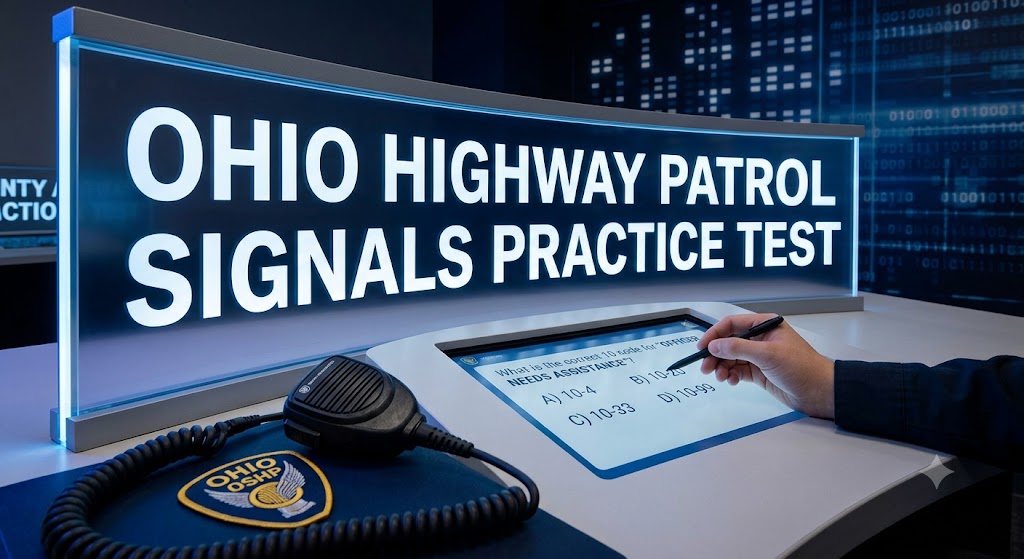
Additional Information
What the Course Entails and Exam Details
Preparing for the OSHP signals assessment, often framed as part of a pre-employment test or communication course, entails mastering a precise vocabulary. You will need to commit to memory hundreds of specific internal codes that define OSHP operations. The core topics include: 1. Ten-codes for operational status, like 10-4 (affirmative), 10-7 (out of service), and 10-20 (location). 2. Priority and emergency codes, including signals for officer needs assistance, active shooter, and high-priority pursuits. 3. Standard phonetic alphabet, essential for spelling names, license plates, and locations accurately over the air. 4. Disposition codes, used to report the outcome of incidents, such as citations issued or arrests made.
What to Expect in the Final Exam
The actual examination for signals proficiency usually forms a section within the larger written or dispatch-specific entrance exam, or it may be a standalone practical assessment. For most candidates, this takes the form of multiple-choice questions where you must identify the correct code for a given situation, or vice versa. The format may also include an oral component, testing your ability to rapidly translate a series of codes played over a speaker or through a headset, simulating real-world conditions. Accuracy is paramount; a very high passing score, often in the range of 80% to 90%, is typically required for this specific section due to the critical nature of communication. Strict time limits are enforced to test your recall speed. You will not be permitted to use any external resources during the test.
How to Study and Exam Centers
Actionable study methods are key to success. Create digital or physical flashcards for every single code and phonetic letter. Use spaced repetition systems to drill the most difficult signals. Listen to actual OSHP radio traffic, if publicly available, or use simulator tools to practice instant code translation. Study with a partner who can quiz you dynamically, asking for a code for a scenario or a scenario for a code. OSHP testing centers are located throughout the state of Ohio at official patrol posts and regional training academies. Authorized third-party testing services or authorized educational institutions may also conduct these tests for certain specialized communications positions. Candidates must locate and register for specific testing times through the official OSHP recruitment portal.
Job Opportunities from the Course
Possessing mastery of OSHP communication signals unlocks several distinct career paths within the organization. This certification, or proven proficiency, is a crucial step toward positions including:
State Trooper (Road Patrol)
Dispatcher / Communications Technician
Intelligence Analyst
Administrative Communications Officer
Special Response Team (SRT) Communications Support
Aviation Unit Communications Specialist
Patrol Supervisor (with accumulated experience)
Frequently Asked Questions
Reviews
5.0
Based on 0 reviews
Leave a Review
No reviews yet. Be the first to review!