
Ohio Lead Risk Assessor Practice Exam
$69.00
- Buy to unlock unlimited access to all Quiz questions and Answers in this Quiz.
- After purchase you can print a PDF of the whole quiz at any point. The PDF will contain the questions and the correct answers.
About this Exam
The Ohio Lead Risk Assessor certification is a crucial professional credential for individuals focused on public health, environmental safety, and housing inspection within the state. This exam is designed specifically for environmental professionals, licensed inspectors, risk assessors, and project designers who need to legally identify lead hazards, assess risk levels in residential or public properties, and provide mitigation recommendations. Obtaining this license is required to perform comprehensive lead inspections and risk assessments in Ohio, ensuring compliance with both state regulations and federal EPA standards. This study guide is your first step toward mastering the material and advancing your career in environmental safety.
Ready to test your knowledge?
Buy Now to Access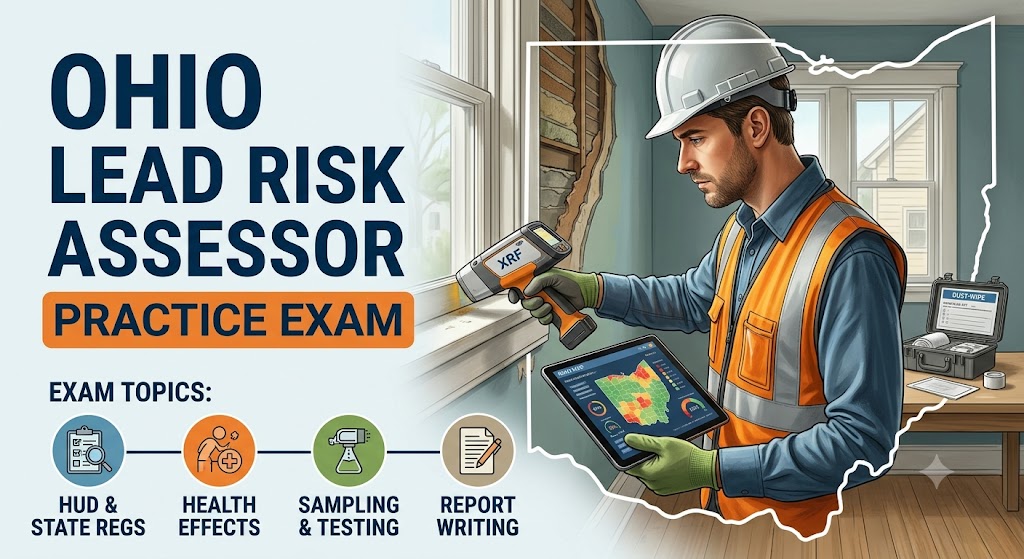
Additional Information
What the Course Entails and Exam Details
To qualify for the Ohio Lead Risk Assessor exam, candidates must typically complete an Ohio Department of Health (ODH)-approved training course. This course is comprehensive, covering the core competencies required to safely and accurately identify lead-based paint hazards. The curriculum covers a wide spectrum of critical skills, starting with the health effects of lead exposure on children and adults, and deep-diving into regulatory requirements from HUD, the EPA, and specifically, the Ohio Administrative Code (OAC).
The course details the protocols for conducting a lead risk assessment, which includes: visual inspections of property conditions; collecting paint chip, dust wipe, and soil samples for laboratory analysis; and interpreting the results to determine if hazards exist. Candidates also learn to use advanced technologies, such as X-ray Fluorescence (XRF) analyzers. The syllabus further includes methods for hazard control, ongoing monitoring strategies, and the preparation of detailed legal reports that outline findings and provide actionable recommendations for property owners. This foundational knowledge ensures assessors can determine not only the presence of lead but the likelihood of exposure.
What to Expect in the Final Exam
The final state licensing exam is a rigorous test of both the theoretical and practical knowledge gained during the training course. Candidates must be prepared for a proctored, standardized test administered either directly by the Ohio Department of Health or through an authorized testing partner. The format primarily consists of multiple-choice questions that require the application of regulatory knowledge to specific, real-world inspection scenarios.
The exam often contains 50 to 100 questions, and a passing score is typically set around 70% or higher, though this threshold can vary based on the specific testing cycle. Candidates are generally allotted a set time limit, often between two to three hours, to complete the exam. It is vital to note that this is a "closed book" examination. Candidates must answer questions based on their retained knowledge, covering Ohio state laws, inspection methodologies, calculation procedures, and safety protocols without the aid of reference materials during the test.
How to Study and Exam Centers
Preparation for this exam must be systematic. The most critical resource is the training manual provided during your ODH-approved course. This manual contains the essential definitions, threshold values, and legal protocols that are frequently tested. Candidates are highly encouraged to develop a study routine that includes actively creating flashcards for key regulatory deadlines, dust-lead hazard levels, and soil concentration thresholds (which are specific to Ohio).
A vital strategy is completing multiple full-length "practice exams." These simulated tests should be taken under timed conditions to replicate the pressure of the actual exam day. These practice sessions help build test-taking stamina and help identify specific knowledge gaps in regulatory knowledge versus practical sampling methodology. Candidates should focus heavily on understanding the exact language used in the Ohio Administrative Code, as slight variations in legal definitions can be the difference between a correct and incorrect answer.
Regarding testing logistics, the state exam must be taken after successful completion of the training course. Testing is coordinated through the Ohio Department of Health's Bureau of Environmental Health and Radiation Protection. The exam is often offered at specific state government facilities or pre-scheduled locations, particularly around Columbus. Candidates must register in advance, pay the required state fees, and bring evidence of their course completion certificate to the testing center on exam day.
Job Opportunities from the Course
Earning the Ohio Lead Risk Assessor license unlocks numerous specialized career paths within the environmental health and housing sectors. Certified professionals find that their expertise is in high demand, as state and federal regulations mandate lead inspections for many properties.
The certification prepares you for specific, impactful roles, including:
Lead Risk Assessor (Performing inspections and identifying hazards for property owners).
Environmental Health Specialist (Working for county or municipal health departments).
Housing Quality Standards (HQS) Inspector (Assessing safety compliance for HUD programs).
Industrial Hygienist specializing in residential exposure.
Environmental Consultant (Providing risk analysis and mitigation planning for development firms).
Renovation, Repair, and Painting (RRP) Compliance Manager for large contracting companies.
Lead Abatement Project Designer (Required for designing complex remediation strategies).
Frequently Asked Questions
Reviews
5.0
Based on 0 reviews
Leave a Review
No reviews yet. Be the first to review!