
Ohio Security Guard License Practice Exam
$69.00
- Buy to unlock unlimited access to all Quiz questions and Answers in this Quiz.
- After purchase you can print a PDF of the whole quiz at any point. The PDF will contain the questions and the correct answers.
About this Exam
The Ohio Security Guard License, technically an identification card registration from the Ohio Department of Public Safety (ODPS), is the mandatory credential for individuals seeking employment with licensed private security companies within the state. This certification verifies that an individual has passed a fingerprint-based criminal background check, met minimum age and character requirements, and completed a state-mandated training course. The associated practice exam is a critical study tool designed to prepare applicants for the final examination administered at the end of this required training, ensuring they possess the necessary legal, safety, and operational knowledge to begin a career in private security.
Ready to test your knowledge?
Buy Now to Access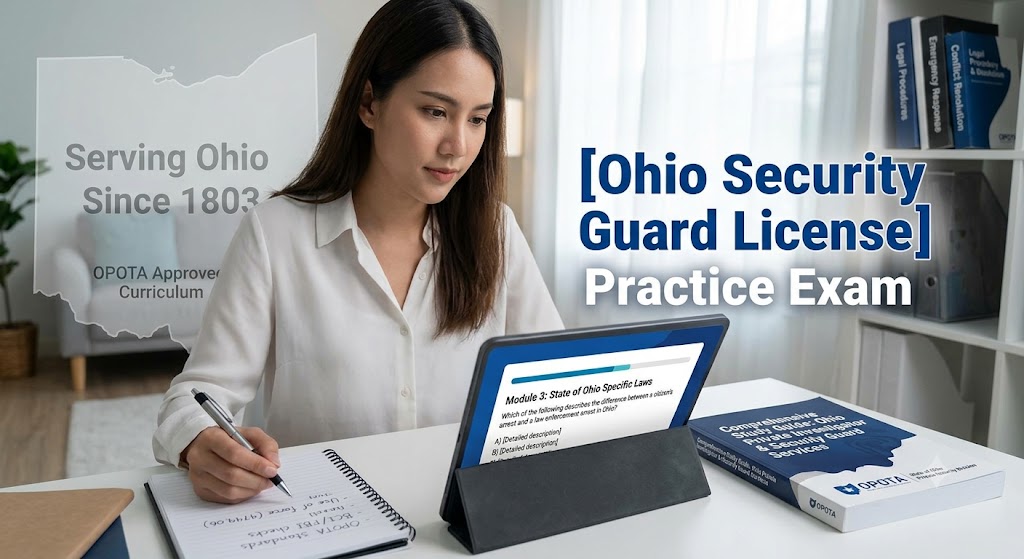
Additional Information
What the Course Entails and Exam Details
To obtain your registration in Ohio, you must complete a minimum of 20 hours of basic training from an approved, certified security guard training provider. The practice exam and the official final exam are built directly from this curriculum. Key areas of focus typically include:
State of Ohio Laws and Regulations: Comprehensive understanding of the Ohio Revised Code Chapter 4749 and related administrative rules.
Role and Responsibilities: Defining the limits of a security guard's authority versus law enforcement, including citizen's arrest procedures in Ohio.
Patrol Techniques: Methods of observation, reporting, and maintaining a visible presence.
Emergency Response: Procedures for handling fires, medical emergencies, bomb threats, and active shooter scenarios.
Communication Skills: Effective public relations, conflict de-escalation, and accurate report writing.
Ethics and Professionalism: Maintaining standards of conduct and protecting client information.
For those seeking to become Armed Security Guards, Ohio requires additional, separate OPOTC-approved firearms training (minimum 20 hours), range qualification, and a concealed handgun license (CHL).
What to Expect in the Final Exam
While a 'practice exam' is your best preparation, the official final examination has its own specific format. It is a multiple-choice exam administered in-person at the conclusion of your mandatory 20-hour training course.
Format: Typically 50 to 100 multiple-choice questions.
Passing Score: A passing grade of at least 70% is standard to be recommended for registration.
Time Limit: You will usually have between 60 to 90 minutes to complete the test.
Rules: The exam is typically closed-book and supervised by the training provider or an ODPS representative.
How to Study and Exam Centers
The key to success is prioritizing state-specific materials.
How to Study:
Use Official Study Guides: Rely primarily on the curriculum materials provided by your certified training school.
Take Multiple Practice Tests: Repeatedly taking a diverse set of practice questions will build your recall speed and familiarity with phrasing.
Review the Ohio Revised Code: Focus on Chapter 4749 and related definitions until you can distinguish your legal limits clearly.
Form Study Groups: Collaborating with other students can clarify complex legal concepts.
Exam Centers: In Ohio, the exam is not taken independently at a third-party vendor like Pearson VUE. Instead, the final exam is proctored directly by your certified training provider at their facility at the end of your course. Your employer must handle the actual registration application and submission to the ODPS Private Investigator and Security Guard Services (PISGS).
Job Opportunities from the Course
A valid Ohio Security Guard ID Card opens the door to numerous entry-level career paths in both the private and public sectors. Some common job titles and career steps include:
Unarmed Security Officer
Corporate Security Attendant
Mobile Patrol Officer
Retail Loss Prevention Specialist
Residential/Apartment Security
Campus Security Officer
Event Security Staff
Hospital/Healthcare Security
(After additional certification) Armed Security Guard
(With experience) Security Supervisor / Team Lead
Frequently Asked Questions
Reviews
5.0
Based on 0 reviews
Leave a Review
No reviews yet. Be the first to review!