
Ohio Vector Control (Category 10d) Practice Exam
$69.00
- Buy to unlock unlimited access to all Quiz questions and Answers in this Quiz.
- After purchase you can print a PDF of the whole quiz at any point. The PDF will contain the questions and the correct answers.
About this Exam
The Ohio Vector Control (Category 10d) certification is an essential credential for professionals dedicated to protecting public health by managing pests that transmit diseases. This certification, administered by the Ohio Department of Agriculture (ODA), is specifically designed for commercial and private pesticide applicators who apply pesticides outdoors to control invertebrate pests that pose a threat to public health or are a nuisance to humans. This includes vectors such as mosquitoes, house flies, chiggers, and ticks. Obtaining this license demonstrates a high level of competence and a commitment to safe, effective, and environmentally responsible pest management practices. Whether you work for a municipal mosquito control program, a public health department, or a private pest control company, this certification is your key to advancing your career in vector control.
Ready to test your knowledge?
Buy Now to Access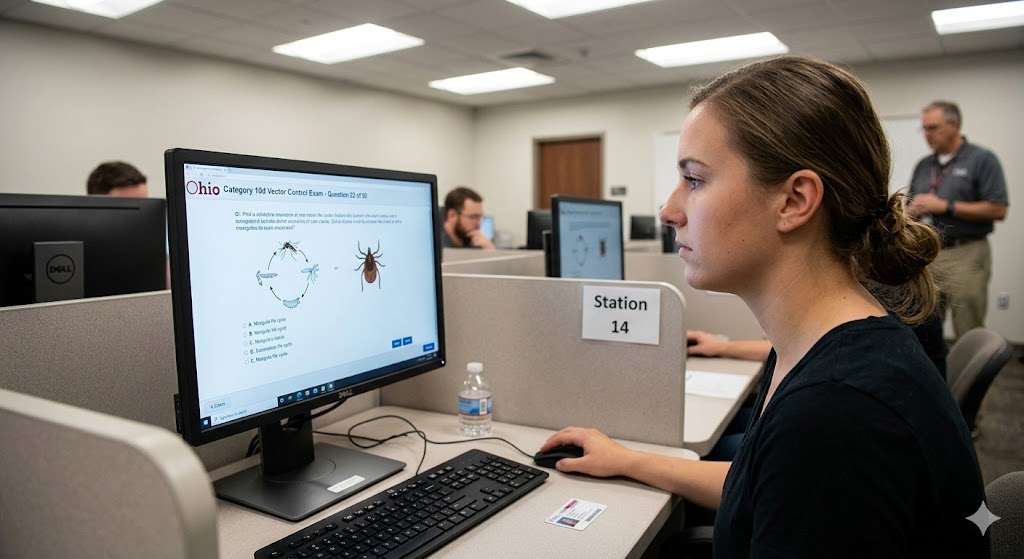
Additional Information
What the Course Entails and Exam Details
Preparing for the Ohio Category 10d exam requires a thorough understanding of Integrated Vector Management (IVM) principles. While the ODA does not require a formal "course," candidates must master a comprehensive set of topics through self-study or training programs. The exam content is based on the official study materials provided by the ODA.
Core topics covered in the exam include:
Vector Identification: Accurate identification of common vectors in Ohio, including various mosquito species (e.g., Culex spp., Aedes spp.), ticks (e.g., blacklegged tick, American dog tick), house flies, and rodents.
Vector Biology and Ecology: Understanding the life cycles, habitats, and behavior of these pests to implement more effective control strategies.
Public Health Importance: Knowledge of the diseases transmitted by these vectors, such as West Nile virus, Lyme disease, and La Crosse encephalitis, and the role of vector control in preventing outbreaks.
Integrated Vector Management (IVM): A decision-making process that combines multiple management techniques, including surveillance, source reduction, biological control, and chemical control, to reduce vector populations.
Pesticide Safety and Handling: Best practices for mixing, loading, and applying pesticides; proper use of Personal Protective Equipment (PPE); and safe storage and disposal methods.
Application Techniques and Equipment: Knowledge of different application methods, such as Ultra-Low Volume (ULV) adulticiding and larviciding, and the proper calibration and maintenance of application equipment.
Environmental Protection: Strategies to minimize the impact of pesticide applications on non-target organisms, water quality, and the overall environment.
Laws and Regulations: Understanding the federal and state laws governing pesticide use, including the Federal Insecticide, Fungicide, and Rodenticide Act (FIFRA) and Ohio-specific regulations.
What to Expect in the Final Exam
The final exam for the Ohio Category 10d certification is designed to test your knowledge and practical understanding of the core concepts of vector control. It is a computer-based, multiple-choice exam administered at an ODA-approved testing location. The number of questions and time limit may vary slightly, but candidates are generally given a fixed amount of time to complete the test. A passing score of 70% is typically required to earn your certification. The questions are derived directly from the official study manuals and will cover all the topics outlined in the exam content. You can expect a mix of recall questions and scenario-based questions that ask you to apply your knowledge to real-world situations. To ensure success, it is crucial to study the official materials and take practice exams to familiarize yourself with the format and types of questions.
How to Study and Exam Centers
The key to passing the Ohio Category 10d exam is a structured and thorough study plan. Start by obtaining the official study manuals for both the Core Exam and the Category 10d exam from the Ohio Department of Agriculture. These manuals are the primary source of information for the test questions.
Study Methodically: Read each chapter of the manuals carefully, taking notes and highlighting key terms and concepts. Pay close attention to definitions, regulations, and safety procedures.
Use Practice Exams: Take multiple practice exams to assess your understanding of the material and identify areas where you need more study. These practice tests can simulate the actual exam experience and help build your confidence.
Review and Reinforce: After taking a practice exam, review all the questions, both correct and incorrect. Understand why the correct answer is correct and why the other options are wrong. This will deepen your knowledge and help you avoid common mistakes.
Seek Practical Experience: If possible, gain practical experience in vector control under the supervision of a licensed applicator. This hands-on training can reinforce the concepts you learn from the manuals.
The Ohio Department of Agriculture administers the pesticide exams at various testing centers across the state. You must register for your exam in advance through the ODA's online portal or by calling their pesticide division. The registration process will require you to select a testing date and location that is convenient for you. Plan to arrive at the testing center early with your identification and a positive mindset.
Job Opportunities from the Course
A Category 10d certification opens up diverse and rewarding career paths in both the public and private sectors. Here are some common job titles and roles you can pursue:
Vector Control Technician: Implement mosquito, tick, and other vector control programs for municipalities, public health departments, or mosquito abatement districts.
Mosquito Control Specialist: Focus specifically on mosquito surveillance, larviciding, and adulticiding operations to reduce mosquito populations and the risk of disease.
Public Health Sanitarian / Environmental Health Specialist: Work for a local or state health department, monitoring vector populations and implementing control measures to protect public health.
Municipal Pest Control Operator: Manage vector and other pest populations on government property, such as parks, facilities, and residential areas.
Pest Control Service Technician: Apply your expertise in vector control for a private pest control company, offering specialized services to residential and commercial clients.
Environmental Specialist: Focus on the ecological aspects of vector control, ensuring that management practices are sustainable and environmentally responsible.
Public Health Educator: Use your knowledge to educate the public about vector-borne diseases and how to protect themselves and their properties.
Frequently Asked Questions
Reviews
5.0
Based on 0 reviews
Leave a Review
No reviews yet. Be the first to review!