
Ohio Vector Practice Exam
$69.00
- Buy to unlock unlimited access to all Quiz questions and Answers in this Quiz.
- After purchase you can print a PDF of the whole quiz at any point. The PDF will contain the questions and the correct answers.
About this Exam
The Ohio Vector Control Certification, specifically the Commercial Pesticide Applicator Category 10d, is a critical credential for professionals dedicated to protecting public health. This specialized certification is designed for individuals working in pest control, public health agencies, and municipalities who are responsible for the management and control of vectors—organisms like mosquitoes, ticks, and rodents that transmit diseases to humans and animals. Achieving this certification demonstrates a high level of competency and ensures compliance with State of Ohio regulations regarding pesticide application in the sensitive area of public health.
Ready to test your knowledge?
Buy Now to Access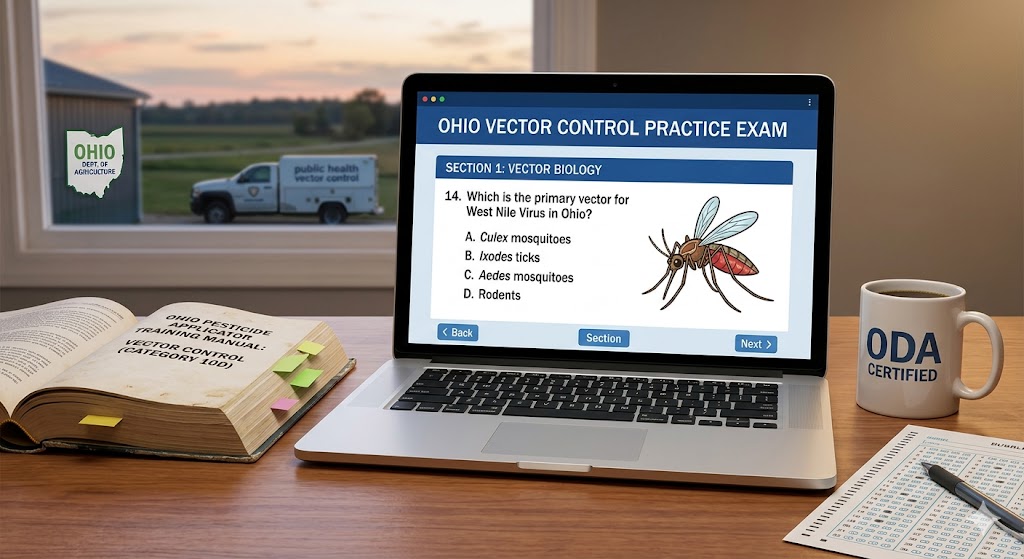
Additional Information
What the Course Entails and Exam Details
This comprehensive course, often structured around the official Ohio Department of Agriculture training manual, covers the essential knowledge required for vector control in the state. Key topics include:
Vector Biology and Ecology: Identification of common Ohio vectors, their life cycles, habitats, and behavior.
Disease Transmission: Understanding the pathogens vectors carry, such as West Nile Virus, Lyme Disease, La Crosse Encephalitis, and others relevant to the region.
Integrated Pest Management (IPM): A focus on environmentally responsible strategies, combining chemical, biological, physical, and cultural controls.
Pesticide Knowledge: Detailed study of larvicides and adulticides, their modes of action, labeling, proper mixing, application rates, and environmental fate.
Safety and Equipment: Instruction on personal protective equipment (PPE), handling spills, and the correct use of application equipment (e.g., ULV foggers).
Ohio Laws and Regulations: Thorough grounding in the specific legal framework governing commercial pesticide application in Ohio.
What to Expect in the Final Exam
The final exam is a state-administered, comprehensive test, typically in a multiple-choice format. Candidates must demonstrate proficiency across all core subject areas. You should be prepared for questions that require you to identify specific vectors, interpret pesticide labels, select appropriate control methods for a given scenario, and apply regulatory knowledge. While specific details on the number of questions, passing score, and time limit can vary and should be confirmed through the Ohio Department of Agriculture (ODA), practice tests are an excellent way to familiarize yourself with the question types and build confidence for exam day. The exam is always proctored.
How to Study and Exam Centers
Effective preparation is key to success on the Ohio Vector Control Exam. Start by obtaining and thoroughly studying the official core and category-specific training manuals provided by the Ohio Department of Agriculture (ODA) or Ohio State University Extension. Complement your reading with a high-quality [Ohio Vector Control Practice Exam] to test your knowledge, identify weak areas, and practice managing your time. Join study groups if available, or contact your local ODA field office for guidance. The exam is administered by the ODA at various proctored testing centers throughout Ohio. Information on scheduling, location details, and whether online proctoring options are available can be found directly on the official ODA website, which is the final authority for all exam logistics and certification requirements.
Job Opportunities from the Course
Earning your Category 10d Vector Control Certification in Ohio opens doors to numerous dedicated public health and pest management careers. This credential makes you a highly valued asset for specialized roles. Some key job opportunities include:
Pest Control Technician (Public Health Specialist): Working for private pest control companies to provide vector-specific services to commercial and residential clients.
Vector Control Program Coordinator: Leading municipal or county-level mosquito or rodent control programs.
Public Health Sanitarian / Inspector: Enforcing public health codes related to vector-borne diseases and environmental conditions.
Mosquito Control District Manager: Overseeing large-scale surveillance and abatement operations for dedicated districts.
Environmental Health Specialist: A broader role within health departments that frequently involves vector-borne disease prevention.
Frequently Asked Questions
Reviews
5.0
Based on 0 reviews
Leave a Review
No reviews yet. Be the first to review!