
OHST Practice Exam
$69.00
- Buy to unlock unlimited access to all Quiz questions and Answers in this Quiz.
- After purchase you can print a PDF of the whole quiz at any point. The PDF will contain the questions and the correct answers.
About this Exam
The Occupational Hygiene and Safety Technician (OHST) certification is a highly respected credential for individuals working across the full spectrum of occupational health and safety (OHS). It is specifically designed for safety practitioners who have managerial, technician, or consultant responsibilities for industrial hygiene and occupational safety. The OHST is ideal for those who perform safety and health duties, even if it's not their primary job function, and want to formally validate their technical knowledge and skills. Achieving this certification demonstrates a commitment to workplace safety and positions professionals as key contributors to their organization's risk management and compliance efforts.
Ready to test your knowledge?
Buy Now to Access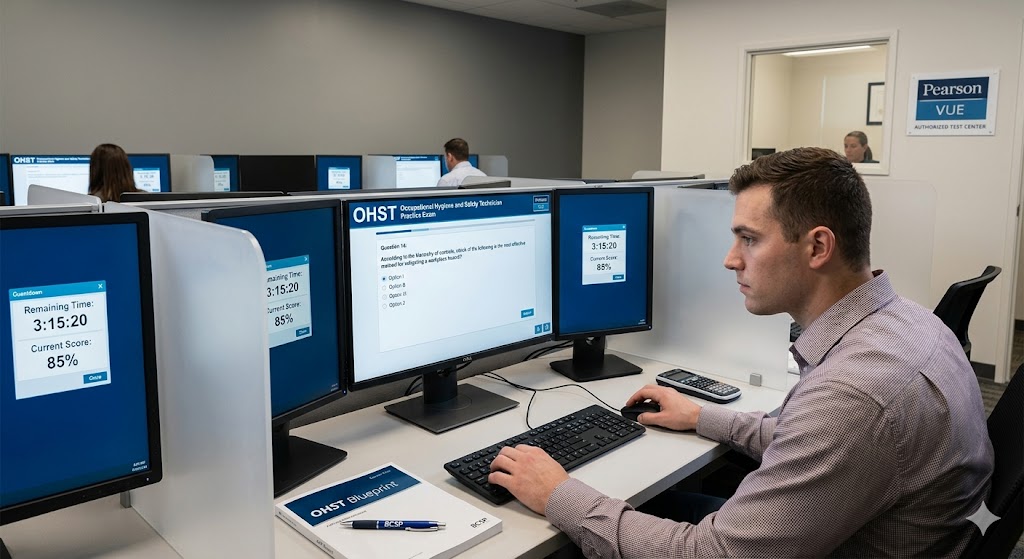
Additional Information
What the Course Entails and Exam Details
Preparing for the OHST involves mastering a broad and technical syllabus. While there is no mandatory "course" to take, the examination is based on a detailed blueprint consisting of seven critical domains of knowledge and skill.
Domain 1: Fundamental Math and Science and Business Calculations/Analysis (9.7%) This area covers basic math, statistics, chemistry, physics, and biology required for OHS calculations. It also includes business terminology, tracking performance metrics, and the economic aspects of losses.
Domain 2: Safety, Health, and Environmental Programs and Risk Management (18.3%) You will be tested on developing, implementing, and auditing various safety programs. Key topics include job hazard analysis, risk management concepts, auditing processes, and behavioral safety principles.
Domain 3: Hazard Identification and Control (31.4%) This is the largest portion of the exam, assessing your ability to identify workplace hazards (like electrical, energy source, or material handling) and apply the hierarchy of controls to mitigate risk. It also covers Personal Protective Equipment (PPE).
Domain 4: Health Hazards and Basic Industrial Hygiene (14.3%) Candidates must understand acute and chronic occupational exposures, sampling methods and equipment, ergonomics, biological hazards, noise control, and medical surveillance.
Domain 5: Emergency Preparedness, Fire Prevention, and Security (10.5%) This covers emergency response planning, fire dynamics and prevention methods, and basic security concepts within a facility.
Domain 6: Organizational Communication and Training/Education (8.4%) You need to know how to effectively communicate safety information and design, deliver, and evaluate technical training programs.
Domain 7: Ethics and Professional Conduct (7.4%) This domain focuses on adhering to the BCSP Code of Ethics and maintaining professional integrity in all workplace situations.
What to Expect in the Final Exam
The actual OHST examination is a demanding test of your practical application of safety principles.
Format: The exam consists of 200 multiple-choice questions. These questions are split between testing knowledge and evaluating skills, with some being based on specific workplace scenarios.
Time Limit: You will have 4 hours to complete the entire exam.
Administration: It is a closed-book, computer-based test, administered at authorized testing locations.
Scoring: BCSP does not publish a static passing score percentage. Instead, they use a scaled scoring method. Official results are provided to the candidate immediately after submitting the exam.
Candidate Eligibility: You must apply through the Board of Certified Safety Professionals (BCSP) and meet experience and education requirements before scheduling your test.
How to Study and Exam Centers
Preparation is key to succeeding on the OHST. Follow a structured approach:
How to Study
Start with the Blueprint: The BCSP OHST Examination Blueprint is your essential study guide. Use it to create a roadmap, prioritizing areas based on their percentage of the final score.
Self-Assessment: Take a pre-assessment or diagnostic test to identify your weakest areas. This allows you to allocate study time effectively.
Use Recommended Materials: Invest in comprehensive study guides or textbooks that specifically target the OHST syllabus. Many professionals use the BCSP’s own "examCORE" learning platform or study with reference manuals.
Practice, Practice, Practice: Work through as many practice questions as possible. This helps you get familiar with the wording of the questions and the types of calculations required.
Consider a Workshop: Many universities and private organizations (like ClickSafety or SPAN) offer 3-day immersive workshops (virtual or in-person) that are highly effective for review.
Exam Centers
The OHST exam is administered worldwide exclusively through Pearson VUE professional testing centers. These centers provide a secure, standardized environment. Once your application is approved by the BCSP and you have purchased your exam authorization, you will schedule your appointment directly with Pearson VUE through your BCSP portal, selecting the date and physical location that works best for you.
Job Opportunities from the Course
Earning the OHST certification unlocks diverse career paths in numerous industries. Here is a list of specific job titles and career paths this certification can enhance or help you obtain:
Occupational Hygiene and Safety Technician
EHS Specialist / EHS Technician
Industrial Hygiene Technician
Safety Officer
Site Safety Manager
Loss Control Specialist
Compliance Officer
Risk Management Technician
Safety Coordinator
Consultant, Occupational Health and Safety
Frequently Asked Questions
Reviews
5.0
Based on 0 reviews
Leave a Review
No reviews yet. Be the first to review!