
Oil Burners License Practice Test
$69.00
- Buy to unlock unlimited access to all Quiz questions and Answers in this Quiz.
- After purchase you can print a PDF of the whole quiz at any point. The PDF will contain the questions and the correct answers.
About this Exam
The Oil Burners License certification is a specialized credential designed for trades professionals who install, service, repair, and maintain oil-fired heating equipment.
This exam is primarily aimed at HVAC technicians, pipefitters, boiler mechanics, and facility maintenance personnel who want to legally and safely work with oil burners in residential, commercial, or industrial settings.
Earning this license proves your competence in handling combustible fuels, understanding electrical circuitry, and adhering to strict environmental and safety regulations.
It is a crucial stepping stone for anyone looking to advance their career in the heating and cooling industry.
Ready to test your knowledge?
Buy Now to Access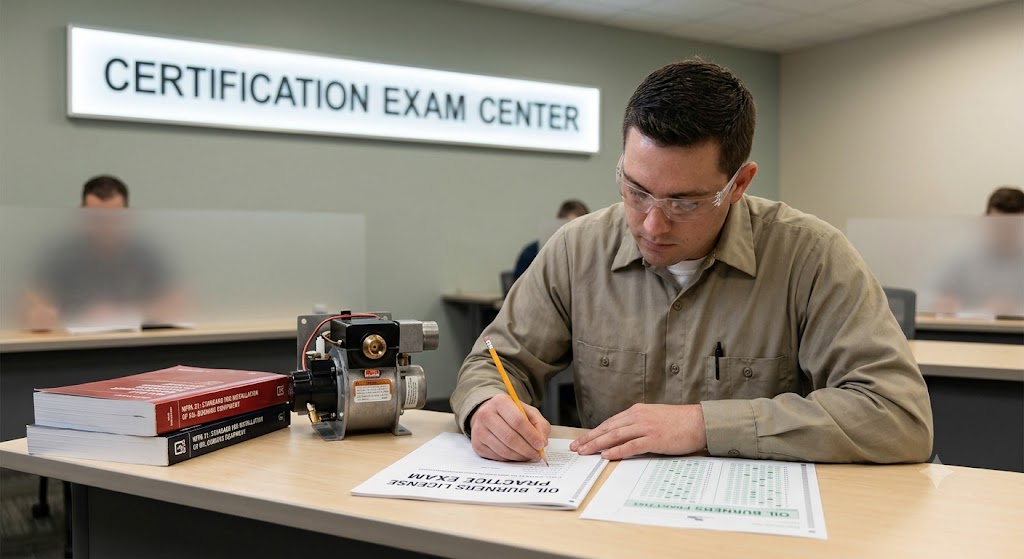
Additional Information
What the Course Entails and Exam Details
Preparing for the Oil Burner License requires a deep understanding of thermodynamics, mechanical systems, and safety codes.
The core syllabus generally covers the physical properties of fuel oil, including viscosity, flash points, and combustion chemistry.
Students will learn about the precise mechanics of oil burners, such as fuel pumps, atomizing nozzles, draft regulators, and ignition transformers.
The course material also dives heavily into electrical systems, focusing on primary controls, limit switches, and thermostats.
Furthermore, you will study state-specific safety codes, proper venting and chimney requirements, and environmental regulations regarding oil storage tanks and spill prevention.
What to Expect in the Final Exam
The final certification exam is typically a multiple-choice test consisting of 50 to 100 questions, depending on your specific state or municipal licensing board.
Candidates are generally given between two to three hours to complete the test.
The passing score requirement is rigorous, usually set at 70% or 75%, reflecting the high safety stakes associated with this line of work.
Depending on your jurisdiction, the exam may be "open book," allowing you to bring approved code books like the NFPA 31 (Standard for the Installation of Oil-Burning Equipment), or it may be strictly closed book.
You should expect situational questions that test your ability to troubleshoot electrical failures, diagnose poor combustion, and apply safety codes to real-world scenarios.
How to Study and Exam Centers
Success on the Oil Burners License exam comes down to consistent, targeted practice and hands-on familiarity with the equipment.
Begin by reading your local and national code books thoroughly, highlighting key clearances, pipe sizes, and safety limits.
Taking full-length, timed practice exams is highly recommended, as it builds your test-taking stamina and helps you identify areas where your knowledge is weak.
Create flashcards for essential formulas, wiring diagrams, and safety threshold numbers.
When you are ready to test, exams are typically administered by authorized third-party testing organizations such as Pearson VUE or Prometric.
Alternatively, in some regions, the exam is hosted directly at the state’s Department of Public Safety or a local authorized trade school. You will need to apply through your local licensing board to receive an authorization to test before booking your seat at a physical testing center.
Job Opportunities from the Course
Earning your Oil Burners License opens the door to a highly stable and lucrative segment of the skilled trades. Here are some of the specialized career paths this certification unlocks:
Licensed Oil Burner Technician
HVAC/R Service Mechanic
Boiler Operator and Installer
Heating System Inspector
Commercial Facilities Maintenance Technician
Fuel Delivery and Service Specialist
Mechanical Code Inspector (Municipal/State Level)
Frequently Asked Questions
Reviews
5.0
Based on 0 reviews
Leave a Review
No reviews yet. Be the first to review!