
Okinawa Status of Forces Agreement (SOFA) License Practice Test
$69.00
- Buy to unlock unlimited access to all Quiz questions and Answers in this Quiz.
- After purchase you can print a PDF of the whole quiz at any point. The PDF will contain the questions and the correct answers.
About this Exam
The Okinawa Status of Forces Agreement (SOFA) driving license is a mandatory requirement for United States military personnel, Department of Defense civilian employees, contractors, and their dependents stationed in Okinawa, Japan.
This certification grants individuals the legal authority to operate privately owned vehicles (POVs) and, in some cases, government-owned vehicles (GOVs) on Japanese roadways.
Because driving in Japan presents unique challenges—such as driving on the left side of the road, understanding kanji-based road signs, and adhering to incredibly strict local traffic laws—this exam ensures that all SOFA personnel are fully equipped to drive safely and respectfully.
Preparing with an Okinawa SOFA License practice test is highly encouraged to help newcomers acclimate quickly and pass their required licensing exam on the very first try.
Ready to test your knowledge?
Buy Now to Access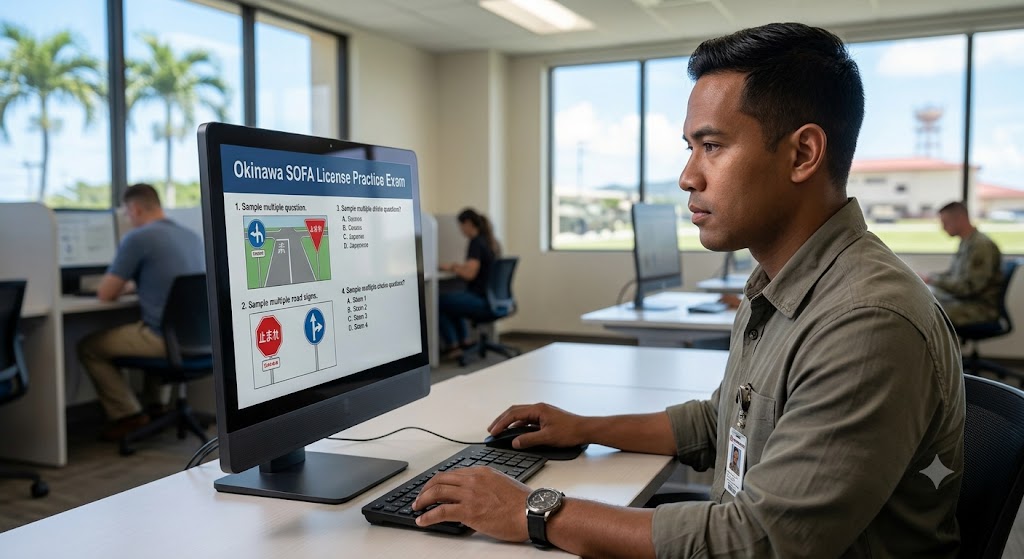
Additional Information
What the Course Entails and Exam Details
The SOFA driving orientation and licensing course focuses heavily on the distinct differences between driving in the United States and driving in Japan.
A major portion of the syllabus is dedicated to Japanese road signs, many of which use distinct shapes and colors that are entirely different from standard American signage.
You will dive deep into right-of-way rules, understanding pedestrian precedence, and the strict protocols for navigating intersections and narrow off-base roads.
The curriculum also covers critical administrative knowledge, such as the Japanese Compulsory Insurance (JCI) system, vehicle registration processes, and annual road tax requirements.
Furthermore, the course emphasizes Japanese traffic laws regarding alcohol—which enforces a strict zero-tolerance policy—as well as the exact legal steps to take in the event of a traffic collision.
What to Expect in the Final Exam
The final examination is designed to test your practical knowledge of the local driving environment and is typically administered as a multiple-choice written test.
Test-takers should expect a strict assessment divided into two main categories: road sign identification and general traffic rules.
While the exact passing threshold can vary slightly depending on your specific military installation, you generally need an 80% to 85% overall score to pass, with an even higher accuracy requirement for the road sign identification section.
The exam is usually timed, giving you ample but bounded time (often 45 to 60 minutes) to complete all questions.
You must take the exam seriously, as failing often requires a mandatory waiting period before you are allowed to attempt a retest.
How to Study and Exam Centers
The key to acing your SOFA driving exam is to thoroughly review the specific driving manual provided by your installation, such as the USFJ Form 4 or base-specific driver's handbooks distributed during your welcome orientation.
Actionable study strategies include using online practice portals to drill Japanese road signs using flashcards and taking timed, simulated practice exams.
Many successful candidates recommend grouping road signs by shape and color to make memorization easier.
The actual examination is an in-person, proctored event administered directly on the military installation.
You will typically take the exam at your base's Pass and Registration office, Base Safety Office, or during your mandatory Newcomers' Orientation briefing (such as at Kadena Air Base or Camp Foster).
Ensure you bring all required documentation, including your orders, military ID, and stateside driver's license, to the testing center.
Job Opportunities from the Course
While the SOFA license is primarily a fundamental requirement for personal mobility and daily living in Okinawa, it is also a vital prerequisite for numerous career paths for both military members and civilians.
Securing this license unlocks opportunities for Base Delivery and Logistics Drivers, who transport essential goods between different camps and installations across the island.
It is also crucial for Military Transport Operators and Motor Transport personnel who need to navigate heavy military vehicles on public Japanese roads.
For DOD civilians and dependents, holding a valid SOFA license is often a baseline requirement for roles such as Field Service Technicians, Real Estate Housing Inspectors, and Off-Base School Bus Drivers.
Additionally, Defense Contractors who perform on-site maintenance or consulting across various installations will find that holding this license is absolutely necessary to fulfill their daily job duties efficiently.
Frequently Asked Questions
Reviews
5.0
Based on 0 reviews
Leave a Review
No reviews yet. Be the first to review!