
Oklahoma Coronal Polishing State Practice Exam
$69.00
- Buy to unlock unlimited access to all Quiz questions and Answers in this Quiz.
- After purchase you can print a PDF of the whole quiz at any point. The PDF will contain the questions and the correct answers.
About this Exam
The Oklahoma Coronal Polishing State Certification is an expanded function permit designed for dental assistants. This certification is crucial for those seeking to enhance their skills and expand their career within a dental practice. It legalizes the procedure of coronal polishing, which is the removal of plaque and extrinsic stains from the clinical crown of the teeth. It is specifically designed for dental assistants who are registered in the state of Oklahoma and wish to advance their professional capabilities and fulfill the legal requirements set by the Oklahoma Board of Dentistry.
Ready to test your knowledge?
Buy Now to Access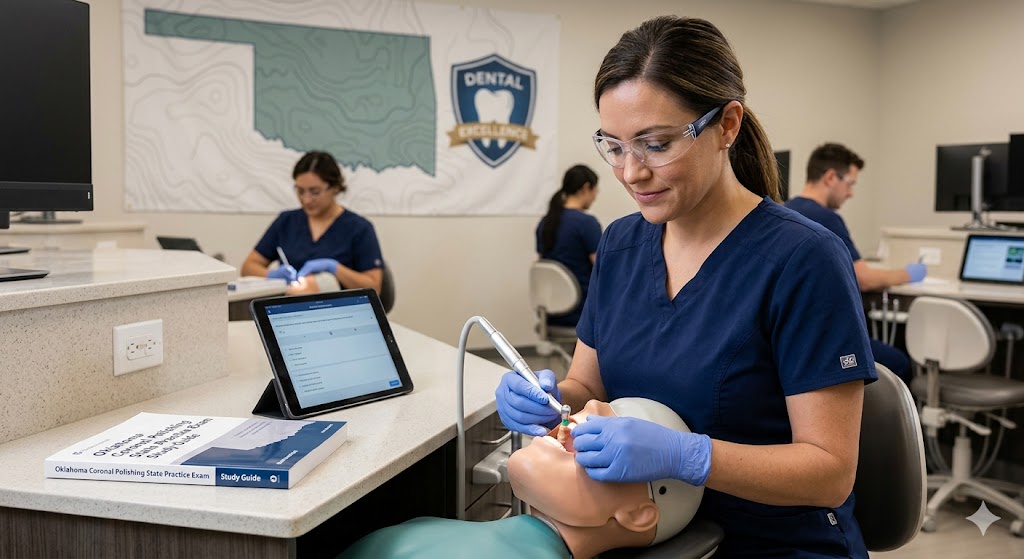
Additional Information
What the Course Entails and Exam Details
The certification requires completion of a state-approved course, often consisting of 14 hours of combined didactic and clinical training. The curriculum covers a wide range of essential topics, including:
The properties and formation of plaque, calculus, and dental stains (intrinsic vs. extrinsic).
Detailed tooth anatomy and oral morphology, specifically concerning coronal polishing.
The characteristics and indicators of healthy gingival tissue.
Various polishing agents, their abrasiveness, and indications and contraindications for use.
The full coronal polishing procedure: armamentarium, tray set-up, equipment care, and technique (handpiece speed, fulcrum use, and patient positioning).
Rigorous infection control protocols.
Patient management, health histories, and handling medically compromised patients.
Patient education regarding oral hygiene.
What to Expect in the Final Exam
The final exam is a written review of the core knowledge acquired. Students should expect:
Format: The exam typically features multiple-choice and true/false questions. It assesses the candidate's understanding of theory, safety, and correct procedure.
Passing Score: While specific percentage requirements can vary by course provider, students are generally expected to pass with a score that demonstrates competency, often in the range of 70-75% or a "Pass" designation.
Time Limit: The duration for the final exam varies but is designed to allow students adequate time to complete the multiple-choice assessment. It is not an excessively long exam but requires a systematic approach.
Rules: The exam focuses on legalities, such as understanding what procedures are legal for dental assistants versus hygienists, the direct supervision required by a dentist, and adherence to infection control.
How to Study and Exam Centers
How to Study
Success on the Oklahoma Coronal Polishing State Exam relies on both academic review and practical skill. Follow these strategies:
Review Course Materials: Go over textbooks, lecture notes, and provided handouts from your state-approved course. Focus on stain classification, contraindications, and anatomical landmarks.
Engage in Practice: Practice the technique on a manikin or classmate under instructor supervision. Perfect your fulcrum and handpiece control.
Form Study Groups: Collaborating with peers allows you to quiz each other and discuss tricky topics like patient scenarios and emergency procedures.
Take Mock Exams: Utilize practice exams or flashcards to familiarize yourself with the question types and formatting. This is one of the most effective ways to identify weak areas.
Exam Centers
The written exam component is typically proctored in person, following the completion of your clinical course. For specific information about exam centers and online portals, consider the following options:
Authorized Training Schools: The exam is often administered at the CODA-accredited or Oklahoma Board-approved schools and technology centers where you complete the coronal polishing course.
Authorized Proctoring Locations: Testing centers at various universities and colleges throughout Oklahoma, such as Rose State College or Oklahoma State University (OKC), may offer proctoring services for expanded function exams. Always confirm with your course provider and the testing site for scheduling and required proctoring fees.
Job Opportunities from the Course
Obtaining the Coronal Polishing Expanded Function Permit in Oklahoma can significantly boost your career within a dental office. Here is a list of job titles and paths that this certification unlocks or enhances:
Expanded Duty Dental Assistant (EDDA)
Dental Assistant with Coronal Polishing Permit
Lead Dental Assistant
Clinical Dental Assistant in a General Dentistry Practice
Specialty Dental Assistant (in Orthodontics or Pedodontics, where polishing is frequently performed)
Frequently Asked Questions
Reviews
5.0
Based on 0 reviews
Leave a Review
No reviews yet. Be the first to review!