
Oklahoma Security Guard Practice Exam
$69.00
- Buy to unlock unlimited access to all Quiz questions and Answers in this Quiz.
- After purchase you can print a PDF of the whole quiz at any point. The PDF will contain the questions and the correct answers.
About this Exam
Take the next step in your public safety career by mastering the foundational knowledge required for licensure in Oklahoma. The Oklahoma Security Guard practice exam is designed specifically for individuals aspiring to become licensed unarmed security officers.
This examination serves as the critical final step after completing the mandatory state-approved training curriculum. It verifies that you understand the legal boundaries, standard operating procedures, and safety protocols necessary to protect people and property within the state of Oklahoma. This comprehensive practice tool is tailored to help you build confidence and ensure first-time success on the official Council on Law Enforcement Education and Training (CLEET) certification exam.
Ready to test your knowledge?
Buy Now to Access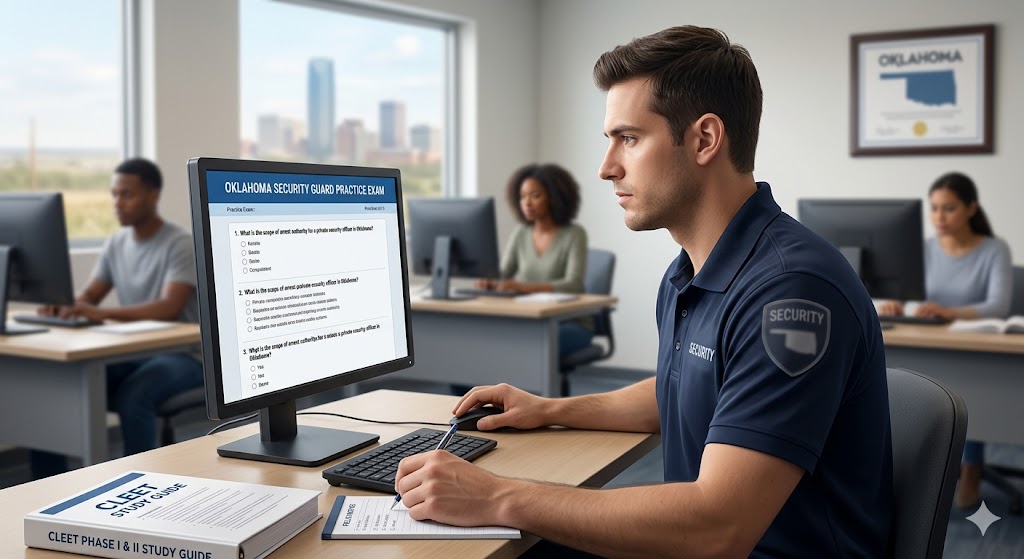
Additional Information
What the Course Entails and Exam Details
The formal Oklahoma training course for unarmed security guards is segmented into key "Phases" as defined by CLEET regulations. The final exam assesses your proficiency across these core competencies.
To be eligible for licensure, candidates must complete Phase I (Foundational Training) and Phase II (Advanced Training).
The examination covers several critical domains of knowledge, including:
Legal Powers and Limitations: Understanding arrest authority, the difference between public and private policing, liability issues, and constitutional rights.
Patrol Procedures: Techniques for effective observation, reporting, access control, and identifying security risks.
Emergency Responsibilities: Protocols for fire safety, disaster response, first aid overview, and interacting with emergency services.
Communication: Mastery of field note-taking, report writing, and effective verbal skills for de-escalation.
Public and Client Relations: Understanding ethical behavior, professionalism, and the role of service in security work.
What to Expect in the Final Exam
The final CLEET certification examination is a standardized test designed to measure your retention of the Phase I and II material.
Knowing what to expect will help reduce anxiety on test day.
Exam Format: The exam generally consists of multiple-choice questions. These are designed to present realistic scenarios you might encounter while on duty, requiring you to apply your legal and procedural knowledge.
Passing Score: To earn your certification, you must achieve a passing score, typically 70% or higher, depending on the specific authorized training facility or CareerTech administering the test.
Time Limits: Candidates are usually provided a set amount of time to complete the test, often between 60 to 90 minutes. This provides ample time if you have studied thoroughly.
Restrictions: This is a closed-book examination. No study materials, smartphones, or outside assistance are permitted during the testing session.
How to Study and Exam Centers
To succeed on the Oklahoma Security Guard exam, active preparation is essential. The most effective strategy is to review your course training manuals diligently.
Pay close attention to the Oklahoma-specific legal definitions and boundaries. Utilizing our practice exam multiple times will help you become familiar with the phrasing of questions and identify any areas where your knowledge is weak.
It is highly recommended that you take several timed practice tests to manage your pacing before the official session.
Where to Take the Official Exam: Licensure testing is not conducted in random locations. You must take the official examination through an authorized entity. These include:
Oklahoma Career Technology Centers (CareerTech): These public institutions are the primary hubs for administering the CLEET private security exams.
Authorized Private Security Schools: Some private training facilities are authorized by CLEET to conduct both the training and the final certification testing.
CLEET Headquarter: In some limited cases, or for specific circumstances, testing may be available at the main CLEET facility.
Always verify testing availability and schedule a session in advance with your chosen authorized testing center.
Job Opportunities from the Course
Earning your Oklahoma Security Guard license opens the door to a stable and growing career field.
This certification is required for nearly all professional security roles in the state. Graduates from this course can pursue diverse career paths, including:
Unarmed Security Officer
Corporate Security Attendant
Loss Prevention Specialist
Access Control Monitor
Event Security Staff
Residential Security Patrol
Mobile Patrol Officer
Frequently Asked Questions
Reviews
5.0
Based on 0 reviews
Leave a Review
No reviews yet. Be the first to review!