
Oleoresin Capsicum (OC) Spray Practice Test
$69.00
- Buy to unlock unlimited access to all Quiz questions and Answers in this Quiz.
- After purchase you can print a PDF of the whole quiz at any point. The PDF will contain the questions and the correct answers.
About this Exam
The Oleoresin Capsicum (OC) Spray Certification, commonly known as Pepper Spray Certification, is a specialized training program designed to teach individuals how to safely and effectively use less-lethal chemical agents. This certification is primarily intended for security guards, law enforcement officers, bodyguards, loss prevention professionals, and any personnel who may be required to utilize a force option below lethal levels to control a situation or defend themselves. It provides a formal validation that an individual understands the physical effects, legal parameters, and tactical deployment of OC spray. This practice test is crafted to help you prepare for the official examination by testing your knowledge of both theoretical concepts and practical procedures.
Ready to test your knowledge?
Buy Now to Access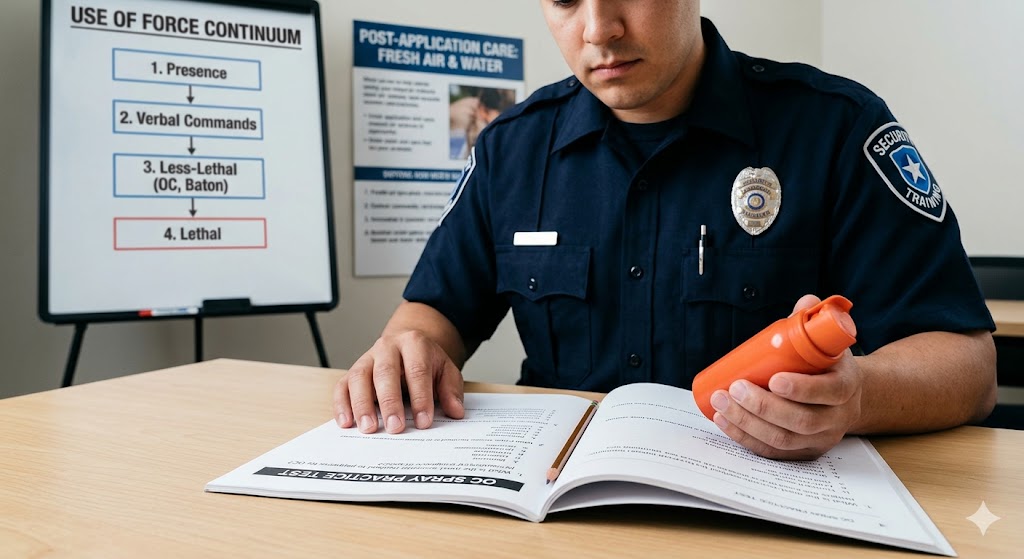
Additional Information
What the Course Entails and Exam Details
A comprehensive OC spray training course covers a wide range of essential topics. Key areas include the physiological effects of OC on the eyes, respiratory system, and skin, understanding the different delivery systems (stream, fog, cone, gel, and foam), their effective ranges (typically up to 15 feet), and tactical considerations like wind and cross-contamination.
The examination details are structured to test your knowledge thoroughly. The course usually has a short duration, such as four hours, and is valid for a limited time, often requiring recertification after one year.
What to Expect in the Final Exam
You should expect the final exam to consist of a combination of a written, multiple-choice test and a practical assessment. The written portion, for which this is a practice test, will assess your memory and understanding of:
Nomenclature: Terms like Scoville Heat Units, capsaicinoid content, and inert training sprays.
Physiological Effects: The temporary duration and typical effects of OC on an exposed individual.
Legal Rules: The 'use-of-force' continuum and when OC deployment is justified, including proper reporting.
Deployment Tactics: Aiming strategies, burst durations, and maneuvering after application.
Medical & Post-Care: Decontamination procedures using fresh air and water, first aid, and managing high-risk subjects.
The practical component is a critical part of the final exam, where you may be required to:
Demonstrate proper handling and drawing of an OC canister.
Execute effective tactical movement and verbal commands while simulating deployment.
Complete a contamination drill to experience the effects firsthand and continue with an activity, such as a retention or defensive exercise.
How to Study and Exam Centers
Effective study requires a hands-on and academic approach.
Utilize Practice Tests: Use resources like this one to identify gaps in your knowledge and get comfortable with the written format.
Use Study Guides & Flashcards: Focus on key terms, tactical ranges, legal definitions, and decontamination procedures.
Practice with Inert Sprays: The best way to learn the physical handling and tactical application is to use water-filled inert training canisters under supervision, practicing draws, aims, and moving in different scenarios.
Official OC spray certification exams are held at authorized security training schools, law enforcement academies, or other accredited safety institutions. Some courses offer the written portion through an online portal, but the crucial practical assessment and contamination drill almost always require in-person attendance at a specific physical testing center.
Job Opportunities from the Course
A valid OC Spray Certification opens doors to several specialized career paths in safety and security, such as:
Security Officer (Armed and Unarmed)
Loss Prevention Agent
Bylaw or Compliance Officer
Law Enforcement Officer
Bodyguard or Executive Protection Specialist
Private Investigator
Sales Representative (Security Products)
Quality Control Inspector (in manufacturing)
Safety Instructor (specifically for less-lethal devices)
Frequently Asked Questions
Reviews
5.0
Based on 0 reviews
Leave a Review
No reviews yet. Be the first to review!