
OLETS CJIS NCIC Practice Exam
$69.00
- Buy to unlock unlimited access to all Quiz questions and Answers in this Quiz.
- After purchase you can print a PDF of the whole quiz at any point. The PDF will contain the questions and the correct answers.
About this Exam
The OLETS CJIS National Crime Information Center (NCIC) exam is a mandatory certification for law enforcement and criminal justice professionals in Oklahoma who require access to sensitive criminal justice databases. It signifies that an individual has mastered the essential knowledge and practical skills to use the Oklahoma Law Enforcement Telecommunications System (OLETS) effectively, ethically, and in full compliance with state and federal regulations. This certification is crucial for those tasked with ensuring public safety and maintaining the integrity of crucial justice data, which flows from state systems to the National Crime Information Center (NCIC) and beyond. The primary audience includes police officers, sheriff’s deputies, dispatchers, court personnel, and state investigators.
Ready to test your knowledge?
Buy Now to Access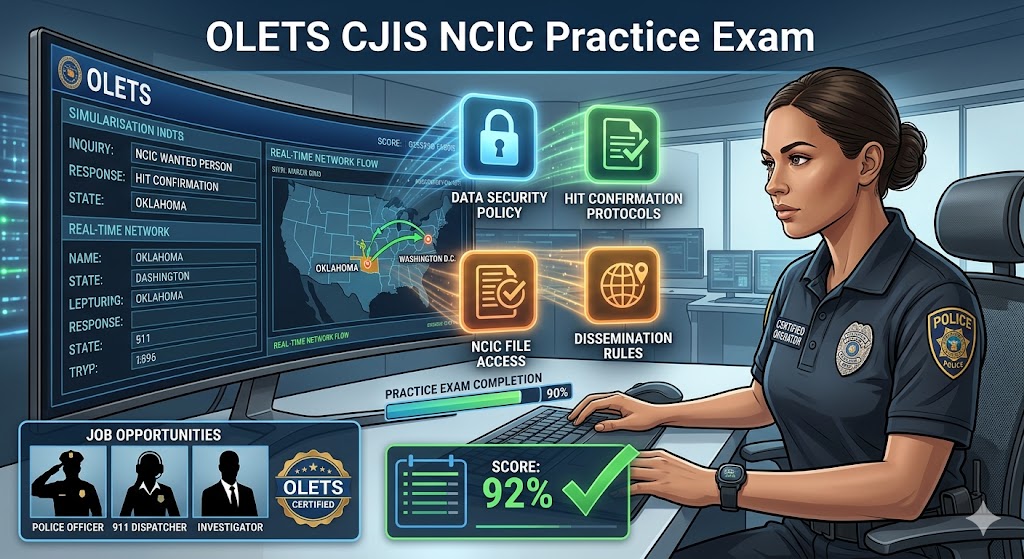
Additional Information
What the Course Entails and Exam Details
This comprehensive course, leading to the OLETS CJIS NCIC certification, covers a wide range of critical operational and security topics, designed to create a unified and efficient information sharing network. Participants will delve into the legal and ethical framework for data access, beginning with Oklahoma State Statutes and CJIS Security Policy. A significant portion of the course focuses on the precise use of OLETS and NLETS (International Justice and Public Safety Network) terminals, teaching correct "mask" codes for diverse inquires. The core curriculum involves understanding entry and inquiry procedures for the various NCIC files, including the Wanted Person File, Missing Person File, Protection Order File, Stolen Vehicle and Boat Files, and Article File. Furthermore, the course emphasizes the interpretation of complex "hits" (positive responses) and the imperative requirement of "hit confirmation" with the entering agency before taking action. Other key modules include proper dissemination and disposal of criminal history record information (CHRI), the use of "purpose codes" to justify inquiries, and robust terminal security practices to prevent unauthorized access.
What to Expect in the Final Exam
The final exam is a rigorous assessment, typically taken via a secure, designated state portal within a law enforcement environment, which can be an open-terminal or closed-book scenario depending on agency policy. It consists primarily of multiple-choice, true/false, and scenario-based reasoning questions, meticulously designed to evaluate not only rote memorization but also practical application of rules. Candidates must demonstrate they can accurately determine if a "hit" provides probable cause, perform a correct vehicle registration inquiry using varying data sets (license plate or VIN), and properly apply "purpose codes" for a standard criminal history check or a housing-related request. A pass/fail scoring method is typically used, with a high passing threshold, often 80% or above, reflecting the critical nature of the system. Failure often necessitates immediate retraining and a re-examination period. The actual time limit can vary by state agency but is structured to reflect realistic operational conditions, ensuring candidates can both think quickly and make correct decisions.
How to Study and Exam Centers
Preparation for the OLETS CJIS NCIC exam requires a multifaceted approach, blending careful study of official materials with hands-on practice. The definitive resource is the official OLETS/NCIC User Manual, which candidates must thoroughly review, taking detailed notes on all policies, codes, and procedures. Creating a personalized study guide, with a particular focus on inquiry "masks," purpose codes, and flowcharts for "hit confirmation," is highly effective. Flashcards are also an excellent tool for memorizing the numerous abbreviations, codes, and exact data field requirements. For active personnel, reviewing real-world, agency-specific OLETS terminal transaction logs and comparing them with policy can provide invaluable context. Practice with an authorized mentor or a designated terminal operator is strongly encouraged. While there are no "external" physical test centers like Pearson VUE, the certification exam is exclusively administered through the Oklahoma Department of Public Safety's authorized systems. Candidates must contact their Terminal Agency Coordinator (TAC) to arrange testing, which is completed on-site within their employing agency or, occasionally, at designated state-run law enforcement training academies.
Job Opportunities from the Course
A current OLETS CJIS NCIC certification is an indispensable prerequisite, opening doors to various challenging and high-demand roles within the law enforcement and criminal justice fields. The career paths unlocked by this certification include:
Police Officer
Sheriff's Deputy
911 Dispatcher / Public Safety Telecommunicator
Criminal Justice Records Clerk / Technician
Terminal Agency Coordinator (TAC)
Court Clerk / Court Services Officer
State Investigator / Detective
Highway Patrol Trooper
Federal Law Enforcement Support Staff (within Oklahoma)
Security Manager for CJIS-Compliant Facilities
Frequently Asked Questions
Reviews
5.0
Based on 0 reviews
Leave a Review
No reviews yet. Be the first to review!