
On-Site Sewage Facilities (OSSF) – Installer I Practice Exam
$69.00
- Buy to unlock unlimited access to all Quiz questions and Answers in this Quiz.
- After purchase you can print a PDF of the whole quiz at any point. The PDF will contain the questions and the correct answers.
About this Exam
The On-Site Sewage Facilities (OSSF) – Installer I certification is a foundational credential for individuals entering the specialized field of wastewater management and septic system installation.
This certification, often mandated and regulated by state or environmental agencies, ensures that professionals possess the essential knowledge and skills to correctly install, construct, alter, repair, and extend standard on-site sewage facilities.
It is designed primarily for entry-level installers, construction laborers, and individuals seeking to establish a career in a critical industry dedicated to protecting public health and the environment.
Ready to test your knowledge?
Buy Now to Access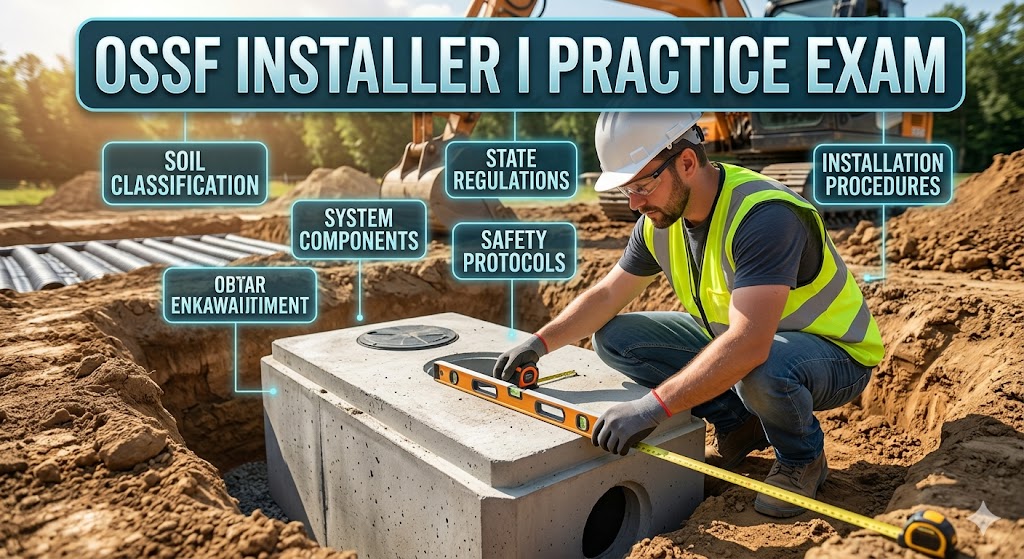
Additional Information
What the Course Entails and Exam Details
This comprehensive course, typically a prerequisite for the OSSF Installer I exam, covers the core principles, technical requirements, and regulatory framework governing the proper design and installation of on-site sewage systems.
Participants can expect to dive deep into topics such as standard system components (tanks, drain fields, treatment units), soil classification and site evaluation basics, proper construction techniques, reading and interpreting site plans, and, most importantly, the relevant state rules, regulations, and safety standards for wastewater systems.
The course aims to equip students with a practical understanding of how to execute OSSF projects safely, legally, and in a way that prevents environmental contamination.
What to Expect in the Final Exam
The final step in achieving your OSSF Installer I license is successfully passing a comprehensive exam.
Typically, this is a closed-book examination administered by a state agency or authorized testing organization. The format is predominantly multiple-choice and true/false, testing a candidate's recall and application of knowledge.
The exam often comprises around 50-100 questions, and individuals are usually allotted a specific time limit, such as 2 to 3 hours, to complete it.
Passing score requirements can vary, but generally, a score of 70% or higher is necessary. The exam content is directly aligned with the topics covered in the authorized training course, making thorough preparation vital for success.
How to Study and Exam Centers
Effective preparation for the OSSF Installer I exam requires a strategic approach. It is highly recommended to actively participate in all training sessions and rigorously study all provided course materials, including textbooks, manuals, and regulatory guidelines.
Taking numerous practice exams, using tools like this OSSF Installer I Practice Exam, is invaluable for familiarizing yourself with the question types and formatting, and identifying areas where additional study is needed. Focus on understanding the why behind the rules and techniques.
Exam centers vary by jurisdiction. They can include state agency offices, local community colleges, vocational schools, and, in some cases, private testing providers with specific, authorized physical centers. Candidates should always consult their state's environmental or licensing department to find official, current information on exam locations, scheduling, and prerequisites.
Job Opportunities from the Course
Earning an OSSF Installer I certification unlocks clear career paths and diverse job opportunities within the essential services sector. This credential demonstrates professional competence and is often a required or highly preferred qualification for roles such as:
Licensed Septic System Installer: Operating within a team to construct and install various on-site sewage facilities.
On-Site Sewage Facility (OSSF) Technician: Assisting with the installation, modification, and basic maintenance of wastewater systems.
Wastewater System Construction Laborer: Specializing in the physical work involved in septic and drainage field preparation and installation.
Utility Construction Crew Member: Working for general or utility-specific contractors on residential and small-scale wastewater projects.
Small Business Owner/Operator: Establishing and running a licensed septic system installation business, subject to other business requirements.
Frequently Asked Questions
Reviews
5.0
Based on 0 reviews
Leave a Review
No reviews yet. Be the first to review!