
Ontario Early Childhood Educator Practice Exam
$69.00
- Buy to unlock unlimited access to all Quiz questions and Answers in this Quiz.
- After purchase you can print a PDF of the whole quiz at any point. The PDF will contain the questions and the correct answers.
About this Exam
The Ontario ECE Practice Exam is a comprehensive study tool designed to help aspiring early childhood educators in Ontario prepare for the cumulative evaluations within an approved Early Childhood Education (ECE) diploma program. In Ontario, becoming a Registered Early Childhood Educator (RECE) is a multi-step process that involves successful graduation from a recognized post-secondary program and subsequent registration with the College of Early Childhood Educators (CECE). This practice exam mimics the core content and format of the final, summative exams you will encounter at the end of your semesters or program, ensuring you are equipped with the knowledge and confidence to succeed and launch your career. It is specifically designed for students currently enrolled in, or preparing to enter, an Ontario College ECE diploma program.
Ready to test your knowledge?
Buy Now to Access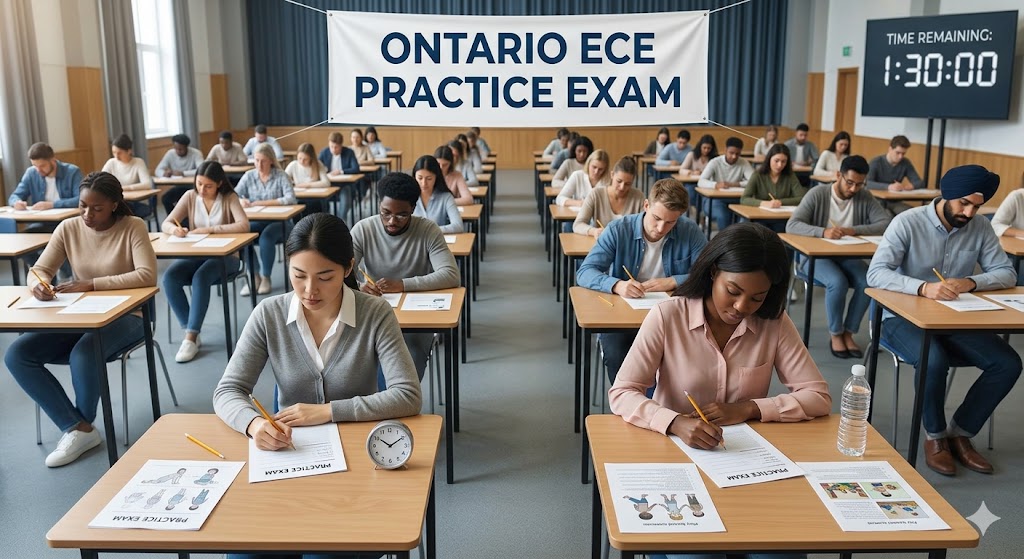
Additional Information
What the Course Entails and Exam Details
The core knowledge covered in a typical Ontario ECE program is vast and interdisciplinary. The Ontario ECE Practice Exam consolidates this material into key domains that align with the CECE Code of Ethics and Standards of Practice, as well as provincial pedagogical frameworks like "How Does Learning Happen?".
The key areas you must master include:
Child Development: In-depth knowledge of physical, cognitive, social, and emotional development from birth to age 12, including major theoretical perspectives.
Health, Safety, and Nutrition: Regulations, policies, and best practices for creating safe learning environments, recognizing child abuse, and promoting healthy child development.
Curriculum Planning and Implementation: Designing, facilitating, and assessing play-based, inquiry-driven, and child-centered curricula.
Professionalism and Ethics: Understanding the roles, responsibilities, and legal obligations of an ECE as defined by the CECE, including ethical decision-making.
Partnerships with Families and Communities: Strategies for building collaborative and respectful relationships with diverse families and community agencies.
Observation and Documentation: Mastering various techniques to observe children and document their learning to inform pedagogical practice.
Diversity and Inclusion: Creating equitable and accessible learning opportunities for all children, respecting diverse social, cultural, and linguistic worldviews, including Indigenous perspectives.
What to Expect in the Final Exam
While the exact format of the final cumulative exams is determined by each individual Ontario College, they typically aim to assess a student’s ability to synthesize and apply knowledge from the entire program.
You should prepare for a combination of the following final assessment formats:
Format: The final "exam" experience is often a series of assessments, including:
Comprehensive Multiple-Choice Exams
Short and Long-Answer Written Exams
Case Study Analyses
Final Practical Placement (Practicum) Evaluations
Time Limit: Comprehensive written final exams at the college level can range from 2 to 4 hours per session.
Passing Score: Most Ontario College programs require a minimum grade of 50% to 60% on individual final exams, alongside a "Pass" grade on all practical placements, to graduate.
Rules: Standard academic integrity rules apply, including bans on external materials and devices. Practical evaluations involve direct observation and grading by a placement supervisor and a college faculty member.
How to Study and Exam Centers
Preparing for the cumulative evaluations of an ECE program requires a sustained and structured approach. The Ontario ECE Practice Exam is a powerful tool in this process.
Actionable Study Strategies:
Use Official College Resources: Your primary study materials are your course outlines, textbooks, and class notes. Review all key concepts systematically.
Take the Practice Exam Repeatedly: Use the Ontario ECE Practice Exam to identify knowledge gaps. Simulating the exam environment will improve your speed and endurance.
Create Study Groups: Collaborating with peers is highly effective for discussing complex case studies and clarifying ethical dilemmas.
Practice Case Studies: Focus heavily on applying theoretical knowledge to real-world scenarios. Many final exam questions involve problem-solving within an early years setting.
Review Practical Experience: Reflect on your practicum placements. How did you apply classroom theory in action? This will be crucial for your final practical evaluations.
Exam Centers:
Because the formal final exams are part of your specific college program, the "exam centers" are the physical campuses or verified online proctoring platforms of the Ontario College where you are enrolled (e.g., Seneca, Humber, George Brown, Fanshawe, Collège Boréal, etc.). You must register for your final exams through your college’s registrar office.
Job Opportunities from the Course
Graduating from an Ontario ECE diploma program and registering with the College of Early Childhood Educators unlocks a wealth of diverse and fulfilling career opportunities in the Early Years sector.
Your RECE designation allows you to pursue job titles such as:
Registered Early Childhood Educator (RECE) in licensed Child Care Centres
Full-Day Kindergarten RECE (Partnering with a Certified Teacher in Ontario schools)
EarlyON Child and Family Centre Facilitator
Licensed Home Child Care Agency Visitor/Supervisor
Registered Early Childhood Educator in Nursery Schools
Child Care Centre Supervisor or Director (with experience)
Special Needs Resource Consultant in the early years sector
Registered Early Childhood Educator in Family Support Programs
Early Childhood Educator in before-and-after school programs
Consultant or Policy Analyst in early learning (with further education)
Frequently Asked Questions
Reviews
5.0
Based on 0 reviews
Leave a Review
No reviews yet. Be the first to review!