
Ontario Grade 11 University Biology Practice Text
$69.00
- Buy to unlock unlimited access to all Quiz questions and Answers in this Quiz.
- After purchase you can print a PDF of the whole quiz at any point. The PDF will contain the questions and the correct answers.
About this Exam
The SBI3U (Grade 11 University Preparation Biology) course is designed for students aiming for post-secondary education in health sciences, biology, biotechnology, or environmental fields. It delves into the complex systems governing living organisms. This comprehensive practice exam serves as a crucial tool for students across Ontario, allowing them to assess their understanding of key concepts, identify knowledge gaps, and build the confidence necessary to excel in their final curriculum-based assessment.
Ready to test your knowledge?
Buy Now to Access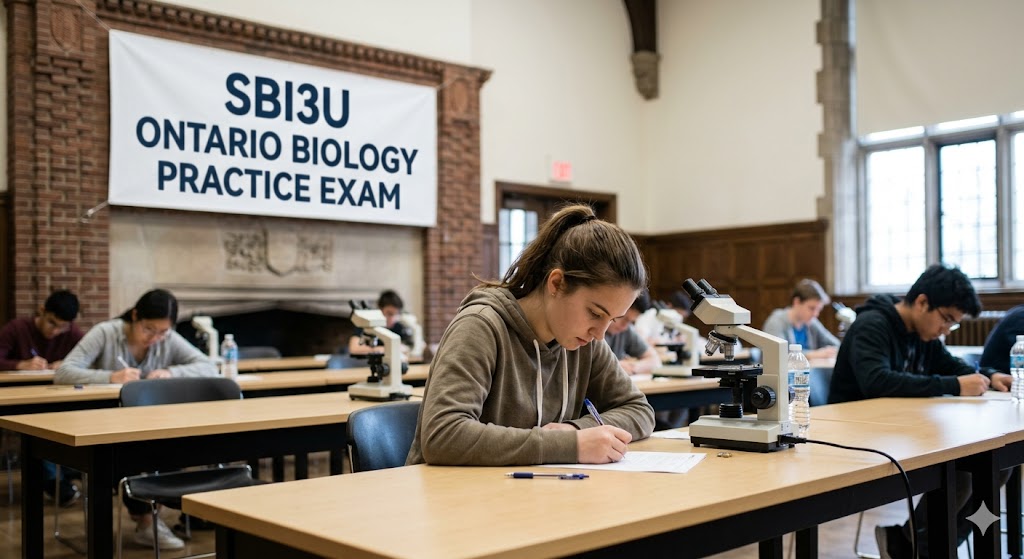
Additional Information
What the Course Entails and Exam Details
This rigorous university preparation course explores major biological systems across five core units. Students must demonstrate deep understanding, application skills, and the ability to relate science to technology, society, and the environment.
Diversity of Living Things: Classification systems, taxonomy, and exploring the six kingdoms of life.
Evolution: Mechanisms of change, natural selection, and evidence supporting evolutionary theory.
Genetic Processes: Meiosis, Mendelian genetics, DNA structure, and complex inheritance patterns.
Animals: Structure and Function: The respiratory, circulatory, and digestive systems in both humans and representative organisms.
Plants: Anatomy, Growth, and Function: Plant tissues, transport mechanisms, and factors affecting growth.
What to Expect in the Final Exam
While individual schools in Ontario administer their own final exams, they must adhere to the standardized SBI3U curriculum guidelines. Here is what students can typically expect:
Format: The exam usually combines multiple-choice, true/false, diagram labeling, short answer, and long-form application/inquiry questions.
Duration: Exams typically run between 2 and 3 hours.
Passing Score: A minimum grade of 50% in the course is generally required to earn the Grade 11 University Biology credit.
Weight: The final exam usually accounts for 20% to 30% of the overall course grade.
Focus: Expect a heavy emphasis on understanding definitions, analyzing processes (e.g., cell division, genetics problems), and explaining relationships between structure and function in animals and plants.
How to Study and Exam Centers
Effective preparation for the SBI3U exam requires consistent effort and active learning strategies.
Actionable Study Strategies:
Master the Vocabulary: Create flashcards for key terms across all five units. Biology is heavy on terminology.
Practice Genetics Problems: Dedicate significant time to solving various Punnett square scenarios (monohybrid, dihybrid, incomplete dominance, sex-linked traits).
Review Diagrams and Lab Work: Be ready to identify, label, and explain the function of components in the respiratory system, circulatory system, and plant cross-sections. Review the purpose and findings of all key labs conducted in class.
Utilize Past Tests and Quizzes: These are your best indicators of your teacher's question style and high-priority topics.
Form Study Groups: Explaining concepts to peers is one of the best ways to reinforce your own understanding.
Exam Centers:
Because this is a standard Ontario high school course (SBI3U), the final exam is administered directly by the secondary school where the student is enrolled.
Registered High School Students: Will take the exam on a scheduled date in a specified classroom or gymnasium at their own school.
Online or Alternative Education Students: Individuals taking SBI3U through authorized providers (such as ILC or private inspected schools) will arrange their exams through those specific institutions, often requiring an approved proctor or utilizing a specific secure online testing portal. There are no external testing centers (like Pearson VUE) for standard Grade 11 high school credits in Ontario.
Job Opportunities from the Course
Successfully completing SBI3U is a required stepping stone for Grade 12 University Biology (SBI4U), which is essential for entry into hundreds of post-secondary science programs. Here are specific career paths and job titles unlocked by this academic trajectory:
Healthcare Practitioner: Doctor (MD), Nurse (RN/RPN), Pharmacist, Physiotherapist, Occupational Therapist.
Veterinary Sciences: Veterinarian, Veterinary Technician, Animal Biologist.
Biotechnology and Research: Laboratory Technician, Research Scientist, Bioinformatics Specialist, Microbiologist.
Environmental & Conservation: Ecologist, Environmental Consultant, Conservation Officer, Marine Biologist, Forester.
Education and Communication: High School Biology Teacher, Science Writer, Public Health Educator.
Agriculture and Food Science: Agronomist, Food Safety Inspector, Plant Breeder.
Frequently Asked Questions
Reviews
5.0
Based on 0 reviews
Leave a Review
No reviews yet. Be the first to review!