
Ontario Grade 9 Destreamed Science (SNC1W1) 2026 Practice Exam
$69.00
- Buy to unlock unlimited access to all Quiz questions and Answers in this Quiz.
- After purchase you can print a PDF of the whole quiz at any point. The PDF will contain the questions and the correct answers.
About this Exam
The Ontario Grade 9 Destreamed Science (SNC1W1) course is a foundational and compulsory science program designed for all students entering secondary school.
It replaces previous streamed academic and applied courses, offering a unified, high-quality learning experience for every learner.
This credit, typically a critical step towards the Ontario Secondary School Diploma (OSSD), is designed to nurture curiosity and build essential scientific literacy.
The final exam, which this practice test simulates, serves as a culminating assessment for students to demonstrate their understanding of core concepts and their ability to apply STEM skills to real-world situations.
It is specifically designed to prepare them for subsequent science courses in Grades 10, 11, and 12 and to become informed citizens in a scientifically complex world.
Ready to test your knowledge?
Buy Now to Access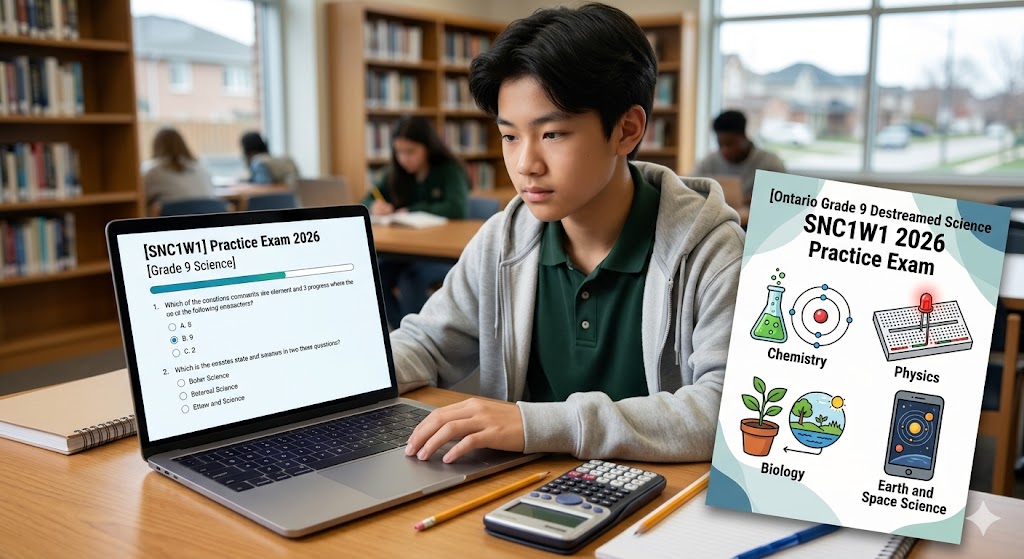
Additional Information
What the Course Entails and Exam Details
The SNC1W1 course is built around four major scientific strands and integrated STEM (Science, Technology, Engineering, and Mathematics) skills.
The comprehensive exam covers all these essential areas.
First, students explore STEM Investigation Skills, Careers, and Connections, which are interwoven throughout the course. This involves understanding scientific processes, engineering design, coding, and computational thinking, as well as making connections between science, technology, society, and the environment.
Second, the Biology: Sustainable Ecosystems and Climate Change unit focuses on the dynamic nature of ecosystems. Students investigate the flow of energy and the cycling of matter, assess the impacts of human activities and climate change on ecological balance, and explore the importance of biodiversity and sustainable practices.
Third, in the Chemistry: The Nature of Matter strand, students delve into the particle theory, the classification of matter, physical and chemical properties, and the organization of elements in the periodic table. They analyze how properties affect the use of everyday materials and the environmental impacts of common elements and compounds.
Fourth, the Physics: Principles and Applications of Electricity unit introduces students to static and current electricity. They explore the law of electric charges, components of simple circuits, and quantities like voltage, current, resistance, and their practical, safe applications, including how emerging technologies might impact power systems.
Finally, the Earth and Space Science: Space Exploration component covers major components of the universe, celestial objects, and the effect of the sun on Earth and its atmosphere. Students compare properties of solar system bodies and assess the social, economic, and environmental impacts of space technologies.
The actual final exam details, such as exact date and format, vary by individual authorized schools. For this practice exam, you should prepare for a comprehensive 1.5 to 2-hour assessment, simulating a school-based final exam.
What to Expect in the Final Exam
While specific formats may vary slightly between schools, a typical final exam for the Ontario Grade 9 Destreamed Science (SNC1W1) course, including this practice exam, will include several distinct components to evaluate different types of understanding.
You can expect a mix of multiple-choice and short-answer questions.
For example, part one may consist of Multiple Choice questions worth about 40% of the total marks, covering all four units.
This is followed by a Short Answer and Application section, often worth 35–40%, requiring explanations of concepts, completion of Bohr-Rutherford diagrams, descriptions of food webs, or short paragraphs on environmental impacts.
A Problem Solving and Inquiry section, worth approximately 15–20%, will test mathematical and procedural skills, such as calculating resistance or voltage in an electric circuit using Ohm's Law or detailing the steps of a scientific investigation.
Finally, there may be a small Culminating Task or Practical Connection section, representing 5–10% of the exam, which could ask students to relate concepts to a previous coding project or engineering design challenge completed in class.
You should aim for a passing score as set by your teacher, which is typically 50%. A non-programmable, non-graphing scientific calculator is often permitted, and necessary reference materials like the Periodic Table and the Electrostatic Series will be provided within the exam.
How to Study and Exam Centers
Since this is a school-based exam, your primary Exam Center is your authorized school or learning institution where you are registered for the SNC1W1 course. All official final exams will be administered there under the supervision of your teachers and school administrators.
To study effectively for both the practice exam and your actual final:
First, create a realistic study schedule, allocating specific time to each of the four main strands: Biology, Chemistry, Physics, and Earth and Space Science. Do not try to cram all the material at the last minute; distribute your study sessions over several days or weeks.
Second, use active recall techniques. Review your class notes, but go further by closing your book and trying to explain a concept from memory. Re-do homework problems, particularly the challenging ones, and self-quiz using past tests or review guides. The more you "test" yourself, the better your recall will be.
Third, focus on understanding and application, not just rote memorization. For every scientific principle, ask yourself "how does this relate to my life, technology, or the environment?" For example, when studying the particle theory, think of everyday changes of state, like boiling water or melting ice.
Fourth, make summary notes, mind maps, and diagrams. Condensing a whole unit of information into a single one-page summary or a well-organized concept map is an excellent way to synthesize your learning. Practice drawing key diagrams, such as electric circuits or food webs.
Fifth, ensure you are well-prepared physically. Get a full night's sleep before the exam and eat a nutritious meal. This will help with concentration and stress management. When sitting the exam, manage your time carefully, move past difficult questions, and return to them later if time allows.
This practice exam is designed to help you simulate these strategies. You can access and take this [Ontario Grade 9 Destreamed Science SNC1W1 2026] Practice Exam through our online portal.
Job Opportunities from the Course
A strong foundation in the Grade 9 Destreamed Science (SNC1W1) course is a key prerequisite for success in all senior high school science courses, including Grade 10 Science, and Grade 11 and 12 Biology, Chemistry, Physics, and Earth and Space Science.
Completing this course successfully unlocks long-term career pathways that require further secondary and post-secondary education, including a bachelor's degree or college diploma.
It is an essential step towards becoming:
A medical professional, such as a doctor, nurse, or pharmacist.
An engineer in various fields like civil, mechanical, chemical, electrical, or software engineering.
An environmental scientist, biologist, or conservation specialist.
A laboratory technician or research scientist.
A data analyst or computer scientist.
A skilled trade professional, such as an electrician or mechanic, where understanding scientific principles and technology is crucial.
A science educator or communicator.
Frequently Asked Questions
Reviews
5.0
Based on 0 reviews
Leave a Review
No reviews yet. Be the first to review!