
Ontario Grade 9 Geography Practice Exam
$69.00
- Buy to unlock unlimited access to all Quiz questions and Answers in this Quiz.
- After purchase you can print a PDF of the whole quiz at any point. The PDF will contain the questions and the correct answers.
About this Exam
This practice exam is designed for students currently enrolled in or preparing for the Ontario Grade 9 Geography course (CGC1W, 'Issues in Canadian Geography'). The course is foundational for understanding Canada’s physical, social, and economic landscape. It explores how various systems and human activities interact within Canada and how we manage our vast resources and diverse population. This practice test is a crucial resource for students aiming to achieve a strong understanding of core concepts and to perform well on their summative evaluations in an Ontario secondary school setting.
Ready to test your knowledge?
Buy Now to Access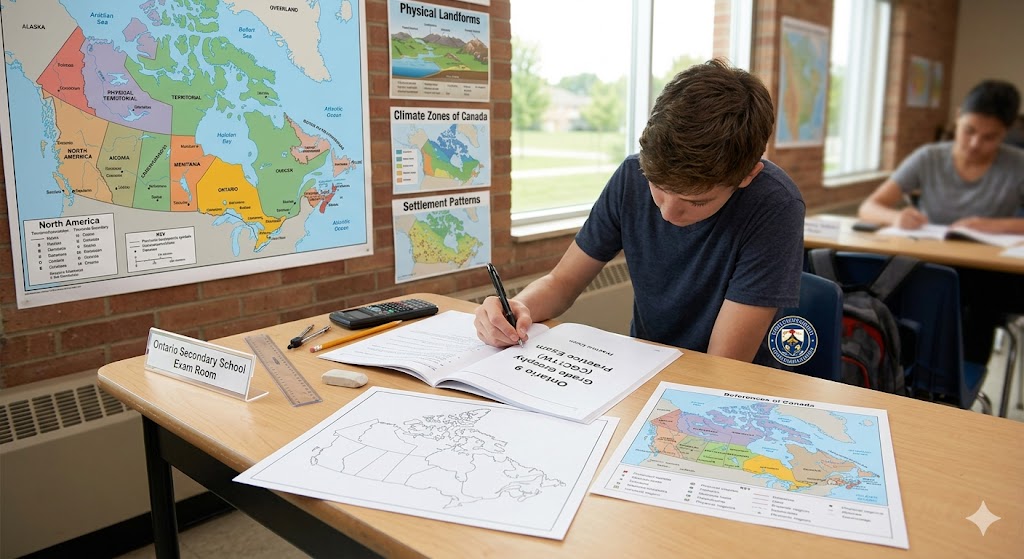
Additional Information
What the Course Entails and Exam Details
The CGC1W course is built around four primary strands of study, all of which will be reflected in a comprehensive practice exam:
Geographic Inquiry and Skill Development: Mastering the use of tools like mapping, GIS (Geographic Information Systems), statistical analysis, and fieldwork methods.
Interactions in the Physical Environment: Analyzing natural processes, climate change, and their impact on Canada’s physical regions.
Managing Canada’s Resources and Industries: Examining how energy, forestry, agriculture, and other key resources are managed sustainably in Canada.
Changing Populations and Sustainable Communities: Understanding demographics, immigration, urban planning, and the concept of liveable, resilient communities in Canada.
The term "exam" in Ontario secondary schools usually refers to a final evaluation, which constitutes 30% of a student's final grade. A comprehensive practice exam should mirror this by covering a wide array of these four strands, assessing both knowledge and application skills.
What to Expect in the Final Exam
The final evaluation for Ontario Grade 9 Geography is rarely a single, sit-down test. Most schools use a combined approach for that final 30%:
A Final Written Exam: This component typically involves various question types: multiple choice, true/false, matching, and, most importantly, structured short-answer questions. Students are often required to demonstrate practical geography skills, such as interpreting a topographic map, drawing a précis map, or analyzing statistical charts related to Canadian demographics or resource consumption.
A Culminating Performance Task (CPT): This is a significant project completed toward the end of the semester. It often counts for a substantial portion of the final 30%. Examples of a CPT might include creating a detailed sustainability plan for a Canadian city, producing a research report on an environmental issue like a pipeline project, or designing a campaign to promote sustainable resource extraction.
A high-quality practice exam will include practice questions for the written component and provide a breakdown or outline of the structure of a common culminating performance task so students know how to plan for both.
How to Study and Exam Centers
Preparation for this exam should be multifaceted and practical:
Practice with a Dedicated Resource: Use an Ontario Grade 9 Geography Practice Exam to simulate the testing environment, timing yourself on different sections and reviewing answers with a teacher or study group.
Master Mapping Skills: Ensure you can identify all provinces, territories, capital cities, major physical regions (like the Canadian Shield and Great Lakes-St. Lawrence Lowlands), and major bodies of water in Canada.
Review Flashcards: Create flashcards for key terms, definitions, and concepts within the four main strands (e.g., 'carrying capacity,' 'urban sprawl,' 'resilience,' 'energy mix').
Use Online Tools: Practice using the 'Atlas of Canada' online or a GIS application, as these skills are often tested and central to the CPT.
Where and How to Take the Exam: Students take their Grade 9 exams directly within their assigned Ontario Secondary School. These are administered by their classroom teacher as part of the accredited school year, not at external centers like Pearson VUE or specialized online portals. The culminating project is usually submitted during standard school hours, and the written exam is scheduled according to the school's exam calendar at the end of the semester.
Job Opportunities from the Course
While Grade 9 Geography is not a vocational certification, it builds essential analytical, critical thinking, and spatial awareness skills that are fundamental to numerous career paths and subsequent post-secondary studies. Careers that directly benefit from a strong understanding of these geographic principles in Canada include:
Geographic Information Systems (GIS) Technician: Using software to map and analyze spatial data for urban planning or resource management.
Environmental Consultant: Advising businesses and governments on sustainable practices and environmental impact.
Urban and Regional Planner: Designing liveable communities and managing land-use development.
Geologist/Geographer: Conducting research on Earth’s processes and physical features.
Conservation Officer/Park Ranger: Managing natural resources and protected spaces.
Tourism and Travel Specialist: Focusing on Canadian travel and regional exploration.
International Development Worker: Applying geographic perspectives to global human issues.
Educator (Geography or Environmental Science Teacher): Sharing knowledge of Canada and the world with future students.
Frequently Asked Questions
Reviews
5.0
Based on 0 reviews
Leave a Review
No reviews yet. Be the first to review!