
Ontario Office of the Fire Marshal (OFM) Firefighter II Certification Practice Exam
$69.00
- Buy to unlock unlimited access to all Quiz questions and Answers in this Quiz.
- After purchase you can print a PDF of the whole quiz at any point. The PDF will contain the questions and the correct answers.
About this Exam
The Ontario Office of the Fire Marshal (OFM) Firefighter II Certification is a professional milestone for seasoned firefighters who have already mastered the foundational skills of Firefighter I. This advanced certification validates an individual's ability to operate with a higher level of autonomy, assume command at small-scale incidents, and perform specialized functions on the fireground. Designed for career and volunteer firefighters seeking to advance their careers and take on leadership roles within their departments, it ensures that personnel can meet the rigorous challenges of complex modern emergency scenarios across the province of Ontario.
Ready to test your knowledge?
Buy Now to Access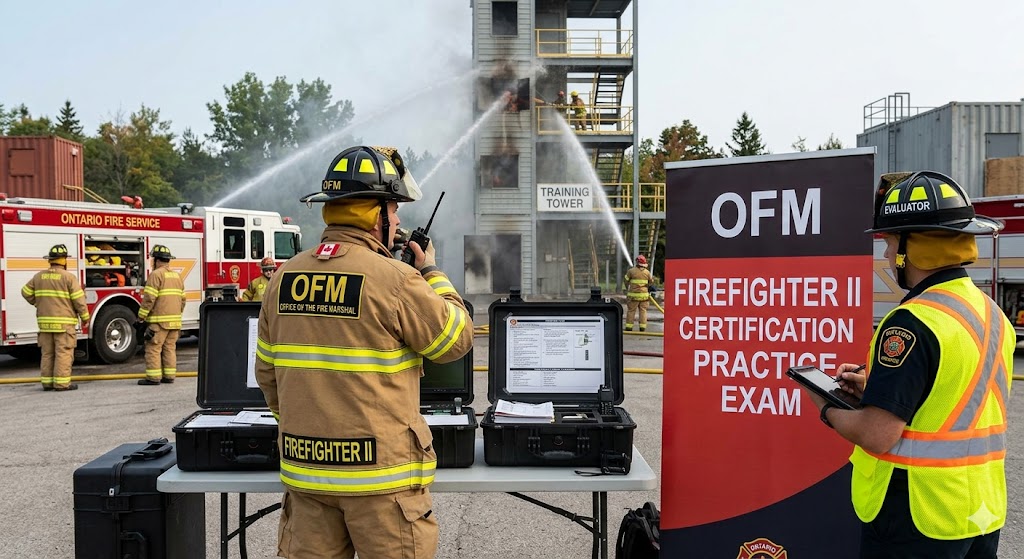
Additional Information
What the Course Entails and Exam Details
The path to OFM Firefighter II certification involves both advanced theoretical training and a comprehensive evaluation of practical skills, typically aligned with NFPA 1001 Standard for Fire Fighter Professional Qualifications. The syllabus expands significantly on Firefighter I concepts, focusing on leadership, specialized operations, and command. Core topics you must master include:
Command and Control: Principles of the Incident Management System (IMS), establishing scene command, and resource management at small-scale incidents.
Advanced Fireground Operations: Strategy and tactics for complex structure fires, defensive operations, master streams, and dynamic risk assessment.
Specialized Rescue: Advanced skills in vehicle extrication, technical rescue awareness, and coordinating with specialized rescue teams.
Hazardous Materials: Advanced scene survey, product identification, and defensive mitigation strategies.
Fire Origin and Cause: Assessing scene evidence to determine fire origin, cause, and protecting potential crime scenes.
Fire Prevention and Public Education: Preparing and delivering fire safety presentations and performing basic fire inspections.
Leadership and Mentorship: Principles of supervising small teams and mentoring junior firefighters.
What to Expect in the Final Exam
The OFM Firefighter II Certification exam is a multi-part process, meticulously designed to evaluate your operational readiness and theoretical depth. It consists of two major components, both referenced to the latest OFM-recognized curriculum and standards like NFPA 1001.
The Written Examination:
Format: A multiple-choice, proctored exam, often consisting of 100 questions.
Content: Questions will cover the entire scope of the Firefighter II curriculum, ranging from complex tactical problems to fire science and leadership principles.
Passing Score: To succeed, candidates must achieve a minimum score of 70%.
Time Limit: A specific time limit, typically 2 to 3 hours, is allotted for completion.
The Practical Skills Evaluation:
Format: A hands-on, scenario-based evaluation at an authorized testing center.
Content: You will be required to demonstrate proficiency in a set number of randomly selected critical skills, such as directing a water stream, commanding a simulated incident, or performing advanced technical rescue tasks.
Scoring: Evaluators grade each skill on a Pass/Fail basis, ensuring you can perform tasks safely, efficiently, and with the required technical accuracy.
Requirement: Candidates must pass a required percentage of skills to be successful.
How to Study and Exam Centers
Preparation is paramount for the OFM Firefighter II exam. A combination of structured study, practical application, and mental preparation will maximize your success rate.
Master the Manuals: Thoroughly review the primary textbooks, specifically the IFSTA Essentials of Fire Fighting, 7th Edition, and all OFM-provided curriculum components.
Scenario-Based Practice: Create complex operational scenarios and practice "flying the desk," verbalizing command, tactical decisions, and dynamic risk assessments with colleagues.
Practical Drills: Regularly perform practical skills, focusing on smooth and safe execution, especially in leadership or specialist roles.
Use Practice Exams: Take advantage of high-quality, relevant practice tests that simulate the real OFM Firefighter II written exam structure, timing, and question types to identify knowledge gaps.
Seek Mentorship: Learn from senior officers and instructors who have successfully navigated the certification process.
The actual OFM Firefighter II exam is administered through your local fire department, a recognized regional fire training center, or an authorized post-secondary institution across Ontario. These centers, which often include colleges with fire service programs, are approved by the Office of the Fire Marshal to provide a standard and secure testing environment for both the written and practical evaluations.
Job Opportunities from the Course
Earning your OFM Firefighter II Certification significantly enhances your qualifications and opens diverse career paths within the Ontario fire service and related public safety sectors. It is a critical prerequisite for advanced positions that require increased responsibility and leadership:
Fire Captain
Fire Lieutenant
Training Officer / Instructor
Fire Prevention Officer / Inspector (with additional certifications)
Specialized Rescue Technician
Hazardous Materials Specialist
Incident Commander for Small-Scale Incidents
Fire Investigator (with additional training)
Career advancement within larger municipal departments, including moving to specialized divisions.
Frequently Asked Questions
Reviews
5.0
Based on 0 reviews
Leave a Review
No reviews yet. Be the first to review!