
Ontario Office of the Fire Marshal (OFM) NFPA Technical Rescue (NFPA 1006) Written Practice Exam
$69.00
- Buy to unlock unlimited access to all Quiz questions and Answers in this Quiz.
- After purchase you can print a PDF of the whole quiz at any point. The PDF will contain the questions and the correct answers.
About this Exam
The Ontario Office of the Fire Marshal (OFM) NFPA Technical Rescue certification, based on the NFPA 1006 standard, is a critical credential for emergency response professionals in Ontario. This certification signifies that an individual possesses the requisite skills and theoretical knowledge to safely and effectively perform complex rescue operations.
It is specifically designed for firefighters, search and rescue personnel, and emergency medical service workers who operate in high-risk environments. This rigorous qualification program ensures that rescuers are prepared for specialized scenarios, ranging from high-angle environments to trench collapses. Achieving this certification demonstrates a commitment to professional excellence and, most importantly, enhances safety for both the rescuer and the public during technical rescue incidents.
Ready to test your knowledge?
Buy Now to Access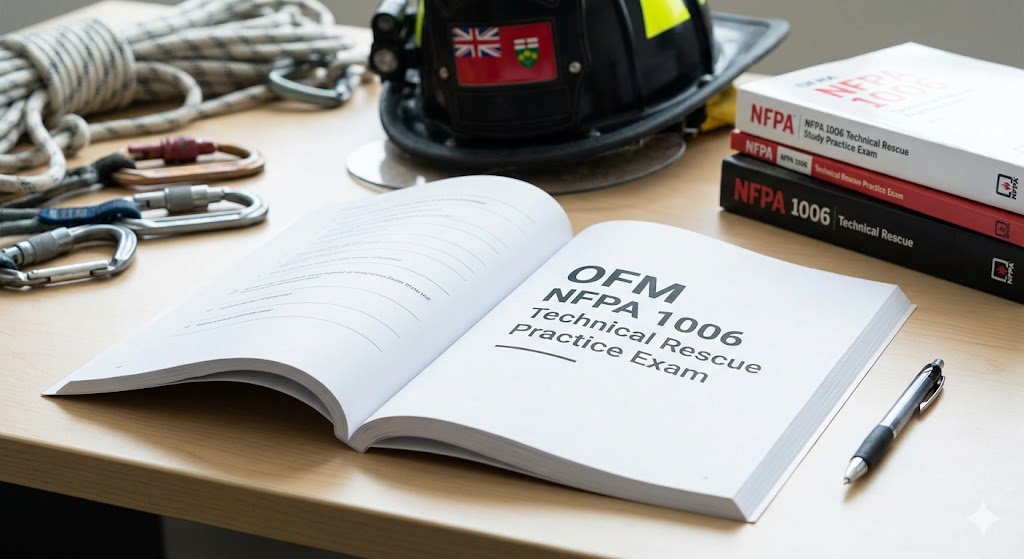
Additional Information
What the Course Entails and Exam Details
The comprehensive training program for NFPA 1006 technical rescue covers a vast array of specialized disciplines. The curriculum is structured to provide candidates with both foundational understanding and advanced practical application in their chosen technical areas.
Core subjects included in the training typically encompass areas such as rope rescue, confined space rescue, structural collapse rescue, trench rescue, vehicle and machinery rescue, and surface water rescue. Candidates study detailed rope systems, mechanical advantage principles, structural shoring techniques, advanced patient packaging and extraction methods, and the identification of atmospheric hazards within confined spaces. Furthermore, the course material includes crucial education on current legislation, safety protocols, equipment maintenance, and complex incident management strategies. The depth of knowledge required demands dedication to mastering intricate details of rescue physics, structural mechanics, and patient care in austere environments.
What to Expect in the Final Exam
The final evaluation for the OFM NFPA Technical Rescue certification involves both practical skills testing and a rigorous written examination to comprehensively assess the candidate's competence.
The practical component requires candidates to demonstrate mastery of essential rescue skills under the supervision of OFM-designated evaluators. This involves successfully executing complex rescue scenarios within specified timeframes and adhering to strict safety standards. The written examination is a formalized assessment of theoretical knowledge and often consists of randomized multiple-choice questions. These questions directly reflect the Job Performance Requirements (JPRs) established in the relevant NFPA standard. Candidates must typically achieve a passing grade of at least 70% on the written portion to advance or receive certification. The exam time allowance is generally standardized, providing a specific duration (often two to three hours) for completion depending on the specific complexity and level (Awareness, Operations, or Technician) of the certification being tested.
Frequently Asked Questions
Reviews
5.0
Based on 0 reviews
Leave a Review
No reviews yet. Be the first to review!