
Ontario Paramedic Practice Exam
$69.00
- Buy to unlock unlimited access to all Quiz questions and Answers in this Quiz.
- After purchase you can print a PDF of the whole quiz at any point. The PDF will contain the questions and the correct answers.
About this Exam
Welcome to your essential guide for mastering the Ontario Paramedic Practice Exam! This comprehensive resource is meticulously designed for ambitious students preparing for their official Ontario paramedic certification examinations. Whether you are aiming to embark on a career as a Primary Care Paramedic or take subsequent steps in this dynamic field, this practice tool is your critical stepping stone. It acts as a realistic simulation of the official testing environment, empowering you to build confidence and refine your comprehensive paramedic knowledge and critical thinking skills before the crucial final exams. Don't leave your hard-earned success to chance; embrace this essential preparation and gear up for a rewarding and impactful career in emergency medical services.
Ready to test your knowledge?
Buy Now to Access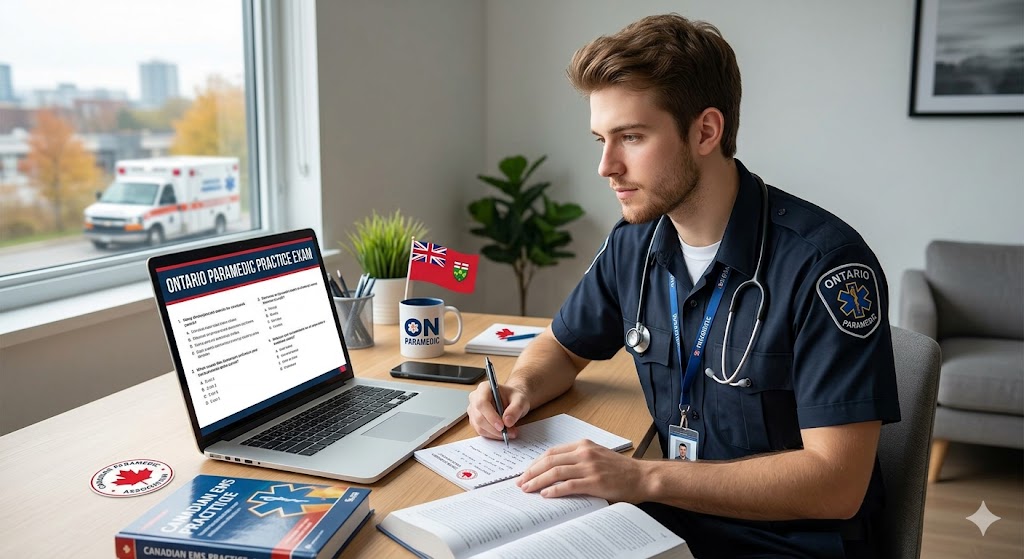
Additional Information
What the Course Entails and Exam Details
While not structured as a traditional course with a series of lessons, the material covered in this Ontario Paramedic Practice Exam robustly mirrors the intricate knowledge base and demanding standards required for paramedics across Ontario. The practice exam itself is typically structured as a comprehensive multiple-choice test that delves deeply into core topics crucial for any paramedic. Expect extensive coverage of thorough patient assessment techniques for diverse age groups and situations. It will test your understanding of medical and trauma emergencies, including cardiac arrest, stroke, anaphylaxis, complex fractures, and critical airway management. Deep dives into pathophysiology, standard Canadian pharmacological principles, including dosages, routes, and interactions, are guaranteed. Crucial elements of ethical and legal considerations, documentation standards, effective communication with patients and healthcare teams, and proper equipment usage within the diverse contexts of Ontario's EMS services are also significantly represented. By practicing with these types of scenario-based questions, you aren't simply memorizing facts; you are developing the critical decision-making abilities essential for effective real-world patient care in demanding environments, all within a dedicated and focused practice setting. This test is designed to not just assess what you know, but crucially how effectively you can apply that knowledge in critical situations.
What to Expect in the Final Exam
It is important to clearly understand the difference between this practice tool and the actual certification process. When you eventually sit for your provincial and potentially national certification exams in Ontario (which often incorporate components from organizations like the Canadian Organization of Paramedic Regulators - COPR, especially for Primary Care Paramedics), you should be prepared for a rigorous, multi-faceted evaluation. While this practice exam will typically utilize a time-limited multiple-choice format to assess your extensive theoretical knowledge base under simulated pressure, the actual final certification process frequently involves two primary, distinct components:
Written Examination: A challenging, comprehensive, and proctored written exam, often primarily consisting of scenario-based multiple-choice questions, very similar in overall format and knowledge areas to the types of questions you are actively practicing. This component typically has a specific time limit, demanding efficient time management and decisive thinking, and often requires a passing score of at least 70% to 80% to demonstrate proficiency.
Practical Evaluation: An intensive series of hands-on assessments, commonly known as OSCEs (Objective Structured Clinical Examinations). These practical stations meticulously challenge your clinical skills, immediate decision-making abilities, teamwork, and professionalism across various realistic simulated emergency situations, employing either standardized patients or high-fidelity simulation manikins. Strict passing criteria are applied to each station, testing your mastery of critical skills under scrutiny.
The actual final exams strictly adhere to rigorous protocols regarding proper identification, permissible items, and overall candidate conduct to ensure absolute fairness and integrity. Your dedicated commitment to thorough preparation with this Ontario Paramedic Practice Exam is the absolute perfect way to build the robust and deep knowledge foundation and critical thinking skills crucially needed to not only face but truly excel in all challenging components of the official final certification hurdles.
How to Study and Exam Centers
Maximize your overall success and readiness by implementing smart, consistent study strategies. Thoroughly review all official paramedic curriculum materials, textbooks, and practice guidelines. Create dedicated and focused study schedules, consistently dedicating substantial time to master each core topic and section of knowledge. Practice, practice, practice! Regularly complete this entire practice exam under strict timed conditions to simulate the true pressure of the real examination environment. Pinpoint your weaker knowledge areas after reviewing your practice scores and actively revisit those specific concepts with targeted study. Consider forming collaborative study groups to discuss complex scenarios, share diverse insights, and quiz each other effectively. Utilize additional reputable online resources, flashcards for key terms and drug information, and review past case studies to enhance your understanding. Maintain consistency in your routine, prioritize quality sleep and healthy habits, and manage any exam anxiety.
Regarding Exam Centers for the Actual Certification: Once you have successfully completed your authorized Ontario paramedic education program (usually from an accredited community college or recognized training institution), you will be formally eligible to register for your official provincial and potential national examinations through the relevant regulatory and certifying bodies (such as the Ontario Ministry of Health or COPR). For the crucial written examination components, you can typically find numerous authorized testing centers strategically located across Ontario. These can include:
Specific Accredited Colleges and Training Facilities: Many authorized educational institutions also act as official test centers for written exams, often in conjunction with professional testing services.
Designated Locations Managed by the Regulatory Body: The Ontario regulating organization may establish specific temporal or permanent locations for holding large-scale exams.
Pearson VUE Professional Centers: Pearson VUE often handles the administration of standard computer-based testing, including the national paramedic exams, so check for available Pearson VUE professional test centers conveniently located for you once you receive authorization to schedule.
Practical examinations (OSCEs) are generally scheduled and conducted at specific authorized college facilities or dedicated simulation centers across the province that are equipped with the specialized resources, multiple simulation stations, and personnel required to host such comprehensive hands-on assessments. When you are fully eligible and ready to book your actual exam dates and preferred physical locations, the relevant regulating and certifying body will provide you with precise, detailed instructions and direct you to the official registration system where you can view available dates and designated locations to select from. For this specific Ontario Paramedic Practice Exam, it is typically accessed and completed online, giving you the flexibility and convenience to take it from your own space, although some institutions might incorporate it into their preparatory materials at a physical center.
Job Opportunities from the Course
Successfully achieving your official Ontario paramedic certification, building upon the foundational knowledge and practice you have gained, unlocks a truly challenging, dynamic, and vital career within Ontario's comprehensive emergency services and healthcare system. Your hard work and dedication will qualify you for multiple impactful roles:
Primary Care Paramedic (PCP): This is the foundational and most common entry-level paramedic position across Ontario, responsible for providing essential and often advanced life-saving pre-hospital emergency care, including comprehensive patient assessment, life support procedures, medical administration, and safe patient transport in both rural and urban services.
Advanced Care Paramedic (ACP): Designed for experienced and additional post-graduate trained PCPs, ACPs possess an expanded scope of practice, performing highly advanced medical procedures, administering a wider range of critical medications, and providing significantly higher levels of specialized care in the most critical and complex medical situations.
Critical Care Paramedic (CCP): Specializing in complex patient monitoring and management during high-acuity inter-facility transports, CCPs provide intensive care to the most critically ill or injured patients requiring specialized equipment, continuous monitoring, and intricate medical management between hospitals.
Community Paramedic: This is a growing and proactive role where paramedics focus on preventative healthcare, supporting vulnerable patients and managing chronic conditions directly within their homes and communities, actively reducing avoidable emergency room visits and hospital admissions.
Flight Paramedic: Working specifically with air ambulance services and often CCP trained, these paramedics provide critical care and emergency response during air transport, frequently responding to remote locations or providing rapid, high-level care over long distances.
EMS Educator: Experienced and knowledge-rich paramedics can progress to rewarding roles in teaching and training, educating future generations of paramedics within college programs or contributing to essential continuing education initiatives for existing practitioners.
Paramedic Services Manager/Supervisor: Leadership and administrative positions within large paramedic services organizations, overseeing operational logistics, personnel management, quality assurance, compliance, and strategic service planning.
Frequently Asked Questions
Reviews
5.0
Based on 0 reviews
Leave a Review
No reviews yet. Be the first to review!