
Ontario Police College Midterm Practice Test
$69.00
- Buy to unlock unlimited access to all Quiz questions and Answers in this Quiz.
- After purchase you can print a PDF of the whole quiz at any point. The PDF will contain the questions and the correct answers.
About this Exam
The Ontario Police College (OPC) is the standardized training facility for all police services in Ontario, with the exception of the OPP and some specialized services. All prospective recruits must successfully complete the Basic Constable Training (BCT) program at OPC to become a sworn police officer. The program is intensive, covering physical skills, driving, and a wide array of legal and operational knowledge. The midterm exam is a significant milestone during this program, serving as a critical indicator of a recruit’s mastery of the core concepts taught up to that point. This practice test is designed specifically for aspiring Ontario police officers, providing a simulated experience to build confidence and refine the knowledge required for success.
Ready to test your knowledge?
Buy Now to Access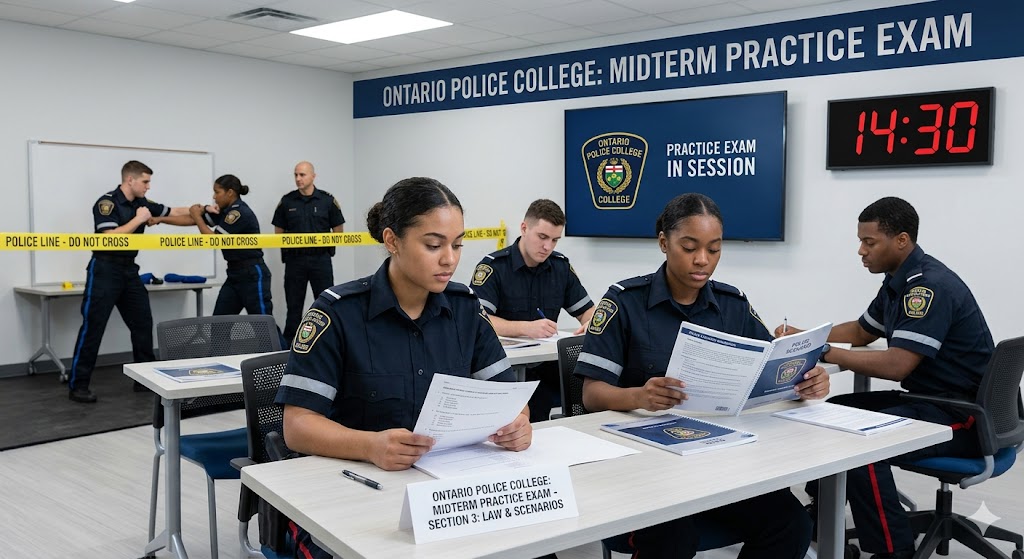
Additional Information
What the Course Entails and Exam Details
The Basic Constable Training course at the Ontario Police College entails a comprehensive blend of academic study and practical skill development. The midterm exam evaluates recruits on the knowledge gained from this foundation.
Key topics covered by the midterm exam include:
Criminal Law: In-depth knowledge of the Criminal Code of Canada, relevant Provincial Statutes (like the Highway Traffic Act), and the application of the Canadian Charter of Rights and Freedoms.
Police Powers and Duties: Understanding legal authorities, use of force models, powers of arrest, and the legal requirements for search and seizure.
Investigations: Foundational investigative techniques, report writing, note-taking, and interviewing skills for victims, witnesses, and suspects.
Human Relations and Diversity: Understanding the role of police in a diverse society, ethical policing, conflict resolution, and communication skills.
Practical Skills (Simulated in the exam): The academic component often features scenario-based questions that test the legal application of physical control and defensive tactics, and operational driving knowledge.
What to Expect in the Final Exam
While a final exam at the end of the BCT program is the ultimate goal, the midterm practice exam is structured to reflect the challenges of the actual midterm, which is a major, official component of the OPC curriculum. The midterm practice test aims to simulate the exam structure that OPC typically utilizes:
Exam Format: The midterm usually consists of multiple-choice questions designed to test knowledge retention and the application of legal concepts to practical scenarios. Some exams may also include short answer questions or case study analyses.
Simulated Pressure: The practice test will present questions under a time limit, encouraging recruits to manage their time effectively, a skill crucial during high-pressure police situations.
Content Specifics: The written component of the actual exam focuses on Canadian and Provincial law. Recruits must show they understand the difference between different types of offenses and the correct procedural responses.
Passing Requirements: Within the official OPC program, a high standard is required. This practice test helps recruits identify if their performance is meeting the benchmarks needed for continuation in the BCT course.
Note: The practice test itself is a simulation tool. The real midterm at the OPC is part of a standardized, multi-phase assessment.
How to Study and Exam Centers
Preparation is paramount for success at the Ontario Police College. A midterm practice test is one of the most effective tools.
Actionable Study Strategies
Use the Practice Test Wisely: Take the test under simulated exam conditions (no notes, strict time limits) to identify areas of weakness.
Review Legal Statutes: Dedicate significant time to reviewing the Criminal Code and key Provincial acts. Focus on scenarios and definitions rather than rote memorization.
Review Your Notes Daily: Consistently reviewing lecture notes from your early weeks at OPC is vital for long-term retention.
Form Study Groups: Collaborating with colleagues helps you discuss complex scenarios and legal applications.
Apply Concepts to Scenarios: For every law you study, think about a real-world scenario you might encounter as a police officer and how you would apply that law.
Practice Test Access and Official Exam Centers
Accessing the Practice Test: The user of this guide accesses the practice test as part of their study tools. Official OPC study materials or approved preparatory courses may offer authorized practice examinations.
Official Ontario Police College Exams: The actual, high-stakes midterm and final exams of the Basic Constable Training are always conducted physically at the Ontario Police College facility in Aylmer, Ontario. There are no other approved remote or physical testing centers for the OPC examinations. Recruits are brought to this central location as part of their employment and training.
Job Opportunities from the Course
Upon successfully completing the Basic Constable Training program at the Ontario Police College (of which the midterm is a major component), recruits become sworn Police Constables and unlock clear, stable career paths. This program is the prerequisite for all of the following specific job titles in Ontario:
Police Constable: The core role within any municipal or provincial police service.
Municipal Police Officer: For services like Toronto Police Service, Ottawa Police Service, Peel Regional Police, or other municipal departments.
Special Constable: Roles within specialized services, court security, or certain public safety entities within Ontario, depending on the service’s requirements and legislation. (Completion of the BCT program at OPC is sometimes a pathway, although some Special Constable roles have different requirements).
Provincial Police Officer (OPP Recruit): While the OPP has its own training academy (the Provincial Police Academy in Orillia), completion of a program that demonstrates proficiency and standard provincial certification can still be a recognized credential or a step for some lateral applicants/recruits depending on specific service agreements. However, for initial OPP recruitment, direct attendance at the OPP Academy is standard.
Specialized Units: After gaining experience, successful completion opens the door to specialized roles like Criminal Investigations (Detective), K9 Unit, Tactical Team, Traffic Reconstruction, and Major Crime Units, which all require initial foundational training.
Frequently Asked Questions
Reviews
5.0
Based on 0 reviews
Leave a Review
No reviews yet. Be the first to review!