
Ontario Primary Care Paramedic Practice Exam
$69.00
- Buy to unlock unlimited access to all Quiz questions and Answers in this Quiz.
- After purchase you can print a PDF of the whole quiz at any point. The PDF will contain the questions and the correct answers.
About this Exam
The Ontario Primary Care Paramedic Provincial Exam, legally designated as the Advanced Emergency Medical Care Assistant (A-EMCA) examination, is the final, essential hurdle for individuals seeking to practice as a paramedic within the province. Successful completion of this exam grants the provincial certification required for employment by all Ontario land and air ambulance services.
This exam is rigorously designed to assess the entry-level competency of graduates from two-year Ontario College Paramedic diploma programs. It evaluates a candidate's ability to integrate complex medical knowledge, critical decision-making, and clinical skill application under pressure. It is not merely a test of recall; it is a test of safe, effective, and ethical patient care readiness.
Ready to test your knowledge?
Buy Now to Access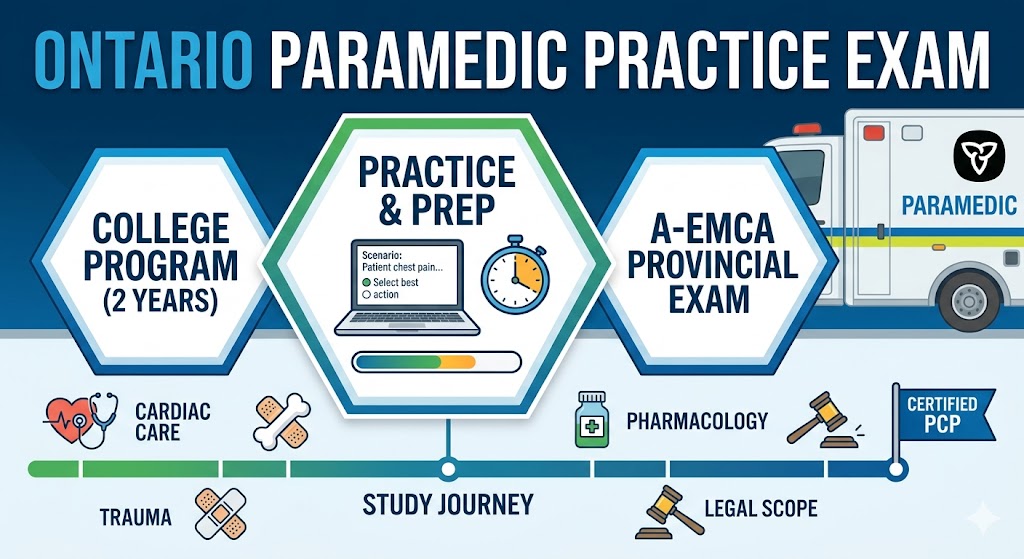
Additional Information
What the Course Entails and Exam Details
The foundation for this exam is the comprehensive curriculum of an approved Ontario Primary Care Paramedic program. The A-EMCA exam itself does not provide a separate course but validates the education you have already completed. The core areas covered in both your training and the provincial exam include:
Anatomy and Physiology: A deep understanding of human body systems and their interaction.
Pathophysiology: The study of how disease and injury alter normal physiological processes.
Pharmacology: Knowledge of pharmacokinetics, pharmacodynamics, and the administration of controlled medical acts and common pre-hospital medications.
Medical and Trauma Emergencies: Assessment and management of diverse acute conditions, including cardiac, respiratory, neurological, obstetric, and traumatic injuries.
Patient Assessment: Mastering the systematic primary and secondary survey techniques.
Special Populations: Dedicated modules for geriatric, pediatric, and psychiatric patient care.
Scene Management and Operations: Safety, extrication, ambulance operations, and multi-casualty incident response.
Legal, Ethical, and Professional Issues: Understanding the legislated scope of practice, documentation, and the regulated acts under Ontario law.
Medical Mathematics: Accurate dosage calculation and drip rate determination.
What to Expect in the Final Exam
The official Ontario Primary Care Paramedic Provincial Exam (A-EMCA) is a high-stakes, standardized written assessment. The specific format can be subject to Ministry update, but typically involves:
Format: A written examination consisting of approximately 200–220 multiple-choice questions. These are often scenario-based, requiring candidates to apply knowledge to a practical situation rather than just recall facts.
Structure: Each question is single-answer, multiple-choice. There are no practical, hands-on skills evaluated during this specific written provincial exam; your practical competence was certified by your graduating college.
Time Limit: Candidates are usually provided with a significant time block, typically 3 to 4 hours, which is divided into two separate, timed sessions.
Passing Score: The required passing score for the A-EMCA provincial exam is standard at 70%.
Rules: The exam is administered under strict invigilation. You must present valid, government-issued photo identification. No personal electronic devices or external study aids are permitted in the testing area.
How to Study and Exam Centers
A strategic approach is required to master the A-EMCA. Leverage the following expert strategies:
Use High-Quality Practice Exams: This is the single most effective study method. Utilize our Ontario Paramedic Practice Exam to familiarize yourself with the question style, pacing, and the types of scenario-based reasoning required. Analyze rationale for both correct and incorrect answers.
Master the Competency Frameworks: Study the Canadian Paramedic Competence Framework (CPCF), as this document outlines the core competencies the exam is designed to validate.
Review Ontario Base Hospital Protocols: You must have an intimate understanding of the medical directives and standing orders specific to Ontario’s Base Hospital Group.
Form Study Groups: Collaborating with peers allows you to run mock scenarios, drill medical math, and teach complex concepts to one another.
Target Your Weaknesses: Use practice exam results to identify subject areas where your score is lowest and dedicate focused study time to those specific topics.
Taking the Exam
The A-EMCA Provincial Exam is managed centrally by the Ministry of Health and Long-Term Care (MOHLTC). While you may use third-party platforms (like ours) for practice, you cannot register for the real provincial exam through this site. To take the actual examination:
Registration: Registration is handled by authorized bodies, most frequently Humber College on behalf of the Ministry. You will receive specific application packages and registration windows through your graduating college toward the end of your program.
Testing Centers: The actual exam is administered at designated physical testing locations across Ontario, typically in major centers such as Toronto, London, and Ottawa. Some recent administrations have utilized secure, online proctoring services, but you must confirm the current year’s delivery method via the official channels (Ministry or Humber College).
Job Opportunities from the Course
Successful completion of your college program and the A-EMCA certification unlocks immediate employment opportunities. Here is a list of job titles and career paths available to certified Primary Care Paramedics in Ontario:
Primary Care Paramedic (PCP): The standard entry-level role for municipal and private land ambulance services throughout Ontario.
Emergency Medical Attendant (EMA): A legislated title sometimes used interchangeably with Paramedic in employment contexts.
Flight Paramedic: Primary Care Paramedics can, with experience and further specialized training, transition to fixed-wing or rotary-wing air ambulance services.
Community Paramedic: A specialized, growing field where PCPs provide proactive, non-emergency care to patients in their homes to reduce hospital admissions.
Private Event Medic: Working at large-scale concerts, sports events, and festivals to provide medical coverage.
Patient Transfer Paramedic: Focusing on the safe, medicalized transport of non-critical patients between facilities.
Paramedic Instructor: With significant field experience, PCPs can become educators within college paramedic programs.
Frequently Asked Questions
Reviews
5.0
Based on 0 reviews
Leave a Review
No reviews yet. Be the first to review!