
Ontario Private Investigator Practice Exam
$69.00
- Buy to unlock unlimited access to all Quiz questions and Answers in this Quiz.
- After purchase you can print a PDF of the whole quiz at any point. The PDF will contain the questions and the correct answers.
About this Exam
The Ontario Private Investigator licensing process is the gateway to a challenging and dynamic career in specialized investigation. This mandatory provincial examination, administered under the authority of the Ministry of the Solicitor General, is designed for individuals seeking to become a licensed Private Investigator (PI) in Ontario. This comprehensive practice exam serves as a critical preparation tool, enabling candidates to assess their understanding of the necessary legal framework, investigative techniques, ethical considerations, and procedural requirements before attempting the official final test. Whether you are a security professional looking to specialize, a career-changer drawn to investigative work, or a recent graduate of an authorized training program, this resource is tailored to help you build confidence and master the required knowledge.
Ready to test your knowledge?
Buy Now to Access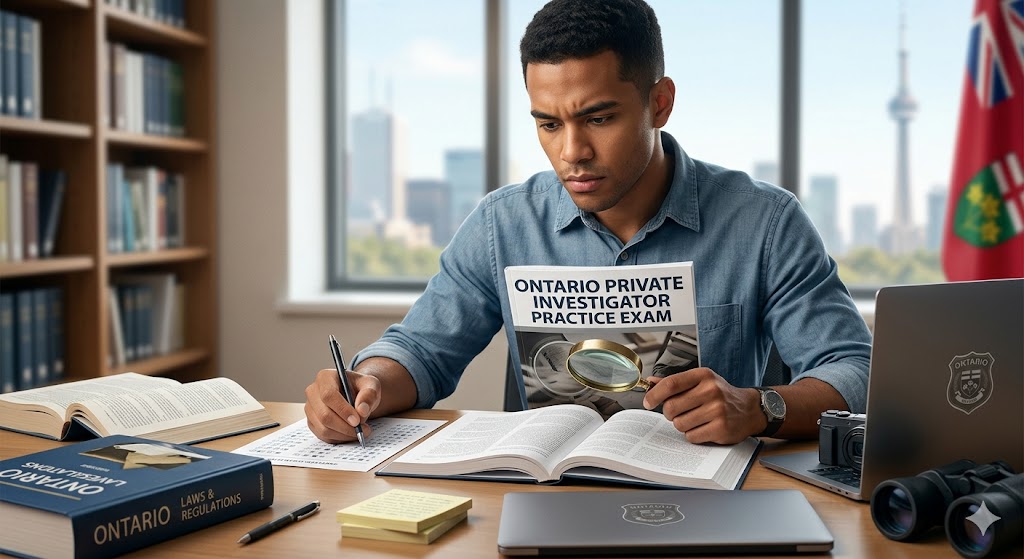
Additional Information
What the Course Entails and Exam Details
Before a candidate is eligible to take the final Ontario Private Investigator exam, they must successfully complete a ministry-approved basic training course, typically 50 hours in length. This course provides the foundational knowledge and theoretical background required for the role. The official final exam, and consequently this practice material, is based on a structured syllabus that covers several core competencies:
Legislative and Regulatory Framework: A thorough understanding of the Private Security and Investigative Services Act (PSISA), along with related Ontario and federal statutes such as the Trespass to Property Act, the Canada Evidence Act, and privacy legislation. This section covers the powers, duties, and restrictions of a PI.
Investigative Techniques: Mastery of common investigation methods, including background checks, surveillance techniques (mobile, stationary, and electronic), locating individuals, and gathering information.
Interviewing Skills: Principles of conducting effective and lawful interviews with witnesses, clients, and potential subjects.
Ethics and Professional Conduct: High standards of professional behavior, maintaining client confidentiality, avoiding conflicts of interest, and managing ethical dilemmas within the investigative environment.
Report Writing: Techniques for documenting investigations, maintaining accurate notebooks, and compiling clear, objective, and detailed investigative reports suitable for client and potential legal use.
Technology and Equipment: Understanding the appropriate and lawful use of various investigative tools and technology, from cameras and recording devices to online databases and forensic software.
Health and Safety: Knowledge of relevant occupational health and safety regulations for the diverse environments in which PIs operate.
What to Expect in the Final Exam
While this practice exam is a simulation, the official final Ontario Private Investigator basic test follows a strict format. This simulation is designed to mimic these conditions closely. You can expect the official test to consist entirely of multiple-choice questions.
Currently, the final exam typically includes 60 multiple-choice questions.
Candidates are usually allotted 75 minutes of pure testing time to complete these 60 questions. The entire appointment, including administrative procedures and results confirmation, generally lasts around two hours.
A passing score on the official final exam is generally considered to be in the range of 75% to 77%. You should aim for a higher score on your practice tests to build a safe buffer.
Specific rules, such as acceptable forms of government photo ID (e.g., driver's license, passport) required for entry, and strict prohibitions on any prohibited aids (phones, notes, etc.) will be detailed by the exam provider. Reviewing these rules in advance is crucial to ensure a smooth testing experience. Your practice efforts should emulate these exam conditions by timing yourself and minimizing distractions.
How to Study and Exam Centers
Preparation is paramount for success on both this practice exam and the official ministry test. The most effective strategy is a multi-faceted approach.
First and foremost, ensure you have thoroughly reviewed and understood the material provided in your ministry-approved training course. Use this course as your primary study guide.
Practice consistently. Take this [Ontario Private Investigator Practice Exam] multiple times. Identify the areas where you consistently miss questions and focus your review on those specific topics in your course materials.
Create flashcards for key legal terms, definitions, legislative sections, and investigative techniques. Actively recall this information.
Join or form study groups with other students from your training program. Explaining concepts to others is an excellent way to solidify your own understanding.
Where and How to Take the Final Exam:
Once you have completed your authorized basic training course and have received your unique Training Completion Number (TCN), you can register for the official final exam. The process is centralized in Ontario, often through a designated third-party testing provider (like the official website associated with DriveTest centers or a similar provincial testing body). You can typically book your exam session online through their portal or via their call center.
Examinations are offered at numerous established, physical testing locations across Ontario, frequently within standard government service or driver testing centers, and potentially some authorized private colleges. You must select a specific date, time, and location, and bring the required identification and your TCN on exam day. Additionally, some providers may offer online, remotely proctored exam options, allowing you to take the test from your own suitable environment, adhering to specific computer and security guidelines. Ensure you follow the specific booking instructions provided by the official Ontario Ministry or the authorized testing agency.
Job Opportunities from the Course
Passing the official Ontario Private Investigator final exam and obtaining your PI license unlocks a diverse and promising array of career paths within the private security and investigation sector. The demand for qualified investigators continues to grow in several fields. Some typical job titles and career paths this certification can lead to include:
Private Investigator
Corporate Investigator
Surveillance Specialist
Claims Investigator (Insurance)
Undercover Investigator
Loss Prevention Specialist / Manager
Workplace Investigator
Legal Investigator
Background Check Analyst / Investigator
Missing Persons Investigator
Skip Tracer
Intellectual Property Investigator
Frequently Asked Questions
Reviews
5.0
Based on 0 reviews
Leave a Review
No reviews yet. Be the first to review!