
Ontario Provincial Police 10 Codes Practice Test
$69.00
- Buy to unlock unlimited access to all Quiz questions and Answers in this Quiz.
- After purchase you can print a PDF of the whole quiz at any point. The PDF will contain the questions and the correct answers.
About this Exam
Police 10 codes are the standardized radio communication codes that form the essential backbone of information exchange for law enforcement professionals across Ontario. This comprehensive practice guide is specifically designed for aspiring applicants and recruits preparing to join the Ontario Provincial Police (OPP).
The [OPP 10 Codes Practice Exam] serves as a crucial bridge between theoretical knowledge and the high-stakes, real-world communications used daily on patrol and in dispatch centers. It is an invaluable resource for anyone preparing for the official assessments administered during OPP recruit or civilian communications training, offering a simulated environment to test their recall accuracy and speed.
Ready to test your knowledge?
Buy Now to Access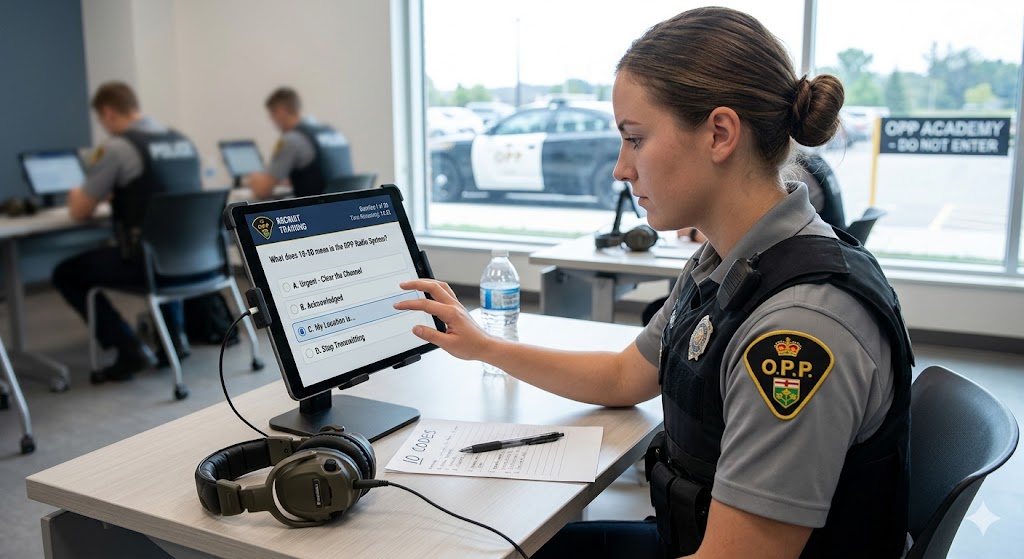
Additional Information
What the Course Entails and Exam Details
While not a standalone "course" in the traditional sense, mastery of the OPP 10 codes is a prerequisite skill taught and assessed within official training curriculums for OPP Constables, Special Constables, and Communications Operators. The syllabus consists of the entire official OPP list of radio codes, ranging from common acknowledgments to critical emergency alerts.
Key components covered in preparation for the assessment include:
Memorization: Rote learning of the precise numeric code (e.g., 10-4) and its exact official meaning (e.g., Acknowledged/OK).
Auditory Recognition: Developing the ability to instantly recognize codes when heard over radio static or in busy environments.
Scenario Context: Knowing which code to apply quickly and correctly in a variety of situational scenarios, such as reporting a traffic accident, requesting assistance, or initiating a pursuit.
What to Expect in the Final Exam
It is important to understand that there is no single external "final exam" for 10 codes that grants a public certification. Instead, this practice test prepares you for the high-standard assessments that are integral parts of employment training within the OPP. Candidates can expect these formal internal exams to be both challenging and time-sensitive to simulate field conditions.
The likely format for these assessments includes:
Format: A combination of multiple-choice questions, fill-in-the-blank definitions, and auditory recognition components. You may listen to a recording of a code and must select its meaning, or be given a situation and must provide the correct code.
Passing Score: Due to the critical nature of accurate communication for officer and public safety, the passing standard is set exceptionally high, typically requiring a score of 90% or greater.
Time Limits: To emphasize the need for rapid, instinctive recall, the assessments are timed, giving you minimal thinking time per question.
Rules: Official exams are taken without aids, including notes or lists, under the supervision of training officers or instructors.
How to Study and Exam Centers
Effective study strategies are crucial for achieving the near-perfect recall demanded by the OPP. You are encouraged to use repetitive and varied methods to reinforce learning:
Actionable Study Strategies:
Active Recall with Flashcards: Create or use digital flashcards to drill codes and meanings in both directions.
Auditory Drills: Record yourself or a partner saying the codes and practice identifying them by ear, and vice-versa.
Scenario-Based Practice: Simulate field calls with another person, using 10 codes in context to build practical application skills.
Frequent, Short Sessions: Engage in daily, short study bursts rather than infrequent, long cramming sessions.
Where to Take the Exam: As an internal component of OPP training, the formal assessments are not taken at external, public testing centers like Pearson VUE. Candidates will take these tests at official, designated training locations once they are employed or have been accepted into a training program. These locations include:
Ontario Police College (OPC): For OPP recruits undergoing basic constable training.
OPP Regional Headquarters or Communications Centres: For civilian staff training to be Communications Operators or Dispatchers.
Job Opportunities from the Course
Mastery of the OPP 10 codes, combined with successful completion of the respective full training programs, unlocks specific and rewarding career paths within the Ontario Provincial Police. This practice material directly helps you prepare for the prerequisite knowledge required for the following roles:
Ontario Provincial Police Constable
Police Communications Operator (Dispatcher)
Ontario Provincial Police Special Constable
This information is intended as a guidance tool for preparation purposes. Always consult the official recruitment information and training materials provided directly by the Ontario Provincial Police.
Frequently Asked Questions
Reviews
5.0
Based on 0 reviews
Leave a Review
No reviews yet. Be the first to review!