
OOW MCA COLREGs Practice Exam
$69.00
- Buy to unlock unlimited access to all Quiz questions and Answers in this Quiz.
- After purchase you can print a PDF of the whole quiz at any point. The PDF will contain the questions and the correct answers.
About this Exam
This study guide focuses on the Officer of the Watch (OOW) Certificate of Competency, specifically preparing you for the critical International Regulations for Preventing Collisions at Sea (COLREGs) component. Designed for aspiring deck officers in the merchant navy or commercial yachting, this practice test simulates the challenging examination process. Mastery of COLREGs is paramount for maritime safety, ensuring you can navigate vessel traffic and prevent collisions. This test evaluates your practical application and theoretical knowledge, a crucial step toward achieving your OOW certification and assuming officer responsibilities.
Ready to test your knowledge?
Buy Now to Access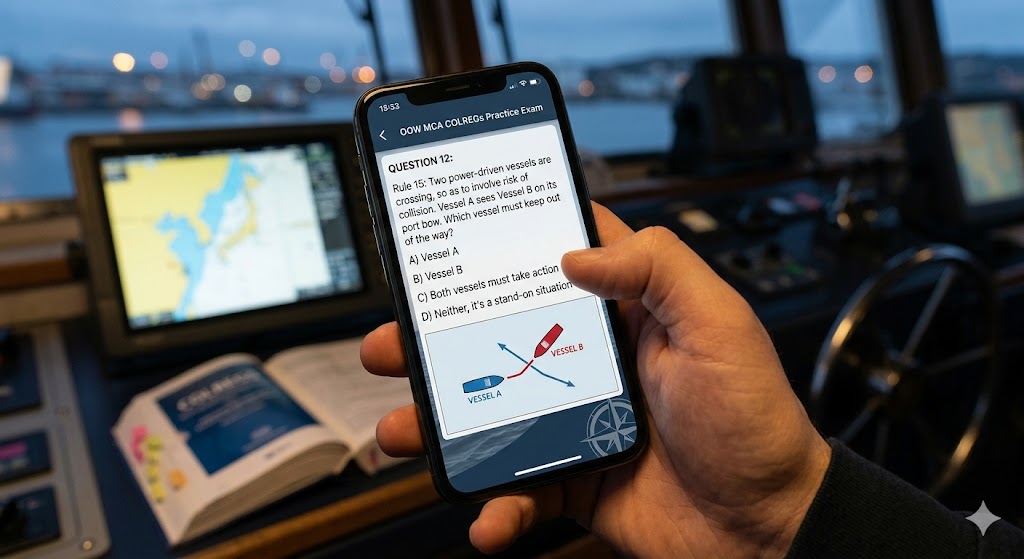
Additional Information
What the Course Entails and Exam Details
This examination focuses strictly on the strict application of COLREGs. You are expected to demonstrate comprehensive understanding and immediate, correct responses. The syllabus covers the entirety of the 1972 Regulations. Key topics include definitions, application, responsibility, navigation in any condition, conduct of vessels in sight, conduct of vessels in restricted visibility, lights and shapes, and sound and light signals. Expect questions that test not only your recall of the rules but your ability to interpret complex nautical situations and identify optimal collision avoidance strategies, even in high-pressure scenarios or low visibility.
What to Expect in the Final Exam
While the exact structure may vary slightly between maritime authorities (such as the UK's MCA), the OOW COLREGs exam is notoriously rigorous. Typically, it involves a multiple-choice format, perhaps with some scenario-based interpretation components. Time limits are strictly enforced, mimicking the time-critical nature of real-life collision avoidance. A very high passing score (often 90% or higher) is required, emphasizing that precision and certainty are critical. You must answer questions accurately and rapidly, simulating the fast decision-making required on the bridge. Practical application scenarios might also be included to assess your bridge-readiness.
How to Study and Exam Centers
Effective preparation requires diligent study. Start by memorizing the COLREGs verbatim. Supplement your reading with detailed explanations, commentaries, and case studies. Engage with numerous practice tests, focusing not just on the correct answer but also on understanding the underlying logic of why an answer is correct. Flashcards for lights, shapes, and signals are helpful. We advise simulating exam conditions by timing yourself while taking practice tests. The formal OOW examinations are conducted through authorized maritime training schools and assessment centers, often in coordination with governmental bodies (like the Maritime and Coastguard Agency or similar authorities worldwide), typically at established maritime hubs.
Job Opportunities from the Course
Successfully navigating the OOW examination pathway, including the COLREGs assessment, leads directly to a vital role on board. Completing your OOW qualification unlocks significant maritime career paths, starting as a Junior Officer and progressing to become the vessel's primary navigating officer. This certification provides essential bridge-watchkeeping responsibilities across various sectors of the industry. Following this qualification, potential job opportunities and career progressions include:
Third Officer on Merchant Vessels (Tankers, Bulk Carriers, Containerships)
Second Officer on Merchant Vessels
Officer of the Watch on Large Commercial Yachts and Superyachts
Bridge Watchkeeping Officer on Offshore Support Vessels (OSVs)
Navigating Officer for Cruise Ships and Passenger Ferries
Career progression towards Chief Mate and ultimately Master (Captain).
Frequently Asked Questions
Reviews
5.0
Based on 0 reviews
Leave a Review
No reviews yet. Be the first to review!