
Open‑Book NATOPS Practice Exam
$69.00
- Buy to unlock unlimited access to all Quiz questions and Answers in this Quiz.
- After purchase you can print a PDF of the whole quiz at any point. The PDF will contain the questions and the correct answers.
About this Exam
The Naval Air Training and Operating Procedures Standardization (NATOPS) program is the cornerstone of safe and standardized flight operations within the United States Navy and Marine Corps. This standardized system provides mandatory procedures and manuals for every aircraft model and operational role in Naval aviation.
The "Open-Book NATOPS Practice Exam" is a crucial study tool designed for pilots, Naval Flight Officers (NFOs), aircrewmen, and aircraft maintainers who are preparing for their mandatory annual or initial NATOPS evaluation. This practice exam helps personnel familiarize themselves with the dense, technical NATOPS manuals and tests their ability to locate critical safety, operational, and emergency procedures efficiently under timed conditions.
Ready to test your knowledge?
Buy Now to Access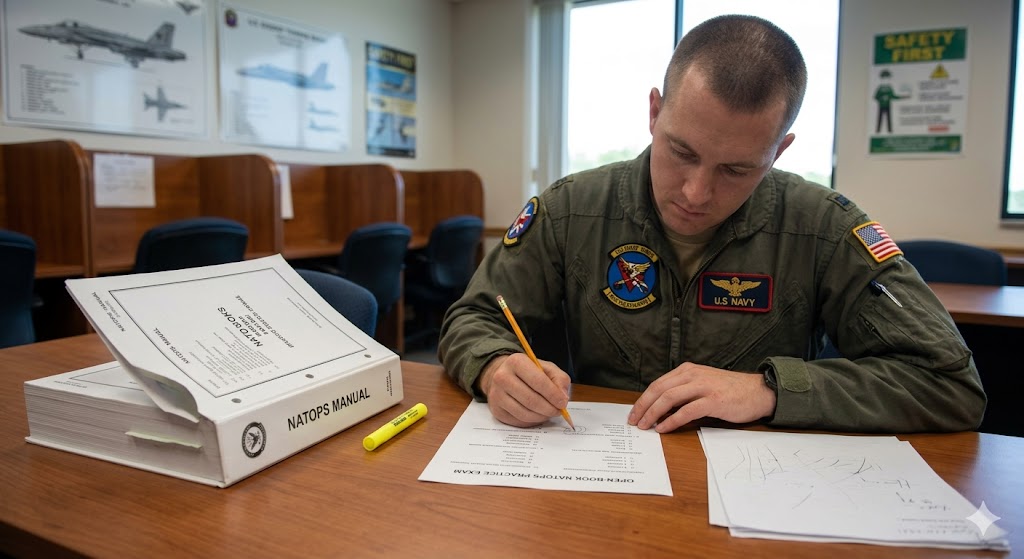
Additional Information
What the Course Entails and Exam Details
The core training for a NATOPS qualification isn't a single course, but rather a continuous process of studying the specific NATOPS manual for a service member’s assigned aircraft or role (e.g., MH-60R NATOPS, F/A-18E/F NATOPS, NATOPS General Flight and Operating Instructions (CNAF M-3710.7)).
The Open-Book NATOPS Practice Exam covers all sections of the relevant manual. Key topics include aircraft systems, operating limitations (airspeed, altitude, G-limits), normal operating procedures, comprehensive emergency procedures, flight rules, communication protocols, and all-weather flight operations. The defining characteristic of this practice exam is that students are permitted to use the official NATOPS manual to find the answers.
What to Expect in the Final Exam
While this is a practice tool, the official final NATOPS evaluation is a rigorous and standardized process. Candidates can expect a challenging timed examination, typically consisting of multiple-choice, matching, and short-answer questions. The exam often utilizes an "open-book" format to evaluate an individual's proficiency in referencing critical information quickly and accurately, mirroring real-world cockpit requirements.
Speed and precision are vital; aviators must achieve a high minimum passing score (often 80-90%, depending on the specific community and command policy). The practice exam aims to build this efficiency. The final evaluation typically includes both this written examination and a practical flight evaluation (or flight simulator event) conducted by a qualified NATOPS Instructor.
How to Study and Exam Centers
Effectively studying for a NATOPS exam requires a structured approach. Do not attempt to memorize the entire manual verbatim; instead, focus on understanding the organization and mastering the indices. Practice navigating the manual rapidly to locate specific procedures, warnings, and limitations. Leverage existing squadron training materials, flashcards, and group study sessions. Use the Open-Book NATOPS Practice Exam multiple times to identify weaknesses and improve your reference speed.
The official written NATOPS exams are administered internally by authorized standardization personnel (NATOPS Instructors or Evaluators) within Navy and Marine Corps squadrons or at designated Fleet Readiness Centers (FRCs) and training commands. The "Practice Exam" described here is typically an internal squadron training asset, although some official study materials may be accessed through official secure Navy learning portals.
Job Opportunities from the Course
Achieving and maintaining a NATOPS qualification is not a commercial certification but a mandatory requirement for key roles in Naval aviation. This proficiency is essential for the following career paths:
Navy and Marine Corps Pilots (Fixed-wing, Rotary-wing, and Tiltrotor)
Naval Flight Officers (NFOs) and Weapon Systems Officers
Enlisted Aircrewmen (Crew Chiefs, Sensor Operators, Rescue Swimmers)
Aircraft Maintenance Officers and Senior Enlisted Maintainers
Squadron NATOPS Instructors and Standardization Officers
Frequently Asked Questions
Reviews
5.0
Based on 0 reviews
Leave a Review
No reviews yet. Be the first to review!