
Operating Engineer Practice Exam
$69.00
- Buy to unlock unlimited access to all Quiz questions and Answers in this Quiz.
- After purchase you can print a PDF of the whole quiz at any point. The PDF will contain the questions and the correct answers.
About this Exam
The [Operating Engineer Practice Exam] is a crucial step for aspiring and current heavy equipment operators seeking to demonstrate their expertise. This certification process is designed to validate the foundational skills and safety knowledge required to effectively and securely operate a variety of heavy machinery commonly found in construction and industrial settings. From bulldozers and excavators to cranes and front-end loaders, being a certified Operating Engineer proves your competence and dedication to professionalism on any worksite. It is primarily designed for individuals looking to start a rewarding career in construction, mining, or public works, and experienced operators wishing to formally certify their skills or stay current with safety regulations.
Ready to test your knowledge?
Buy Now to Access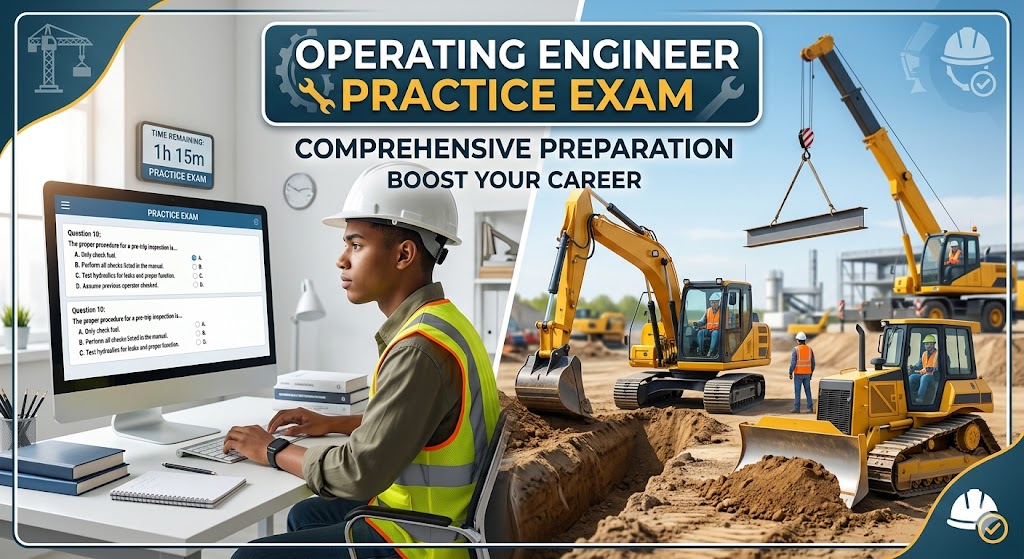
Additional Information
What the Course Entails and Exam Details
This practice exam preparation aims to cover the comprehensive body of knowledge typically required by certification bodies. The core topics, while potentially varying slightly by specific location or certifying organization, generally include:
Core Safety Protocols: Understanding OSHA regulations, hazard recognition, personal protective equipment (PPE) requirements, and emergency procedures is paramount.
Equipment Specifics & Operation: Gaining a detailed understanding of the components, controls, and safe operating principles for different classes of heavy machinery (e.g., excavators, cranes, bulldozers, backhoes).
Preventative Maintenance & Inspection: Learning how to perform thorough pre-shift inspections, identify potential mechanical issues, and carry out basic maintenance tasks to ensure equipment longevity and safety.
Operational Techniques: Mastering the practical skills required for specific tasks like grading, lifting, digging, and maneuvering in various terrains and conditions.
Site Preparation & Regulations: Understanding basic surveying, reading blueprints/site plans, and adhering to environmental and load limit regulations.
What to Expect in the Final Exam
The final certification exam typically consists of a significant theoretical component, often presented as a multiple-choice written test. This section assesses your understanding of safety regulations, equipment mechanics, site procedures, and operational principles.
Depending on the specific certification, a practical skills assessment might also be required. This part involves demonstrating your proficiency in operating actual heavy machinery under the supervision of an evaluator.
Format: Primarily multiple-choice questions for the theory portion. Practical components, if included, involve hands-on operation.
Passing Score: Requirements can vary, but generally fall between a 70% to 80% score to achieve certification.
Time Limits: Are typically in place for the theoretical test, ranging from one to several hours. Practical assessments may have varied duration based on the skills being tested.
Specific Rules: Are strictly enforced, particularly regarding safety during any practical components. Check with your specific testing center for exact rules, permitted materials for the theoretical portion (typically none other than approved calculators), and mandatory safety gear for any hands-on tests.
How to Study and Exam Centers
Preparation is the key to success. Here are actionable strategies to effectively get ready for your [Operating Engineer Practice Exam]:
Study Official Manuals: Always review the comprehensive safety manuals, operator handbooks, and specific study guides provided by the certifying body or authorized training center.
Utilize Practice Tests: Make full use of sample questions and practice tests – like the ones implied by the exam name – to familiarize yourself with the question format, identify your strengths and weaknesses, and boost your confidence.
Hands-on Experience: Whenever possible, gain practical experience with heavy equipment through a formal training program, apprenticeship, or guided on-the-job training. Nothing substitutes for real-world practice.
Safety First: Consistently prioritize safety in your studies and practice. Memorize and understand key safety regulations and procedures.
Join a Training Program: Structured courses offered by vocational schools or union training centers are often the most comprehensive way to learn the required skills and knowledge.
Where to Take the Exam
Authorized testing locations can include:
Authorized Vocational & Trade Schools: Many accredited training institutions are also certified testing centers.
Dedicated Heavy Equipment Operator Training Centers: Facilities specifically designed for operator training often host certification exams.
Union Halls & Training Facilities: Local Operating Engineers unions frequently coordinate training and testing for their members.
Specific Physical Testing Centers: Some national or regional certification organizations utilize designated, independent testing centers.
Online Portals (Theory only): For the theoretical portion, certain programs may offer supervised testing through secure online proctoring portals. Always confirm the authorized methods and locations with your chosen certification board.
Job Opportunities from the Course
A certified Operating Engineer is in high demand and has access to diverse and rewarding career paths across the construction, mining, public works, and maintenance sectors. Some of the specific job titles you can unlock with this certification include:
Heavy Equipment Operator (General)
Crane Operator
Backhoe Operator
Excavator Operator
Bulldozer Operator
Front-End Loader Operator
Construction Site Supervisor (typically requires experience in addition to certification)
Heavy Equipment Maintenance Technician
Asphalt/Paving Machine Operator
Plant Operator (e.g., in manufacturing or material production facilities)
By demonstrating your proficiency through certification, you open doors to competitive wages, job security, and various opportunities for advancement.
Frequently Asked Questions
Reviews
5.0
Based on 0 reviews
Leave a Review
No reviews yet. Be the first to review!