
Operational Risk Management (ORM) Practice Exam
$69.00
- Buy to unlock unlimited access to all Quiz questions and Answers in this Quiz.
- After purchase you can print a PDF of the whole quiz at any point. The PDF will contain the questions and the correct answers.
About this Exam
The ORM Operational Risk Management certificate is a prestigious credential designed for professionals who manage, oversee, or analyze the risks that arise from an organization's internal processes, people, and systems, or from external events.
It is ideal for risk managers, internal auditors, compliance officers, and operations managers across all industries, particularly in banking, finance, insurance, and manufacturing.
This certification validates your ability to identify, assess, mitigate, and monitor operational risks, showcasing a commitment to protecting an organization's value and reputation in a complex global environment.
Ready to test your knowledge?
Buy Now to Access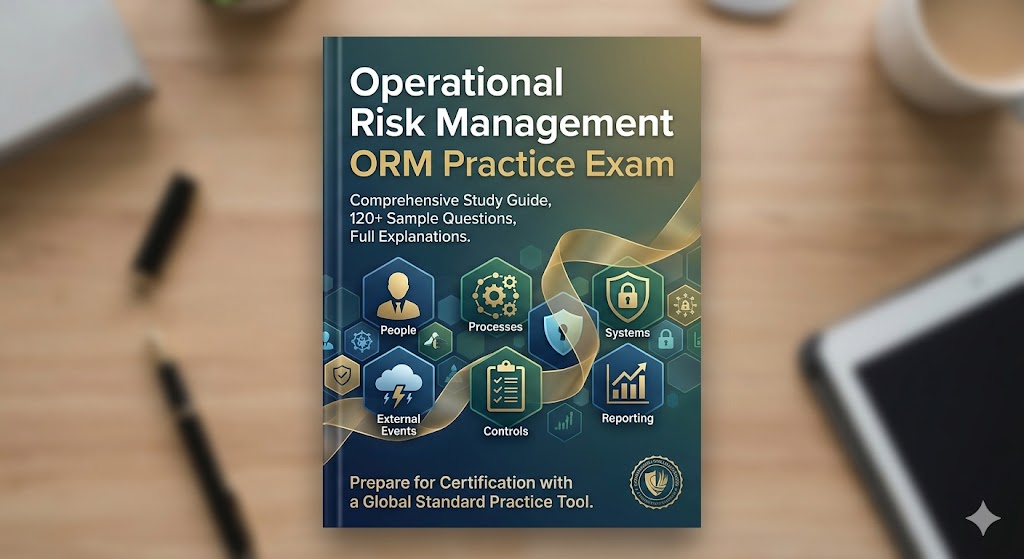
Additional Information
What the Course Entails and Exam Details
This comprehensive course covers the entire lifecycle of operational risk management.
Students will dive deep into foundational concepts and advanced methodologies.
Core topics include:
The definition and scope of Operational Risk.
Establishing an effective Risk Governance Framework.
Risk Identification tools like Risk & Control Self-Assessments (RCSA).
Understanding and identifying Key Risk Indicators (KRIs).
Techniques for Risk Assessment and Measurement, including scenario analysis and loss data collection.
Developing robust Risk Mitigation and Control strategies.
Internal and external Risk Reporting and Monitoring standards.
Integration with other risk types (e.g., credit, market risk).
The syllabus also addresses critical modern challenges such as Cybersecurity Risk, Vendor and Third-Party Risk, and Business Continuity Planning (BCP).
What to Expect in the Final Exam
The final certification exam is a rigorous test of both theoretical knowledge and practical application.
The format is typically multiple-choice questions, ranging from 80 to 100 questions.
Candidates are given a fixed time limit, often around 2 to 3 hours, to complete the exam.
The passing score requirement varies slightly by the specific certifying body (e.g., PRMIA or specific institute programs), but generally falls between 60% and 70%.
The exam is conducted in a proctored environment, ensuring integrity and standardized testing conditions for all candidates.
How to Study and Exam Centers
Effective preparation is key to success on the ORM exam.
Start by thoroughly reviewing the official study guide and recommended textbooks provided by the certifying body.
Complement your reading with our specialized ORM Operational Risk Management Practice Exam, which is an essential tool to gauge your understanding, identify weak areas, and become familiar with the question format and time constraints.
Join professional forums or study groups to discuss complex scenarios and gain different perspectives.
The exam itself is typically administered globally through dedicated online portals or at authorized computer-based testing (CBT) facilities, such as Pearson VUE centers.
Specific professional schools or risk management institutes may also serve as authorized physical testing locations. Candidates must register in advance and schedule their preferred testing date and location.
Job Opportunities from the Course
Earning an Operational Risk Management certification significantly boosts career prospects and unlocks diverse opportunities within any risk-conscious organization.
Graduates with this qualification often pursue the following roles:
Operational Risk Manager
Risk Analyst (focusing on Operational Risk)
Internal Auditor (with a risk-based approach)
Compliance Officer
Business Continuity Manager
Risk and Control Self-Assessment (RCSA) Coordinator
Vendor/Third-Party Risk Manager
Enterprise Risk Management (ERM) Associate
Operational Excellence Consultant
Frequently Asked Questions
Reviews
5.0
Based on 0 reviews
Leave a Review
No reviews yet. Be the first to review!