
Ophthalmic Dispensing Practice Test
$69.00
- Buy to unlock unlimited access to all Quiz questions and Answers in this Quiz.
- After purchase you can print a PDF of the whole quiz at any point. The PDF will contain the questions and the correct answers.
About this Exam
The [Ophthalmic Dispensing Practice Test] is a vital resource designed to prepare aspiring opticians and ophthalmic dispensers for their official certification or licensing examinations. This test is crafted for individuals who are either currently in an opticianry training program, finishing an apprenticeship, or seeking to validate their years of on-the-job experience. Ophthalmic dispensing is a specialized field that bridges the gap between eye care and retail, focusing on the fitting, adjusting, and dispensing of eyeglasses and other ophthalmic devices. Successfully passing the eventual official exam is a mandatory step in many states and countries to practice legally as a licensed dispenser. The practice test aims to simulate the exam experience, identify knowledge gaps, and build the confidence needed to succeed on the final, high-stakes assessment.
Ready to test your knowledge?
Buy Now to Access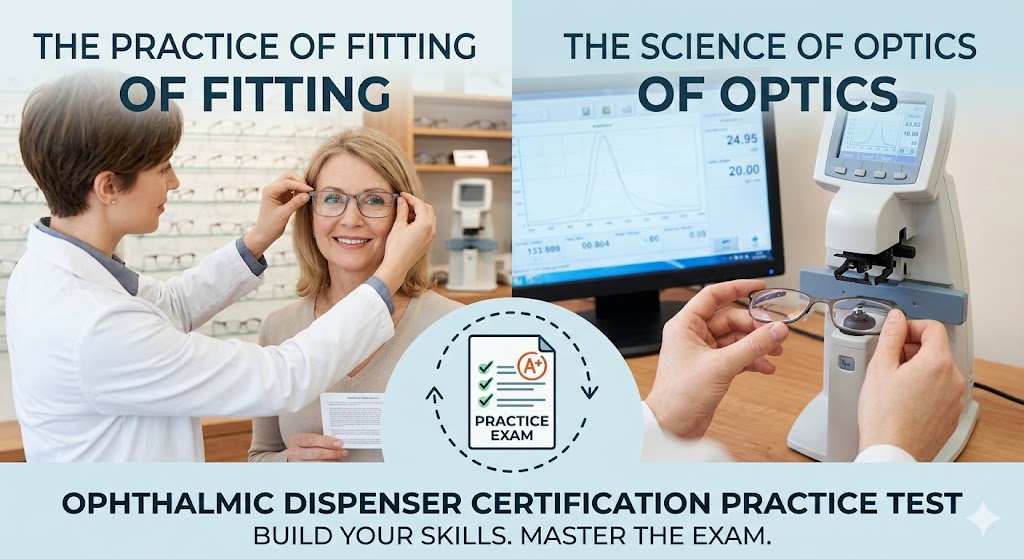
Additional Information
What the Course Entails and Exam Details
Preparing for an ophthalmic dispensing exam involves mastering a diverse set of technical and practical skills. While specific course syllabi and exam outlines can vary by organization (such as the ABO-NCLE in the United States or various state-level boards), they generally cover several core domains. These include:
Ophthalmic Optics: You must possess a deep understanding of light propagation, lens theories, prism effects, and the properties of different lens materials and coatings. This domain includes the ability to use various optical formulas to calculate precise lens measurements.
Ocular Anatomy and Physiology: A fundamental knowledge of the structure and function of the human eye, common refractive errors, and ocular pathologies is crucial for interpreting prescriptions and communicating effectively with patients and other eye care professionals.
Dispensing Procedures: This is the practical core of the profession. It encompasses the entire process from taking precise facial measurements (interpupillary distance, segment height) and assisting with frame selection, to the skillful adjustment of frames for optimal comfort and function.
Prescription Interpretation and Neutralization: You must be expert at reading, understanding, and transposing spectacle and, in some cases, contact lens prescriptions. This includes using a lensometer to measure the powers and prism of an existing pair of glasses.
Instrumentation and Product Knowledge: The course covers the operation and maintenance of optical tools and instruments. It also includes in-depth information about various lens types (single-vision, progressive, multifocal) and the wide range of frame styles, materials, and features available in the market.
Laws, Regulations, and Professional Standards: Understanding the ethical guidelines, state laws, product standards, and universal precautions governing the practice of ophthalmic dispensing is essential for professional conduct and patient safety.
What to Expect in the Final Exam
While a practice test is a representation, the official final exam can be a formal, comprehensive hurdle. Knowing what to expect can significantly reduce anxiety.
Format: The primary component is often a computerized, multiple-choice examination. Some licensing boards may also require a separate practical or "viva" (oral) component to test hands-on skills in a simulated practice environment.
Number of Questions: A typical multiple-choice exam, like the basic certification, may consist of approximately 125 questions, with a subset being non-scored, developmental items.
Time Limit: Candidates are usually allocated a fixed amount of time to complete the test, frequently around two to two and a half hours for the theoretical portion.
Passing Score: The required passing score can vary and may be set based on criterion-referenced scoring, meaning a set number or percentage to demonstrate competency, which might adjust depending on the difficulty of the specific test form.
Rules: The exam is strictly proctored. Personal items are usually not allowed in the testing room, and the use of calculators or external study aids is strictly prohibited. You must present valid, government-issued photo identification.
How to Study and Exam Centers
Preparation is the single most important factor for success. Here are actionable strategies and information on how to access the exam:
Study Strategies:
Structured Review: Use a comprehensive textbook and study guides specifically recommended by the credentialing body. Create a regular study schedule and stick to it.
Practice Tests: The [Ophthalmic Dispensing Practice Test] is your most valuable tool. Take it multiple times to become accustomed to the phrasing and types of questions. Use your results to focus your study time on areas where you are weakest.
Hands-on Experience: There is no substitute for real-world practice. If possible, complete an apprenticeship or work in an optical setting. Practice neutralizing lenses, taking measurements, and adjusting frames on friends and family.
Flashcards: Use digital or physical flashcards for formulas, optical terms, and anatomy facts for quick and effective recall.
Review Courses: Consider enrolling in a formal review course, which can provide a comprehensive overview and guided instruction.
Exam Centers and Access: To take the practice test, you will typically access an online portal provided by the educational resource or certification board.
The official final exam, being high-stakes and proctored, is almost always administered at authorized physical testing centers. For major certifications like the ABO, this includes computerized testing facilities operated by third-party services like Prometric or Pearson VUE, located in hundreds of sites nationwide. Some organizations may now also offer a securely proctored, remote online testing option. For practical exams or State Board exams, the location may be a specific state institution, technical college, or designated testing center.
Job Opportunities from the Course
A qualification in ophthalmic dispensing is not just a title; it is a direct pathway to multiple career opportunities in the vibrant and growing optical industry. Completing the necessary courses and passing the examination can unlock positions such as:
Licensed/Registered Dispensing Optician (LDO/RDO): The primary and most recognized role, involving the full spectrum of patient service in private practices, retail chains, and clinics.
Optician: A non-licensed role in some jurisdictions, focusing on dispensing and fitting spectacles, often with a path towards licensure.
Optical Practice Manager: With experience, you can move into leadership, overseeing the daily operations, staff, and profitability of an optical retail store or clinic.
Optical Lab Technician (Lab Optician): For those who prefer a more behind-the-scenes role, fabricating, surfacing, and finishing ophthalmic lenses.
Ophthalmic Assistant/Technician: Providing clinical and technical support in an ophthalmologist's or optometrist's office, which may include dispensing.
Contact Lens Technician/Dispenser: After further specialization and certification, focusing specifically on the pre-fit, fitting, and delivery of contact lenses.
Optical Sales Representative: Working for manufacturers and distributors to sell frames, lenses, and equipment to optical practices.
Frequently Asked Questions
Reviews
5.0
Based on 0 reviews
Leave a Review
No reviews yet. Be the first to review!