
Ophthalmic Surgical Assistant Practice Exam
$69.00
- Buy to unlock unlimited access to all Quiz questions and Answers in this Quiz.
- After purchase you can print a PDF of the whole quiz at any point. The PDF will contain the questions and the correct answers.
About this Exam
The Ophthalmic Surgical Assistant (OSA) certification is a specialty credential for already-certified Allied Ophthalmic Personnel, including Certified Ophthalmic Assistants (COA), Certified Ophthalmic Technicians (COT), and Certified Ophthalmic Medical Technologists (COMT).
This certification validates an individual's advanced knowledge and highly specialized skills required to support an ophthalmologist within a surgical environment. It is designed for those seeking to excel in both minor in-office procedures and complex major surgeries in ambulatory surgery centers or hospital operating rooms. Achieving the OSA designation demonstrates a high level of commitment and expertise, making certified professionals highly valuable in the fast-paced, high-stakes world of ocular surgery.
Ready to test your knowledge?
Buy Now to Access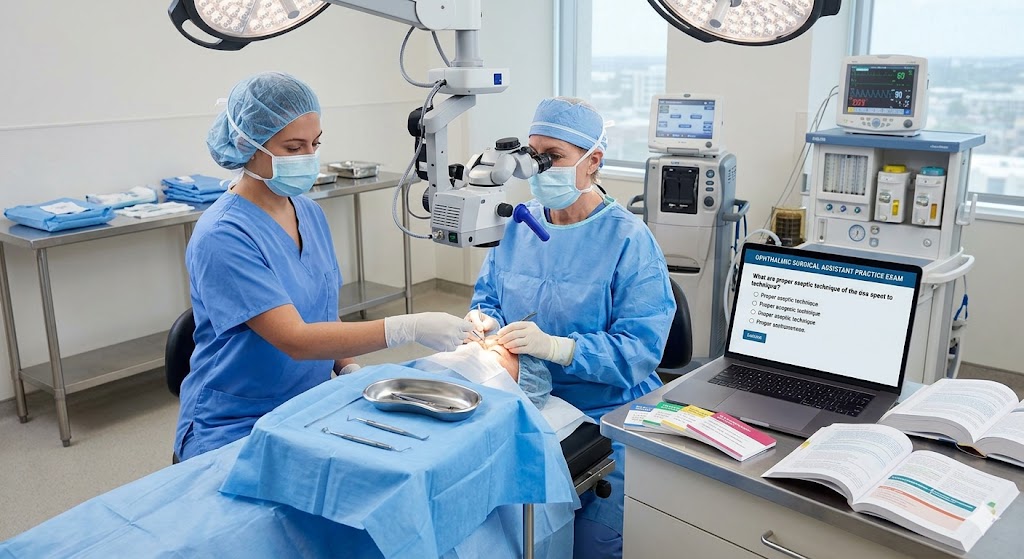
Additional Information
What the Course Entails and Exam Details
To prepare for the Ophthalmic Surgical Assistant certification and its practice exam, candidates must master a core curriculum focused on the surgical suite.
Key areas of study include:
Surgical Instrumentation: In-depth knowledge of all tools, from delicate microsurgical instruments to specialized equipment like the phacoemulsification machine. Students learn to identify, select, handle, clean, and maintain instruments, including an understanding of how to prevent corrosion and use specific agents like instrument milk.
Sterile Technique and Asepsis: Master the principles of the sterile field. This entails proper surgical scrubbing, gowning, gloving, and handling sterile supplies without compromising the environment.
Sterilization and Infection Control: Understanding different sterilization methods (e.g., autoclaving, ethylene oxide gas) and the stringent processes required to ensure patient safety and prevent post-operative infections.
Patient Care and Safety: Comprehensive instruction on patient preparation, including preoperative counseling, monitoring vital signs, administering ophthalmic medications, and positioning.
Surgical Procedures: Knowledge of the steps, requirements, and required assistant actions for common ophthalmic surgeries, such as cataract extraction, glaucoma filtration, retinal detachment repair (e.g., scleral buckle), and eyelid procedures.
Ocular Emergencies: Recognizing and responding to time-sensitive ocular emergencies, such as ruptured globes, intraocular foreign bodies, and acute glaucoma.
The corresponding practice exam mirrors these critical domains, providing a realistic assessment of a candidate’s readiness.
What to Expect in the Final Exam
The actual Ophthalmic Surgical Assistant certification exam is administered by the International Joint Commission on Allied Health Personnel in Ophthalmology (IJCAHPO).
It is a computer-based, multiple-choice examination. Typically, the final exam lasts one hour and consists of approximately 75 to 80 multiple-choice questions.
The content of the exam is based on a research-driven blueprint that identifies the crucial tasks performed by Ophthalmic Surgical Assistants. Candidates are expected to recall and apply knowledge under time pressure. The scoring is usually a scaled score, with a designated passing standard set by the certifying body.
Unlike some other certifications, the OSA is a standalone specialty exam and does not require a separate practical skills evaluation for this specific credential, as candidates are already required to hold a core certification.
How to Study and Exam Centers
Preparation for the Ophthalmic Surgical Assistant exam requires a dedicated, multi-faceted approach. To optimize your study and enhance performance, utilize the following methods:
Online Practice Exams: Realistic Ophthalmic Surgical Assistant Practice Exams are essential. They simulate the actual test environment, complete with timed sections and the official exam's multiple-choice format. Look for bundles that provide detailed explanations for every answer, allowing you to strengthen your understanding and identify weak areas.
Official Study Guides and Textbooks: Consult the resources recommended by IJCAHPO. These often include specific independent study courses and comprehensive review manuals.
Flashcards and Review Sheets: Create or buy flashcards focusing on critical categories like instrument identification, sterilization protocols, and procedure-specific assistant steps.
On-the-Job Experience: As a prerequisite for the exam, your daily practical experience in a surgical setting is an invaluable asset. Actively connect clinical practice with your study material.
The final IJCAHPO Ophthalmic Surgical Assistant certification exam is taken at secure, authorized testing centers worldwide, primarily through the Pearson VUE network. Once you apply for the exam and receive your authorization to test, you can schedule your appointment at a location and time that is convenient for you.
Job Opportunities from the Course
Earning the Ophthalmic Surgical Assistant certification unlocks a specialized career path within ophthalmology. The credential is a clear mark of dedication and expertise, which is highly sought after by employers who demand the highest standards of care in their surgical suites.
Upon achieving certification, you will be eligible for various roles in hospitals, private ophthalmic practices, and dedicated ambulatory surgery centers (ASCs).
Common job titles and career paths available to a Certified Ophthalmic Surgical Assistant include:
Ophthalmic Surgical Assistant
Ophthalmic Surgical Technician
Certified Ophthalmic Technician (with surgical specialty)
Surgical Scrub Technologist (ophthalmology focus)
Instrument Technician
Ophthalmic Scrub Assistant
Ophthalmology First Assistant
Frequently Asked Questions
Reviews
5.0
Based on 0 reviews
Leave a Review
No reviews yet. Be the first to review!