
Ops 2 Border Patrol Practice Test
$69.00
- Buy to unlock unlimited access to all Quiz questions and Answers in this Quiz.
- After purchase you can print a PDF of the whole quiz at any point. The PDF will contain the questions and the correct answers.
About this Exam
The Border Patrol Agent (BPA) Entrance Exam is the first critical step for individuals aspiring to join the ranks of U.S. Customs and Border Protection (CBP) as a frontline federal law enforcement officer. Specifically designed for applicants applying to GL-5 or GL-7 positions, this rigorous examination evaluates the key cognitive abilities required to succeed in the challenging and dynamic environment of the U.S. border. The exam is not about testing prior knowledge of the job; rather, it is designed to measure your potential, ensuring that incoming agents possess the analytical skills necessary for critical decision-making under pressure.
Ready to test your knowledge?
Buy Now to Access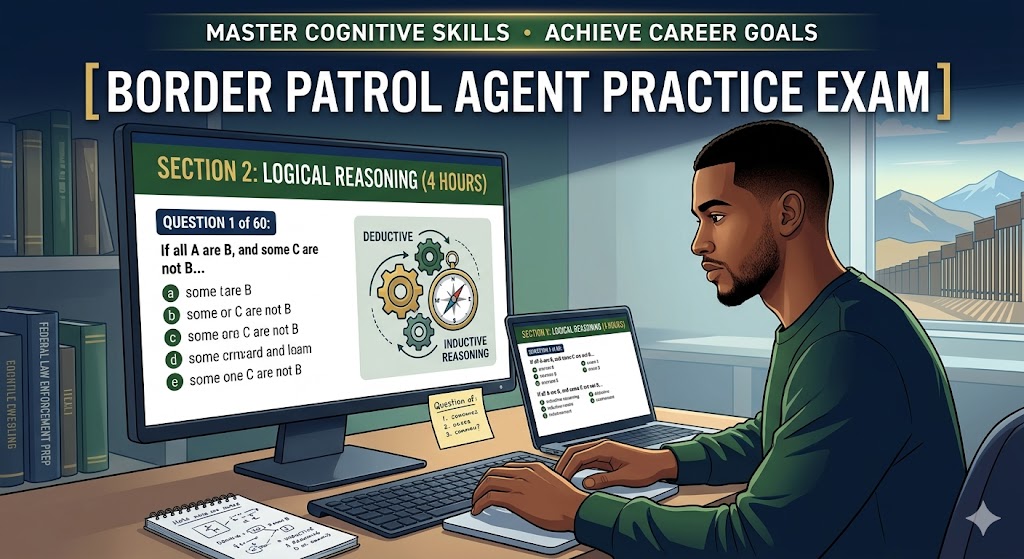
Additional Information
What the Course Entails and Exam Details
This entrance exam focuses heavily on your cognitive and reasoning abilities. It is broadly divided into two main components: a pre-test administrative component and a proctored cognitive assessment. The cognitive part, which is the heart of the examination, is the Logical Reasoning Test.
The current format for Border Patrol Agents focuses exclusively on logical reasoning. You will not be tested on math, writing skills, or foreign languages (such as Spanish) during this entrance exam, as these are no longer required for initial application to the BPA position.
What to Expect in the Final Exam
When you move forward with your application, you will be directed to a testing vendor to take the official exam, which is administered in two distinct parts that must be completed in order.
Part 1: Candidate Experience Record (CER): This is a short, unproctored online assessment that asks questions about your previous work experience and background. It must be completed quickly, typically within 72 hours of receiving the invitation, and is not something you can study for.
Part 2: Logical Reasoning Test (LRT): If you pass the CER, you will be invited to schedule the LRT. This is a lengthy, proctored computer-based test that can take approximately 4 hours to complete. It consists of multiple-choice questions designed to measure your ability to draw valid conclusions based on a set of facts. You will be presented with a complex scenario and five possible conclusions, from which you must identify the only valid or invalid one. This section requires intense focus and a methodical approach.
While official passing scores are not publicly disclosed as precise percentages, you are encouraged to aim for the highest score possible. If you do not obtain a passing score, there is a mandatory 90-day waiting period before you are eligible to retest.
How to Study and Exam Centers
Effective preparation is paramount to success on the BPA Entrance Exam. Since the core cognitive test is on Logical Reasoning, your study efforts should focus on that specific area.
Actionable Study Strategies:
Review the Official BPA Study Guide: CBP provides a comprehensive PDF study guide and test information document. This is your most vital resource.
Take the Official Practice Test: CBP offers a BPA Entrance Exam Practice Test that offers a direct preview of the types of questions and logical structures you will encounter. Treat this as a simulation of the actual test.
Watch Official Lesson Videos: Use the CBP-provided videos on Logical Reasoning, including a lesson with a knowledge check and a practice test with feedback.
Practice Active Logic: Train your mind to identify premises, assumptions, and valid versus invalid conclusions. Do not rely on outside knowledge; focus only on the information provided in each test question.
Testing Centers and Administration:
The exam is administered by an authorized third-party testing vendor. After completing your application on USAJOBS and the CER, you will receive an email from the vendor instructing you to schedule your Logical Reasoning Test. You will typically have a 14-day window to complete the LRT.
The test can be taken at local testing centers located throughout the country. In some instances, it may be offered via an online proctoring option, but a physical testing center is the most common method. You are responsible for scheduling your session promptly and potentially expanding your search radius to find an available time at a center near you.
Job Opportunities from the Course
Successfully navigating the BPA Entrance Exam opens the door to a challenging and rewarding career within the U.S. government.
Job Titles and Career Paths:
Border Patrol Agent (BPA) GL-5/7/9: The starting point for field operations.
Border Patrol Agent - GL-9/11/12: Advanced positions with increased responsibility.
Supervisory Border Patrol Agent: Leading a team of agents.
Border Patrol Intelligence Agent: Specialized role focused on data and analysis.
Field Operations Supervisor: Managing larger scale border operations.
Special Operations Group (SOG): Elite tactical units within the Border Patrol.
Air and Marine Interdiction Agent: (Requires additional flight or maritime qualifications).
Frequently Asked Questions
Reviews
5.0
Based on 0 reviews
Leave a Review
No reviews yet. Be the first to review!