
Optician License Practice Exam
$69.00
- Buy to unlock unlimited access to all Quiz questions and Answers in this Quiz.
- After purchase you can print a PDF of the whole quiz at any point. The PDF will contain the questions and the correct answers.
About this Exam
The Optician License Practice Exam is an essential study tool designed for aspiring opticians preparing for their state licensure or national certification exams, such as those administered by the American Board of Opticianry (ABO) and National Contact Lens Examiners (NCLE). Achieving licensure is a critical step for individuals seeking a career in the optical field, validating their knowledge and skills in interpreting prescriptions, fitting eyewear, and providing patient care. This practice exam is tailored for students currently enrolled in opticianry programs, apprentices gaining hands-on experience, or anyone aiming to become a certified dispensing optician.
Ready to test your knowledge?
Buy Now to Access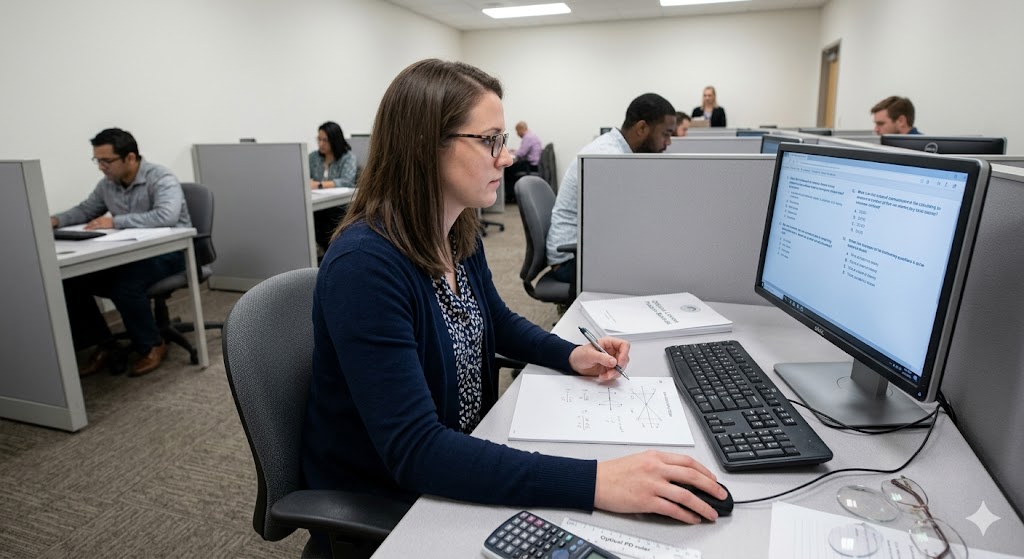
Additional Information
What the Course Entails and Exam Details
This comprehensive practice exam covers the core curriculum required for professional opticianry certification. The material is typically divided into two main areas: spectacles and contact lenses. The course entails a thorough review of ophthalmic optics, including lens theory, design, and effect. Students must master optical formulas, transposition, and the use of lensometers to verify prescriptions accurately. The curriculum also focuses on the anatomy and physiology of the eye, common vision problems, and the fundamentals of frame selection, fitting, and adjustment based on a patient’s facial structure and lifestyle needs. Furthermore, professional conduct, state regulations, and federal laws regarding the optical industry are covered.
What to Expect in the Final Exam
The actual optician licensure exam is typically a rigorous, computer-based test consisting of multiple-choice questions. It may be split into two separate examinations: the ABO (for spectacles) and the NCLE (for contact lenses). Candidates are generally given around two to two and a half hours to complete each section. A passing score, often around 70%, is required to obtain certification. The exam structure tests both theoretical knowledge and practical application, requiring candidates to solve mathematical optical problems and make sound dispensing decisions based on clinical scenarios. No outside materials are allowed during the exam, and it is usually proctored.
How to Study and Exam Centers
Effective preparation for the Optician License Exam requires a combination of focused study and practical experience. Utilizing practice exams is crucial for identifying knowledge gaps and becoming familiar with the types of questions asked. Candidates should review official study guides provided by the ABO-NCLE or their state licensing board. Flashcards are helpful for memorizing terminology, formulas, and ocular anatomy. Hands-on practice in an optical lab or dispensary is invaluable for mastering practical skills like neutralization, fitting, and troubleshooting patient complaints. The national ABO and NCLE exams are administered through authorized testing centers, such as Pearson VUE, located across the country. Candidates must register in advance through the official ABO-NCLE website and schedule their testing appointment.
Job Opportunities from the Course
Successfully passing the licensure exam opens numerous doors within the optical industry. Licensed opticians are in high demand and can pursue various fulfilling career paths. Common job titles and opportunities unlocked by this certification include:
Licensed Dispensing Optician
Optical Store Manager
Independent Optical Shop Owner
Ophthalmic Lab Technician
Contact Lens Fitter
Optical Sales Representative for frame or lens manufacturers
Here is the SEO-optimized article and a corresponding image for the Optician License Practice Exam.
Optician License Practice Exam
Description
The Optician License Practice Exam is an essential study tool designed for aspiring opticians preparing for their state licensure or national certification exams, such as those administered by the American Board of Opticianry (ABO) and National Contact Lens Examiners (NCLE).
Achieving licensure is a critical step for individuals seeking a career in the optical field, validating their knowledge and skills in interpreting prescriptions, fitting eyewear, and providing patient care.
This practice exam is tailored for students currently enrolled in opticianry programs, apprentices gaining hands-on experience, or anyone aiming to become a certified dispensing optician.
What the Course Entails and Exam Details
This comprehensive practice exam covers the core curriculum required for professional opticianry certification.
The material is typically divided into two main areas: spectacles and contact lenses.
The course entails a thorough review of ophthalmic optics, including lens theory, design, and effect.
Students must master optical formulas, transposition, and the use of lensometers to verify prescriptions accurately.
The curriculum also focuses on the anatomy and physiology of the eye, common vision problems, and the fundamentals of frame selection, fitting, and adjustment based on a patient’s facial structure and lifestyle needs.
Furthermore, professional conduct, state regulations, and federal laws regarding the optical industry are covered.
What to Expect in the Final Exam
The actual optician licensure exam is typically a rigorous, computer-based test consisting of multiple-choice questions.
It may be split into two separate examinations: the ABO (for spectacles) and the NCLE (for contact lenses).
Candidates are generally given around two to two and a half hours to complete each section.
A passing score, often around 70%, is required to obtain certification.
The exam structure tests both theoretical knowledge and practical application, requiring candidates to solve mathematical optical problems and make sound dispensing decisions based on clinical scenarios.
No outside materials are allowed during the exam, and it is usually proctored.
How to Study and Exam Centers
Effective preparation for the Optician License Exam requires a combination of focused study and practical experience.
Utilizing practice exams is crucial for identifying knowledge gaps and becoming familiar with the types of questions asked.
Candidates should review official study guides provided by the ABO-NCLE or their state licensing board.
Flashcards are helpful for memorizing terminology, formulas, and ocular anatomy.
Hands-on practice in an optical lab or dispensary is invaluable for mastering practical skills like neutralization, fitting, and troubleshooting patient complaints.
The national ABO and NCLE exams are administered through authorized testing centers, such as Pearson VUE, located across the country.
Candidates must register in advance through the official ABO-NCLE website and schedule their testing appointment.
Job Opportunities from the Course
Successfully passing the licensure exam opens numerous doors within the optical industry.
Licensed opticians are in high demand and can pursue various fulfilling career paths.
Common job titles and opportunities unlocked by this certification include:
Licensed Dispensing Optician
Optical Store Manager
Independent Optical Shop Owner
Ophthalmic Lab Technician
Contact Lens Fitter
Optical Sales Representative for frame or lens manufacturers
Frequently Asked Questions
Reviews
5.0
Based on 0 reviews
Leave a Review
No reviews yet. Be the first to review!