
Optics 7 Practice Test
$69.00
- Buy to unlock unlimited access to all Quiz questions and Answers in this Quiz.
- After purchase you can print a PDF of the whole quiz at any point. The PDF will contain the questions and the correct answers.
About this Exam
The Optics Level 7 exam is a significant milestone for optical professionals seeking to validate advanced knowledge and skills in the field of opticianry and eye care support. This comprehensive certification is designed for experienced optical assistants, dispensing opticians, and ophthalmic technicians who want to demonstrate mastery in complex optical principles, advanced lens technology, and refined patient management. Achieving this level of certification signals to employers and patients a commitment to excellence and a high degree of technical competence.
Ready to test your knowledge?
Buy Now to Access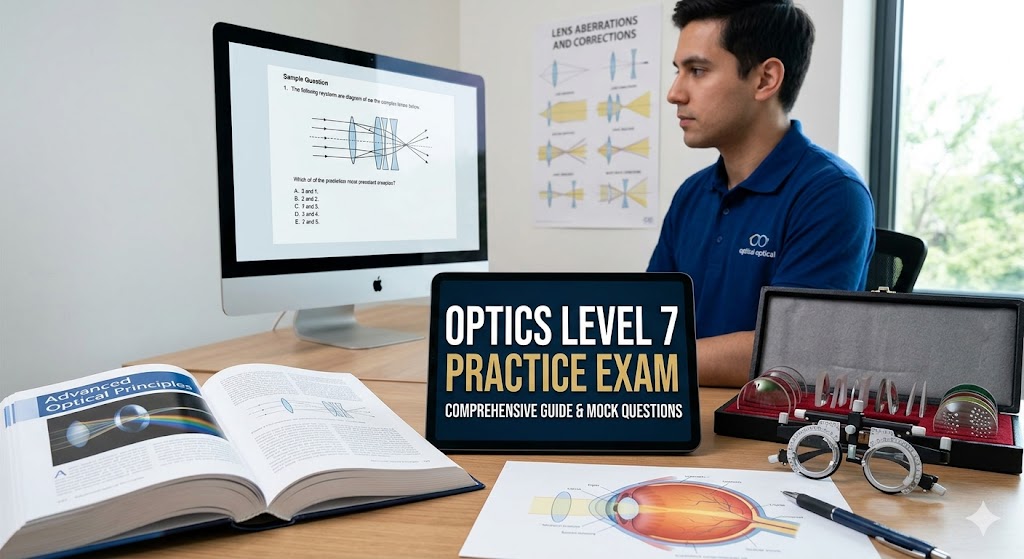
Additional Information
What the Course Entails and Exam Details
This advanced level of optics goes beyond basic dispensing. The associated course, or the knowledge required for the exam, covers an intricate syllabus, including:
Advanced Ocular Anatomy and Physiology: Deep dive into eye structures, common pathologies, and their refractive implications.
Complex Lens Theory: Master the principles of multifocal lenses (progressives, trifocals), specialized lens designs, and high-index materials.
Optical Aberrations and Corrections: Understand and minimize vertex distance, pantoscopic tilt, and lens aberrations (spherical, coma, astigmatism).
Specialized Dispensing Techniques: Fitting for complex prescriptions, slab-off, high-power lenses, and safety eyewear.
Troubleshooting and Problem Solving: Expertly resolving patient vision complaints related to new eyewear.
Low Vision Aids: Introduction to devices and techniques for assisting visually impaired patients.
Contact Lens Fundamentals (Basic to Intermediate): Material science, fitting philosophy, and patient instruction for soft contact lenses.
Optical Business and Ethics: Regulations, professional standards, and effective practice management.
What to Expect in the Final Exam
The final Optics Level 7 exam is rigorously structured to test both theoretical understanding and practical application. Candidates can typically expect:
Format: A closed-book exam, primarily consisting of multiple-choice questions (often 100–150 questions). Some exams may include multi-step problem-solving or case-study scenarios.
Time Limit: Usually 2 to 3 hours, requiring efficient time management.
Passing Score: The threshold is typically set between 70% and 75%.
Practical Component: Depending on the specific certifying body, a separate practical examination (e.g., in lensometry, frame alignment, and dispensing) may also be required to obtain full certification.
Rules: Standard proctoring rules apply, requiring valid identification and prohibiting external aids.
How to Study and Exam Centers
Preparation is key to succeeding on this challenging exam. Use a multi-faceted study strategy:
Utilize a Practice Test: Take a full-length [Optics 7 Practice Test] to identify your strengths and weaknesses. Use it to gauge your readiness and practice your timing.
Review the Official Syllabus: Focus your studying on the detailed content outline provided by the certifying body.
Deep Dive into Textbooks: Refer to recommended academic texts on dispensing optics and visual science.
Create Flashcards: Memorize critical formulas, anatomical terms, and lens characteristics.
Form Study Groups: Collaborating with peers can provide new perspectives and support.
Exam Centers and Registration:
To take the exam, you must first register through the authorized certifying organization. Testing is often facilitated through established networks of computer-based testing centers, such as:
Pearson VUE or Prometric: Many professional organizations utilize these secure global testing networks.
Approved Colleges and Optical Schools: Specific institutions may be designated as official testing sites.
Online Proctoring: Some organizations offer the option to take the written exam remotely with live online proctoring.
Job Opportunities from the Course
Successfully passing the Optics Level 7 exam and obtaining the associated certification opens doors to advanced roles and increased earning potential within the optical industry. This qualification positions you for careers such as:
Senior Dispensing Optician
Optical Practice Manager or Assistant Manager
Optical Product Specialist (for lens manufacturers or frame companies)
Lead Ophthalmic Technician
Optometric Technician Manager
Low Vision Assistant
Clinical Trainer/Educator in an optical setting
Frequently Asked Questions
Reviews
5.0
Based on 0 reviews
Leave a Review
No reviews yet. Be the first to review!