
Optometric Technician Certification Practice Exam
$69.00
- Buy to unlock unlimited access to all Quiz questions and Answers in this Quiz.
- After purchase you can print a PDF of the whole quiz at any point. The PDF will contain the questions and the correct answers.
About this Exam
Welcome to your essential first step toward a fulfilling career in eye care! An Optometric Technician (often Certified Paraoptometric, or CPO/CPOT at higher levels) is a crucial member of an optometric team. They are the eyes and ears of the practice, providing vital support to optometrists and delivering excellent care to patients. This certification and the corresponding exam are designed for ambitious individuals who possess a strong interest in healthcare, the biological sciences, and patient interaction. Achieving this credential, through an accredited program or by gaining relevant work experience, demonstrates your professional competence and commitment. Our comprehensive practice exam is meticulously crafted to simulate the core knowledge and skills required, helping you to build confidence, identify key areas for study, and significantly increase your chances of success in your final certification journey. Whether you are currently enrolled in a program, working in an eye care setting, or exploring a new career path, this resource is your invaluable companion for thorough preparation.
Ready to test your knowledge?
Buy Now to Access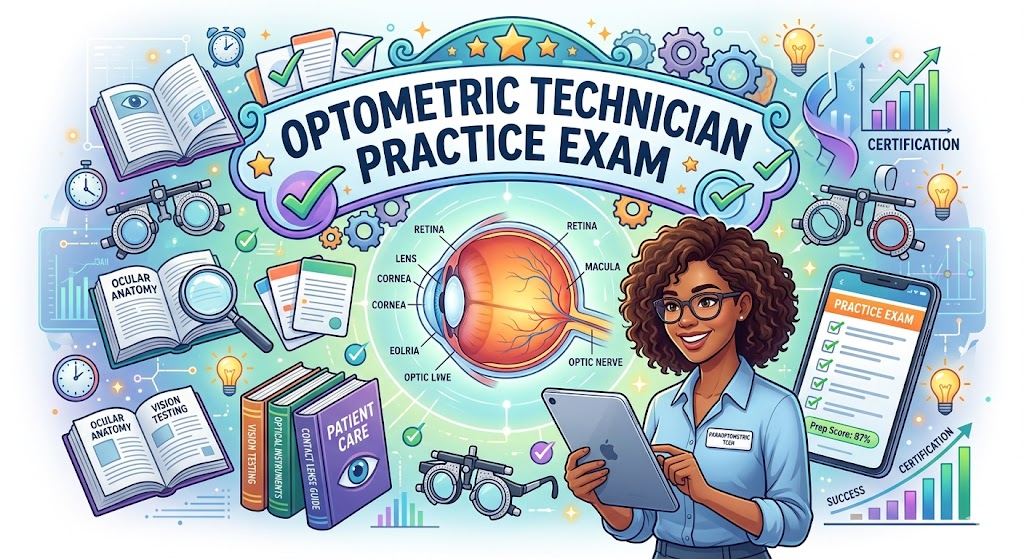
Additional Information
What the Course Entails and Exam Details
Preparing for the Optometric Technician certification involves mastering a wide array of foundational and technical areas. Both your potential coursework and the actual certification exams will delve deeply into subjects crucial for success in a busy clinical environment.
Fundamental areas typically include:
Ocular Anatomy and Physiology: Gaining a comprehensive understanding of the eye’s structure and function.
Optometric Instruments and Equipment: Familiarizing yourself with the use, maintenance, and calibration of essential tools like phoropters, tonometers, slit lamps, and digital imaging devices.
Vision Testing Procedures: Mastering visual acuity testing, color vision assessment, stereopsis, and basic refraction techniques.
Contact Lenses and Spectacles: Learning about lens types, materials, fitting principles, and patient education.
Pharmacology for Optometry: An overview of common ophthalmic drugs and their applications.
Patient History and Care: Developing strong communication skills for gathering medical history and ensuring patient comfort.
Safety, Infection Control, and Ethics: Adhering to professional standards and healthcare regulations.
While precise details can vary between different certifying bodies (such as the American Optometric Association’s Commission on Paraoptometric Certification), most final examinations are standardized. They are usually computer-based, multiple-choice tests administered during set windows throughout the year. The number of questions and exact time limits are defined for each level of certification, with the entire technician exam typically requiring a few hours of dedicated concentration. The exam is structured to assess your understanding of practical application as well as theoretical knowledge, reflecting the diverse and hands-on nature of the profession.
What to Expect in the Final Exam
As you prepare for your final Optometric Technician certification exam, it’s essential to have a clear understanding of the test’s structure. The actual exam is generally a rigorous, computer-based experience consisting of a designated number of multiple-choice questions.
Expect the exam environment to be strictly proctored, whether you are in a physical testing center or using an approved remote proctoring service. Time management is key, as most exams are timed, typically providing several hours to complete all sections. The final score needed to pass is determined by the specific certifying board (e.g., the CPC) and is often scaled, meaning that direct percentage scores can vary and are calculated to reflect difficulty.
Be prepared for questions that test your ability to apply your knowledge to real-world scenarios. This might involve interpreting patient data, recognizing common conditions, understanding proper instrument usage, or ensuring appropriate patient safety and privacy. Thoroughly review all the study materials and utilize diverse resources, including official handbooks and practice tests like this one, to build both your knowledge and your exam-taking stamina.
How to Study and Exam Centers
Effective studying is your most powerful tool. Approach your preparation with a structured and proactive mindset.
Actionable Study Strategies:
Utilize Official Resources: Your primary guide should be the current candidate handbook from your specific certifying body (e.g., the AOA's CPC for paraoptometric certifications). This document details eligibility requirements, registration, the complete exam content outline, and reference lists.
Diverse Study Materials: Combine your core textbooks with flashcards, educational videos, and reliable online study guides.
Simulate the Exam: Regularly use comprehensive practice exams like this one. Take them under timed conditions to build stamina, understand the question style, and pinpoint areas that require more focus.
Work Experience and Mentorship: If you are already working in the field, learn from your colleagues and optometrists. Real-world experience reinforces classroom knowledge and builds valuable clinical skills.
Create a Schedule and Stay Consistent: Dedicate regular, focused study time each week and avoid last-minute cramming.
Exam Center Information:The actual certification exams are administered through recognized testing providers. The two most common pathways are:
Physical Testing Centers: Many examinations, such as those for the AOA's CPC, are held at computer-based testing centers managed by established organizations like Prometric or Pearson VUE. These centers are located globally, allowing you to select a convenient location well in advance.
Remote Proctoring: Increasingly, there are options for remote proctoring, where you can take the exam from a private, suitable location (like your home), monitored securely via a webcam and microphone, provided you meet all technical and space requirements.
Always verify the official registration process and exam locations through the direct portal of your chosen certifying body to ensure accuracy.
Job Opportunities from the Course
A strong score on your practice exam is an encouraging sign of your preparation. Completing your full course and achieving your certification unlocks a range of rewarding and in-demand career paths within the eye care industry. Your expertise and validated skills will make you a valued asset in various healthcare settings. Potential job titles and roles include:
Optometric Technician / Paraoptometric Technician: The fundamental technical and clinical role in both private and corporate optometric practices.
Ophthalmic Assistant / Technician: Similar roles, often found in ophthalmology practices or hospital clinics, working alongside medical eye specialists.
Refractive Surgery Assistant: Assisting during laser vision correction procedures.
Contact Lense Coordinator / Specialist: Focusing on all aspects of contact lens care, fitting support, and patient instruction.
Optical Sales Associate: While often requiring opticianry training for full scope, technician skills are an asset in retail eye care.
Practice Manager / Coordinator: With experience, your technical and administrative understanding can lead to leadership roles.
Clinical Research Assistant: Supporting studies related to vision and eye health.
Frequently Asked Questions
Reviews
5.0
Based on 0 reviews
Leave a Review
No reviews yet. Be the first to review!