
Optometry Admission Test (OAT) Practice
$69.00
- Buy to unlock unlimited access to all Quiz questions and Answers in this Quiz.
- After purchase you can print a PDF of the whole quiz at any point. The PDF will contain the questions and the correct answers.
About this Exam
The Optometry Admission Test (OAT) is a standardized, computerized examination designed to measure general academic ability and comprehension of scientific information.
It is the essential gatekeeper exam for aspiring students seeking admission to schools and colleges of optometry in the United States and Canada.
This rigorous test evaluates whether an applicant possesses the prerequisite knowledge and analytical skills necessary to succeed in a demanding professional optometry program.
Passing this exam is not just about memorization; it is about demonstrating critical thinking and a deep understanding of the scientific foundations of the future profession.
Ready to test your knowledge?
Buy Now to Access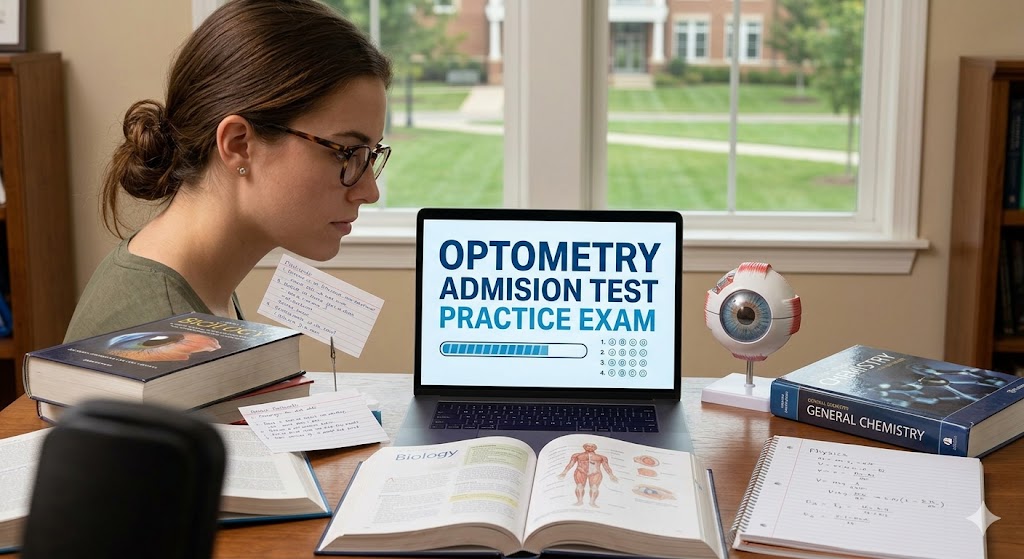
Additional Information
What the Course Entails and Exam Details
Preparing for the OAT requires a comprehensive review of undergraduate-level science and mathematical concepts.
The examination content is divided into four primary sections:
Survey of the Natural Sciences: This massive section covers Biology (cell and molecular, diversity of life, genetics, evolution), General Chemistry (atomic structure, bonding, states of matter, equilibrium, kinetics), and Organic Chemistry (mechanisms, synthesis, reactions).
Reading Comprehension: This section assesses your ability to read, comprehend, and analyze scientific and professional passages. You will answer questions based on the provided texts.
Physics: You will be tested on classic and modern physics concepts, including mechanics, thermodynamics, electromagnetism, optics, and nuclear physics.
Quantitative Reasoning: This section measures your mathematical skills, covering arithmetic, algebra, geometry, trigonometry, and probability and statistics.
What to Expect in the Final Exam
The OAT is a computer-based standardized test administered under strict security conditions.
You should expect a marathon session, as the total testing time is nearly five hours, including an optional break.
The final exam structure generally follows this format:
Total Time: Approximately 4 hours and 40 minutes, including optional tutorials and a 30-minute break.
Format: The entire exam consists of multiple-choice questions within the four specified sections.
Scoring: Each section is scored on a scaled range from 200 to 400.
Passing Score: There is no universal "passing" score. Each optometry school sets its own benchmarks for competitive scores based on their applicant pool, though scores above 300 are generally considered average nationally.
How to Study and Exam Centers
Effective OAT preparation requires a structured, long-term study plan, usually spanning several months.
Actionable Study Strategies:
Diagnostic Test: Start with a full-length, timed practice exam to identify your weak areas immediately.
Structured Content Review: Use specialized OAT prep books and online courses to systematically review the science and math content.
Active Practice: Don't just read; solve hundreds of practice questions. Use flashcards for Biology and Chemistry terms.
Timed Practice Exams: Take multiple full-length practice tests under realistic timed conditions to build stamina and master pacing.
Exam Centers and Registration:
You must register for the OAT through the official Association of Schools and Colleges of Optometry (ASCO) website.
The OAT is administered year-round at specialized Prometric Testing Centers throughout the United States and Canada. After registering, you will schedule your specific appointment at a physical Prometric center convenient for you.
Job Opportunities from the Course
Successfully mastering the OAT is the required first step to entering optometry school. Completing this entire pathway unlocks lucrative and rewarding career titles in the eye care field.
While the OAT itself is an admission test, the career path it initiates leads directly to the following specialized job titles:
Doctor of Optometry (O.D.)
Primary Care Optometrist
Pediatric Optometrist
Geriatric Optometrist
Low Vision Specialist
Contact Lens Specialist
Ocular Disease Specialist
Vision Therapy Optometrist
Research Optometrist
Optometry School Faculty/Professor
Frequently Asked Questions
Reviews
5.0
Based on 0 reviews
Leave a Review
No reviews yet. Be the first to review!