
OptoPrep National Board of Examiners in Optometry (NBEO) Practice Test
$69.00
- Buy to unlock unlimited access to all Quiz questions and Answers in this Quiz.
- After purchase you can print a PDF of the whole quiz at any point. The PDF will contain the questions and the correct answers.
About this Exam
The [OptoPrep National Board of Examiners in Optometry (NBEO) Practice Test] is an essential, online preparation platform designed specifically for optometry students in the United States and Canada.
This comprehensive course is your pathway to success on the rigorous three-part NBEO licensure examinations.
Passing these boards is the critical step toward obtaining your license to practice optometry and becoming a qualified eye care professional.
OptoPrep provides a realistic, adaptive, and highly effective way to master the material, build test-taking confidence, and ensure you are fully prepared for exam day.
Ready to test your knowledge?
Buy Now to Access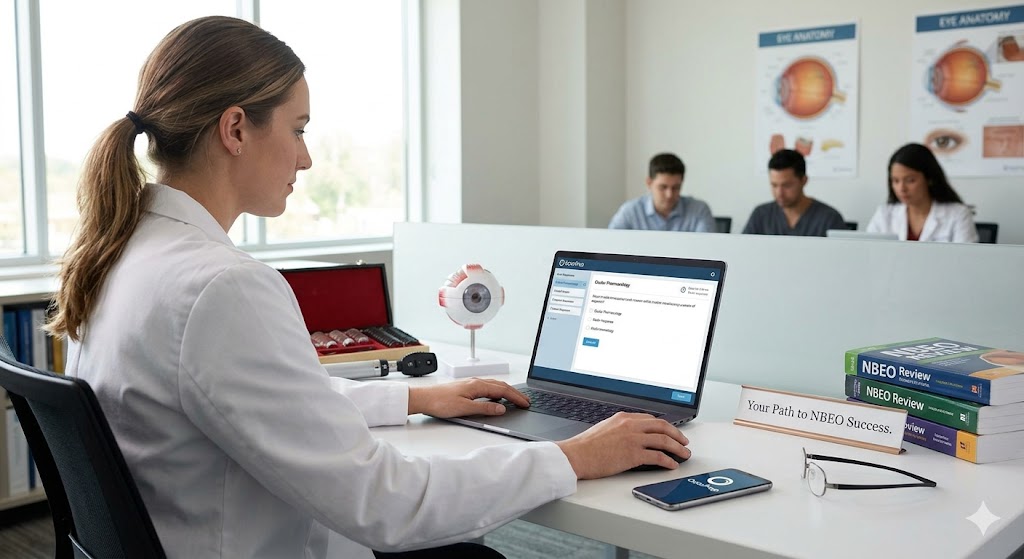
Additional Information
What the Course Entails and Exam Details
This preparation course meticulously mirrors the structure and content of the actual NBEO exams.
It offers a massive bank of expertly authored, NBEO-style questions, including single-response multiple-choice, multi-response, and case-based scenarios.
OptoPrep is broken down into specific sections that align with the three major parts of the NBEO boards.
You will find comprehensive content for Part I: Applied Basic Science (ABS), Part II: Patient Assessment and Management (PAM), including the Treatment and Management of Ocular Disease (TMOD) subset, and material designed to assist with the Clinical Skills examination.
The platform provides timed, simulated exams that create a true test-day experience, helping you improve your speed and stamina.
You will receive instant, detailed feedback and performance statistics, allowing you to track your progress by topic and focus your studies where you need it most.
OptoPrep also includes customizable study plans, printable study materials, and mobile apps for learning on the go.
What to Expect in the Final Exam
The official NBEO examinations are a pivotal component of the optometry licensure process. Here is a breakdown of what to expect for each part:
Part I: Applied Basic Science (ABS)
This is a computer-based test that consists of multiple-choice questions, many of which are multi-response. It assesses fundamental knowledge of basic sciences relevant to optometry, including anatomy, physiology, biochemistry, immunology, microbiology, pathology, optics, and pharmacology. Candidates are given two 3.5-hour sessions to complete the exam. The score is scaled from 100 to 900, with 300 required to pass.
Part II: Patient Assessment and Management (PAM)
This computer-based exam is case-based, simulating real-world patient encounters. Candidates are presented with patient cases and must answer questions regarding diagnosis, treatment, and management. A subset of Part II is the Treatment and Management of Ocular Disease (TMOD) examination, which can be taken independently for certain state licensure requirements. Part II consists of two 3.5-hour sessions. Like Part I, scores are scaled from 100 to 900, with 300 as the passing mark.
Part III: Clinical Skills Examination (CSE) / Patient Encounters and Performance Skills (PEPS)
This is a hands-on, performance-based examination conducted at the NBEO's National Center. It evaluates a candidate's clinical skills and ability to interact effectively with patients. The format is designed to test communication, professionalism, and procedural skills in both interactive and non-interactive stations. This part is scored on a pass/fail basis.
How to Study and Exam Centers
Successfully navigating the NBEO exams requires a structured, disciplined study plan and the right resources.
Actionable Study Strategies:
Start Early: Give yourself ample time to cover the vast content. A multi-month study plan is recommended.
Use OptoPrep's Full Potential: Consistently practice with the large question bank. Review not just the correct answers but, more importantly, the detailed rationales for why options are correct or incorrect.
Simulate Exam Conditions: Take full-length, timed practice tests in OptoPrep. This builds the mental endurance needed for the 7-hour testing days and helps you manage your time effectively.
Focus on Weak Areas: Utilize the personalized statistics to identify your knowledge gaps and allocate more study time to those specific topics.
Create your own aids: supplementing your practice with your own review sheets, mind maps, and flashcards for quick recall of key formulas and concepts.
Exam Center Locations:
Parts I and II (ABS and PAM): These computer-based exams are administered at Pearson VUE professional testing centers located throughout the United States and Canada. You must register through the NBEO website and then schedule your specific date and location with Pearson VUE.
Part III (Clinical Skills): The performance-based Part III exam is held exclusively at the NBEO National Center in Charlotte, North Carolina. Candidates must travel to this central location to take this portion of the boards.
Job Opportunities from the Course
Passing the NBEO examinations is the key that unlocks your entire career as a licensed doctor of optometry.
While the course itself is a preparation tool, the certification it helps you achieve opens the door to a wide range of prestigious and rewarding career paths:
Primary Care Optometrist
Cornea and Contact Lens Specialist
Pediatric Optometrist
Geriatric Optometrist
Ocular Disease Specialist
Low Vision Rehabilitation Specialist
Vision Therapy and Neuro-Optometry Specialist
Corporate Optometrist (e.g., within major optical retailers)
Hospital-Based Optometrist (e.g., VA hospitals)
Academic Optometrist (Teaching and research at optometry schools)
Clinical Research Scientist (In industry or academia)
Industry Consultant (For pharmaceutical or medical device companies)
Public Health Optometrist
Frequently Asked Questions
Reviews
5.0
Based on 0 reviews
Leave a Review
No reviews yet. Be the first to review!