
Oral and Maxillofacial Surgery In-Service Training (OMSITE) Practice Exam
$69.00
- Buy to unlock unlimited access to all Quiz questions and Answers in this Quiz.
- After purchase you can print a PDF of the whole quiz at any point. The PDF will contain the questions and the correct answers.
About this Exam
The Oral and Maxillofacial Surgery In-Service Training Examination, commonly known as OMSITE, is a critical, formative assessment designed specifically for residents currently enrolled in accredited Oral and Maxillofacial Surgery (OMS) training programs in the United States and Canada. Administered annually by the American Board of Oral and Maxillofacial Surgery (ABOMS), the OMSITE is not a licensing or certifying exam in itself. Instead, it serves as a powerful diagnostic tool, helping residents identify areas of strength and weakness in their clinical knowledge and assisting Program Directors in evaluating the effectiveness of their curriculum. Succeeding on the OMSITE is a major milestone, as it is highly predictive of future success on the rigorous ABOMS Board Certification examinations required for independent practice. This guide provides an overview for students seeking to understand this crucial step in their surgical career.
Ready to test your knowledge?
Buy Now to Access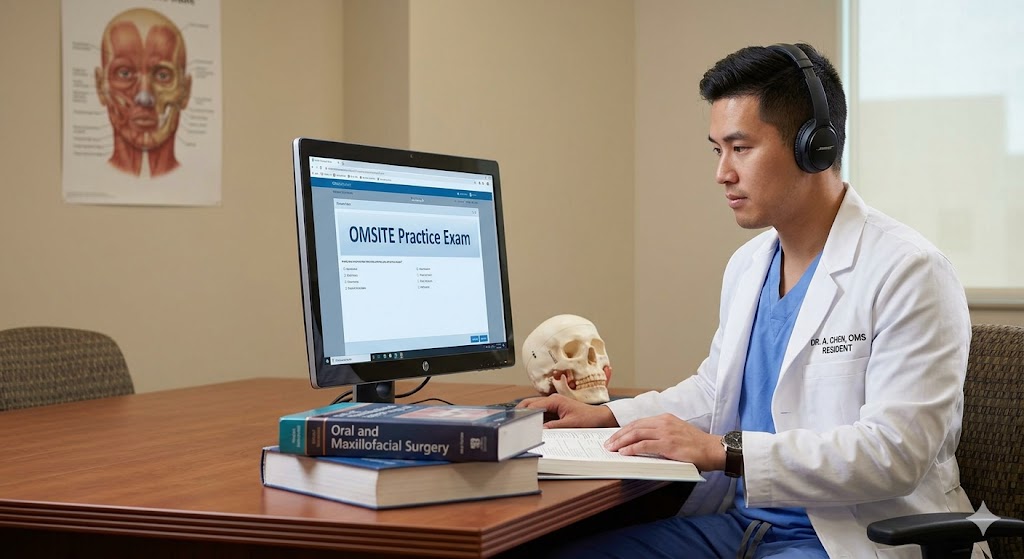
Additional Information
What the Course Entails and Exam Details
The OMSITE is designed to be comprehensive, measuring the expanding knowledge, clinical skills, and critical thinking required of a practicing Oral and Maxillofacial Surgeon. The examination is structured around the ABOMS blueprint, which is updated regularly to reflect the current scope of the specialty. The 10 core content areas covered in depth include:
Medical Assessment and Management: Preoperative evaluation, management of acute and chronic medical conditions in the surgical patient.
Anesthesia and Pain Control: Principles of local anesthesia, moderate sedation, deep sedation, and general anesthesia, including physical assessment and complication management.
Dentoalveolar Surgery: Management of impacted teeth, complex extractions, and associated infections.
Trauma: Evaluation and surgical treatment of injuries to the face, jaws, and associated soft tissues.
Orthognathic Surgery/Cleft/Obstructive Sleep Apnea (OSA): Surgical correction of skeletal facial deformities, congenital defects, and airway management.
Cosmetic Maxillofacial Surgery: Aesthetic procedures of the head, face, and neck.
Temporomandibular Disorders/Facial Pain: Diagnosis and surgical/non-surgical management of TMJ disorders and chronic pain.
Pathology: Evaluation, diagnosis, and management of benign and malignant lesions of the oral and maxillofacial region.
Reconstruction: Hard and soft tissue grafting, including vascularized and non-vascularized flaps.
Dental Implants: Biological principles, treatment planning, site preparation, placement, and complication management.
What to Expect in the Final Exam
On the day of the OMSITE, residents can expect a demanding, full-day, computer-based examination. It typically consists of 250 multiple-choice questions designed to test both foundational knowledge and the application of clinical judgment to complex surgical scenarios. The time limit is structured, often allowing several hours for the entire session. Unlike certification exams that have a fixed passing score, the OMSITE uses "normative scoring." Residents are not given a "pass" or "fail" result. Instead, they receive a detailed score report providing a percentile rank. This rank compares their performance directly against all other participating residents at the same Post-Graduate Year (PGY) level across the U.S. and Canada. This specific feedback is invaluable for tailoring future study efforts and measuring progress toward Board readiness.
How to Study and Exam Centers
Effective preparation for the OMSITE requires a sustained and structured approach throughout the residency year. Successful residents rely on a multi-faceted study strategy:
Standard Textbooks: Focus on core specialty texts like Fonseca's Oral and Maxillofacial Surgery and Peterson's Principles of Oral and Maxillofacial Surgery.
ABOMS Blueprint Review: Align study efforts with the specific weights and topics listed in the official ABOMS blueprint.
Active Recall and Practice Questions: Utilize recognized question banks and previous years' available OMSITE questions to simulate the exam environment.
Literature Review: Stay current by reading foundational articles from the Journal of Oral and Maxillofacial Surgery (JOMS).
Regarding exam centers, the OMSITE is unique. It is not administered at public testing facilities like Pearson VUE. Registration and scheduling are handled entirely within the resident's specific training program by the Program Director. The examination itself is taken at the resident's home institution or an authorized facility designated by the residency program, under secure, proctored conditions.
Job Opportunities from the Course
While the OMSITE itself is not a certification and does not grant independent practice privileges, it is an essential hurdle on the path to becoming a Board-Certified Oral and Maxillofacial Surgeon. Mastery of the knowledge base measured by OMSITE is the foundation for all career paths within the specialty. Following successful residency completion and ABOMS certification, surgeons have access to a wide array of prestigious and demanding opportunities:
Private Practice Oral and Maxillofacial Surgeon
Academic Oral and Maxillofacial Surgeon (teaching and research)
Hospital-Based Staff Surgeon (Trauma and Emergency)
Sub-Specialist in Oral and Maxillofacial Trauma
Sub-Specialist in Orthognathic and Craniofacial Surgery
Sub-Specialist in Head and Neck Oncology/Reconstructive Surgery
Sub-Specialist in Pediatric OMS and Cleft Lip/Palate Surgery
Sub-Specialist in Facial Cosmetic Surgery
Frequently Asked Questions
Reviews
5.0
Based on 0 reviews
Leave a Review
No reviews yet. Be the first to review!