
Oral and Maxillofacial Surgery (OMFS) Board Practice Exam
$69.00
- Buy to unlock unlimited access to all Quiz questions and Answers in this Quiz.
- After purchase you can print a PDF of the whole quiz at any point. The PDF will contain the questions and the correct answers.
About this Exam
The Oral and Maxillofacial Surgery (OMFS) Board Practice Exam is an essential tool for surgeons-in-training and experienced practitioners seeking board certification or recertification in this highly complex field. This exam is designed to simulate the rigorous conditions of the formal certification process, providing candidates with a realistic assessment of their knowledge and readiness. It covers a broad spectrum of procedures involving the face, mouth, and jaws, from routine wisdom tooth extractions and dental implants to intricate craniofacial surgeries, trauma reconstruction, and treatment of head and neck pathology. By identifying strengths and weaknesses through structured practice, candidates can develop focused study plans to enhance their confidence and perform well on the actual examination.
Ready to test your knowledge?
Buy Now to Access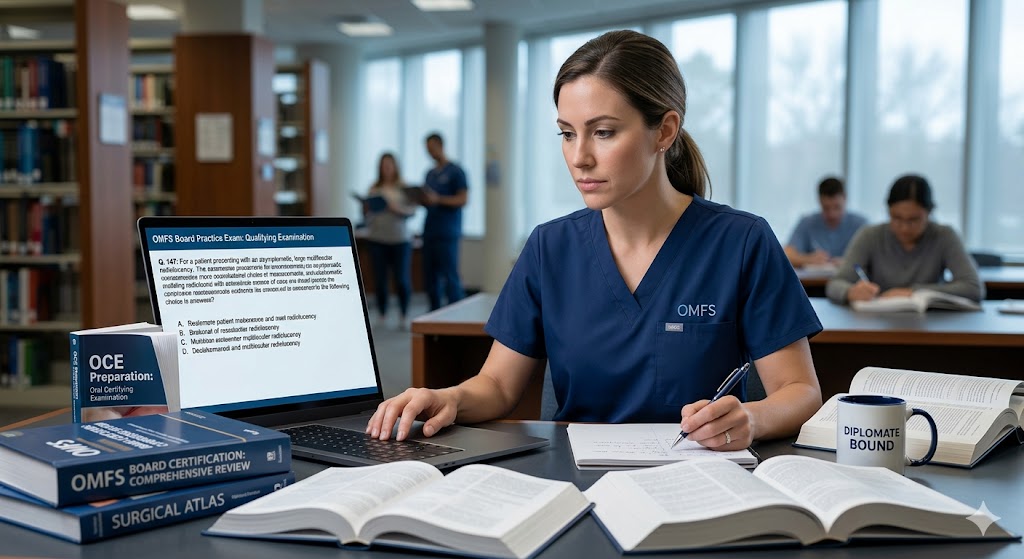
Additional Information
What the Course Entails and Exam Details
This practice exam is a comprehensive self-assessment that evaluates proficiency across key domains required for a board-certified oral and maxillofacial surgeon. Candidates are tested on their detailed understanding of numerous critical areas, including but not limited to, orthognathic surgery, dentoalveolar procedures, implantology, trauma management, facial cosmetic surgery, temporomandibular joint disorders, pathological conditions, and reconstructive techniques. Furthermore, questions assess non-surgical skills, such as anesthesia delivery, patient assessment, medical management, and ethical considerations. While it is not a traditional 'course' with structured lectures, utilizing this practice exam provides a practical syllabus of topics a surgeon must master to successfully navigate the actual certification, reinforcing both academic knowledge and clinical judgment.
What to Expect in the Final Exam
While the exact structure of national and regional boards can vary, practice exams typically mimic the primary formats. Most written board examinations are multiple-choice, focusing on foundational knowledge and its practical application. Candidates should expect timed sections with numerous scenario-based questions that assess diagnosis, treatment planning, and surgical management decisions. Practice tests prepare you for this structure, teaching you to manage time efficiently and recall information under pressure. Following a successful written component, candidates often progress to complex oral exams, where they are tested on live case simulations by examiners. Although practice exams primarily mirror the written test, the deep knowledge base they build is invaluable for the subsequent oral portions. It is crucial to check the specific guidelines of your certifying board regarding exact question types, passing scores, and duration.
How to Study and Exam Centers
Effective preparation for the OMFS board exam requires a multi-faceted approach. Use the practice exam strategically: don't just take it once; use it as a diagnostic tool. Analyze incorrect answers, review the rationales provided, and revisit the underlying medical and dental literature. Complement practice tests with a structured study routine involving trusted textbooks, board review manuals, and relevant peer-reviewed journals. Consider joining a study group or engaging with mentors who have recently completed the process. Utilizing flashcards for spaced repetition of key facts can also be beneficial. The practice exams themselves are often available through online educational portals or specialized testing organizations. For the final, official examination, candidates take the test at authorized professional testing centers, such as Pearson VUE, which are widely available in various cities. Registration and location details are provided through the specific certifying board’s website.
Job Opportunities from the Course
Successfully preparing for and passing the OMFS board exam opens countless doors within the prestigious field of oral and maxillofacial surgery. Certification often leads to significantly greater career flexibility, earning potential, and professional recognition. Common career paths and job titles after becoming a certified OMFS specialist include:
Board-Certified Oral and Maxillofacial Surgeon in Private Practice: Running your own surgical practice or joining an established group.
Hospital-Based Oral Surgeon: Working within a hospital setting, often with trauma center responsibilities.
Academic OMFS Faculty Member: Teaching and mentoring residents in dental schools or medical centers.
Maxillofacial Traumatologist: Specializing in complex facial trauma and reconstruction cases.
Craniofacial Surgeon: Focusing on congenital and acquired facial deformities in multi-specialty clinics.
Consultant in Complex Oral Care: Advising other specialists and general dentists on complex cases.
Clinical Research Director: Leading research initiatives in the surgical field.
Hospital Medical Director or Leadership Roles: Taking on administrative or leadership positions within a healthcare system.
Frequently Asked Questions
Reviews
5.0
Based on 0 reviews
Leave a Review
No reviews yet. Be the first to review!