
Orange County Florida Emergency Medical Services (EMS) Protocol Practice Test
$69.00
- Buy to unlock unlimited access to all Quiz questions and Answers in this Quiz.
- After purchase you can print a PDF of the whole quiz at any point. The PDF will contain the questions and the correct answers.
About this Exam
Mastering the Orange County Florida EMS Protocols is an essential rite of passage for any prehospital provider operating within the region. These protocols represent the standardized medical authority and authorized procedures that Emergency Medical Technicians (EMTs) and Paramedics must follow to ensure high-quality, legally sound patient care.
Our comprehensive Orange County Florida Emergency Medical Services (EMS) Protocol Practice Test is designed for current EMTs, Paramedics, and students enrolled in Florida-approved EMS programs. Whether you are preparing for a local agency sign-off, a continuing education requirement, or seeking to gain a competitive edge for a career with Orange County Fire Rescue or a private ambulance service, this practice exam offers a realistic and rigorous simulation of the protocol knowledge necessary for field authorization.
Sample Questions
Explanation:
Explanation:
Explanation:
Explanation:
Explanation:
Ready to test your knowledge?
Buy Now to Access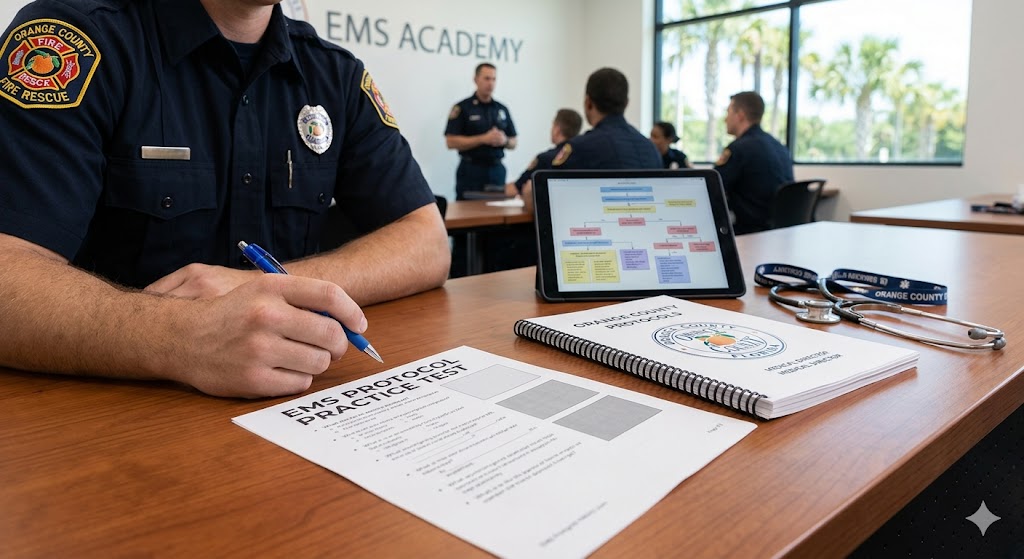
Additional Information
What the Course Entails and Exam Details
Our Orange County Florida EMS Protocol Practice Test provides an in-depth review of the critical algorithms, pharmacological interventions, and patient assessment standards mandated by the Office of the Medical Director. This practice material is built directly from the official, current protocol manual and focuses on translating theoretical knowledge into practical, field-ready decision-making.
The content covers all major sections of the Orange County EMS protocols, ensuring you are prepared to handle diverse emergencies. Core topics include:
General Principles of Medical Care: Scene management, refusal standards, and medical command procedures.
Adult & Pediatric Medical Protocols: Advanced care for respiratory failure, sepsis, anaphylaxis, dynamic glycemic emergencies, and suspected stroke.
Adult & Pediatric Trauma Protocols: Trauma Alert criteria, selective spinal motion restriction, hemorrhage control, whole blood administration procedures, and management of environmental emergencies.
Cardiac Protocols: Comprehensive pathways for VF/pVT, Asystole/PEA, Bradycardia, Tachycardia, and post-resuscitation care.
Procedure Manual & Medication Formulary: Detailed operational guidance on the 'Six Rights' of medication administration, airway management (including surgical cricothyrotomy and video laryngoscopy), and intraosseous access.
What to Expect in the Final Exam
It is important to understand the distinction between state certification and local authorization. In Florida, initial licensing for EMTs and Paramedics is achieved by passing the National Registry of Emergency Medical Technicians (NREMT) cognitive exam. However, to work in a specific system like Orange County, you must demonstrate proficiency in that county's unique protocols.
Our practice test prepares you for the local examinations and sign-offs administered by individual employers, such as fire departments or ambulance companies, to gain your authorization to practice. While a standardized county-wide "final exam" may not exist, here is what you can typically expect in a local protocol testing environment:
Scenario-Based Questions: Exams often use detailed, case-study scenarios where you must identify the appropriate protocol based on clinical findings and determine the precise order of interventions, including specific medication dosages.
Multiple-Choice Format: Many knowledge-based questions are designed to test your quick recall of specific flowcharts, contraindications, and equipment settings.
Time Constraints: Local protocol tests may be timed to simulate the high-pressure environment of the field, requiring you to retrieve information efficiently.
Passing Score Requirements: Agencies typically maintain high passing standards, often requiring scores of 80% or 90% to demonstrate proficiency.
How to Study and Exam Centers
Effective preparation requires a multi-faceted strategy that prioritizes the authorized protocol source. This practice test is a critical final step, but the following methods are recommended for a deep, comprehensive understanding:
How to Study
Use the Official Source: The most vital step is to download and thoroughly study the official "Orange County EMS Protocols" available through the Office of the Medical Director or authorized portals like the Acid Remap platform.
Algorithm Flowcharts: Do not just read the text; you must visually memorize the flowcharts for common emergencies, particularly cardiac, trauma, and pediatric calls.
Active Recall & Flashcards: Convert medication dosages, protocol criteria (e.g., Trauma Alert criteria), and equipment specifications into digital flashcards (using tools like Anki).
Scenario Practice: Work with a study partner to run mock calls, requiring the responding "provider" to verbalize their actions and specify the exact protocol they are referencing.
Utilize Practice Tests: Use our practice exam repeatedly to identify knowledge gaps, practice time management, and build confidence before a formal assessment.
Exam Centers
You will not find an "Orange County Florida EMS Protocol Practice Test" location listed on a state-wide center finder. The path to protocol certification involves two steps:
Florida Licensing: The cognitive licensing exam (NREMT) is administered at authorized Pearson VUE Testing Centers throughout Florida, including locations in the greater Orlando area.
Protocol Testing: Assessments specifically for the Orange County Protocols are conducted internally by the training and education bureaus of authorized EMS provider agencies. These include Orange County Fire Rescue, municipal fire departments, and private ambulance services (e.g., AdventHealth EMS, AMR). Students in Valencia College’s EMS programs will also face protocol-based testing during their coursework.
Job Opportunities from the Course
Mastery of these protocols is a direct requirement for working in the premier EMS systems within Orange County. Successfully passing agency-specific protocol tests can unlock a wide range of career opportunities:
Orange County Fire Rescue Paramedic or EMT-B
Municipal Firefighter/Paramedic (e.g., Orlando Fire Department, Winter Park Fire-Rescue)
Private Ambulance Service Paramedic or EMT (providing 911 response or inter-facility transfer)
Critical Care Transport Paramedic
Hospital-Based Emergency Room Technician
EMS Educator or Training Officer
Flight Paramedic (requiring extensive field experience and protocol expertise)
Frequently Asked Questions
Reviews
5.0
Based on 0 reviews
Leave a Review
No reviews yet. Be the first to review!