
Oregon Barber Certification Practice Exam
$69.00
- Buy to unlock unlimited access to all Quiz questions and Answers in this Quiz.
- After purchase you can print a PDF of the whole quiz at any point. The PDF will contain the questions and the correct answers.
About this Exam
The Oregon Barber Certification process is a vital milestone for aspiring grooming professionals in the state. This comprehensive procedure, overseen by the Oregon Health Licensing Office (HLO) and the Board of Cosmetology, ensures that candidates possess the necessary skills and foundational knowledge to practice barbering safely and effectively in Oregon. This guide, designed for individuals who have completed the required training at a Board-approved Oregon barber school, provides crucial preparation for the essential state exams. Utilizing resources, including practice exams, is a highly effective way to build confidence and reinforce the theory and regulations you’ve studied, setting you on the path to successful licensure.
Ready to test your knowledge?
Buy Now to Access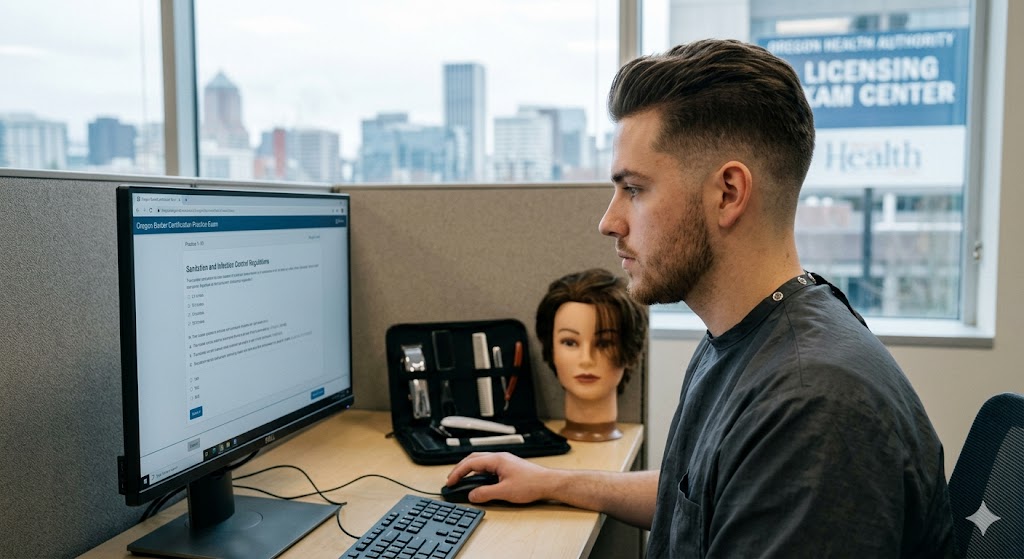
Additional Information
What the Course Entails and Exam Details
The standard preparation for Oregon Barber Certification includes a rigorous school-level training program that covers a broad spectrum of practical skills and theoretical concepts. This intensive coursework, often ranging from 746 to 1350 hours, encompasses extensive hands-on experience and deep classroom study. Key practical skills involve various hair services such as cutting, styling, facial massage, and the crucial skill of shaving. The curriculum also delves into essential scientific concepts like anatomy, physiology, microbiology, and the chemistry behind product knowledge. Safety and infection control procedures are seamlessly integrated throughout the entire training program.
The subsequent state-administered process involves two distinct examinations that candidates must pass to obtain licensure:
Barbering Written Exam: This theory-based test, typically based on textbooks like Milady or Pivot Point, contains approximately 100 questions. These cover core areas such as safety and infection control, scientific concepts, hair care services, implements and equipment, and product knowledge. A significant portion is dedicated to diseases, disorders, and individual hair services including hair cutting and shaving.
Oregon Laws and Rules Written Exam: This critical assessment, comprising around 90 questions, tests your understanding of the relevant statutes and administrative rules governing the practice of barbering and facility operation in Oregon. Important topics include professional standards, facility requirements, licensing procedures, chemicals, and disciplinary actions.
Candidates are often required to provide proof of successfully passing a separate practical exam, which is typically administered and graded at the school level during their training program. The Board then evaluates your knowledge through these rigorous written state examinations.
What to Expect in the Final Exam
Understanding the final state written exams is paramount to your success. Both the Barbering Written and Oregon Laws and Rules exams are typically taken on a computer-based or paper-and-pencil walk-in basis at the specific testing center in Salem. You must achieve a passing score of at least 75% on both of these tests.
Each examination is allotted a strict time limit of 90 minutes. If you are taking both exams on the same day, you should plan for a total of three hours for the testing process, not including administrative time. It is highly recommended that you arrive by 9:00 a.m. to allow sufficient time for registration and completion of both exams.
Official information, including Candidate Information Bulletins, can be accessed through the Oregon Health Licensing Office (HLO) website for the most accurate and up-to-date procedures, rule specifics, and any current testing rules (such as identification requirements, calculator use, or dress code, though the state-administered tests focus purely on the written knowledge).
How to Study and Exam Centers
Effectively preparing for your Oregon Barber Certification requires a structured and dedicated study plan:
Master the Core Material: Thoroughly review the primary textbooks recommended by your school, such as Milady's Standard Professional Barbering or Pivot Point's Fundamentals: Barbering. Concentrate on the detailed breakdowns for each written exam topic area provided by the state.
Utilize Study Aids: Use flashcards to memorize key terms, definitions, anatomy points, and regulatory rules. Join a study group with fellow students to discuss complex topics.
Practice with Purpose: Actively seek out and utilize relevant practice exams, mock tests, and sample questions that simulate the structure, content, and time constraints of the real state exams. This helps identify weak areas and builds valuable test-taking confidence. Many reputable online resources and study guides offer realistic practice materials. Ensure you are familiar with the style of multiple-choice questions you will encounter.
Know Your HLO Center: The Oregon barber written examinations are uniquely administered at the Oregon Health Licensing Office (HLO). The office is located at 1430 Tandem Ave. NE, Suite 180, Salem, OR 97301. Be sure to confirm the exact location, current walk-in hours (typically morning and sometimes early afternoon, with specific recommendations on arrival time), and accepted forms of identification and payment for exam fees.
Job Opportunities from the Course
Successfully navigating your barber school training and passing the state examinations for Oregon Barber Certification unlocks a wide range of rewarding career paths:
Licensed Barber: The core role, performing diverse grooming services for clients, including hair cutting, styling, facial hair trimming, and shaving.
Barber Shop Manager: Overseeing daily operations, managing staff, and ensuring exceptional client services in a bustling barber shop.
Barber Shop Owner: Taking the entrepreneurial leap to establish, brand, and run your own independent grooming business.
Mens Haircut Stylist: specializing in contemporary and classic men’s styles.
Shaving Specialist: Focusing on providing high-quality traditional straight razor shaves.
Product Educator/Representative: Working with professional barbering product lines to educate others and promote their use.
Film, Theater, and Editorial Barber/Stylist: Lending your skills to the entertainment and fashion industries for specialized grooming needs (with experience and sometimes additional certifications).
Cosmetology or Barbering Instructor: With sufficient work experience and further education/certification, you can share your passion and knowledge with the next generation of barbers (this path typically requires a separate instructor license).
Frequently Asked Questions
Reviews
5.0
Based on 0 reviews
Leave a Review
No reviews yet. Be the first to review!